
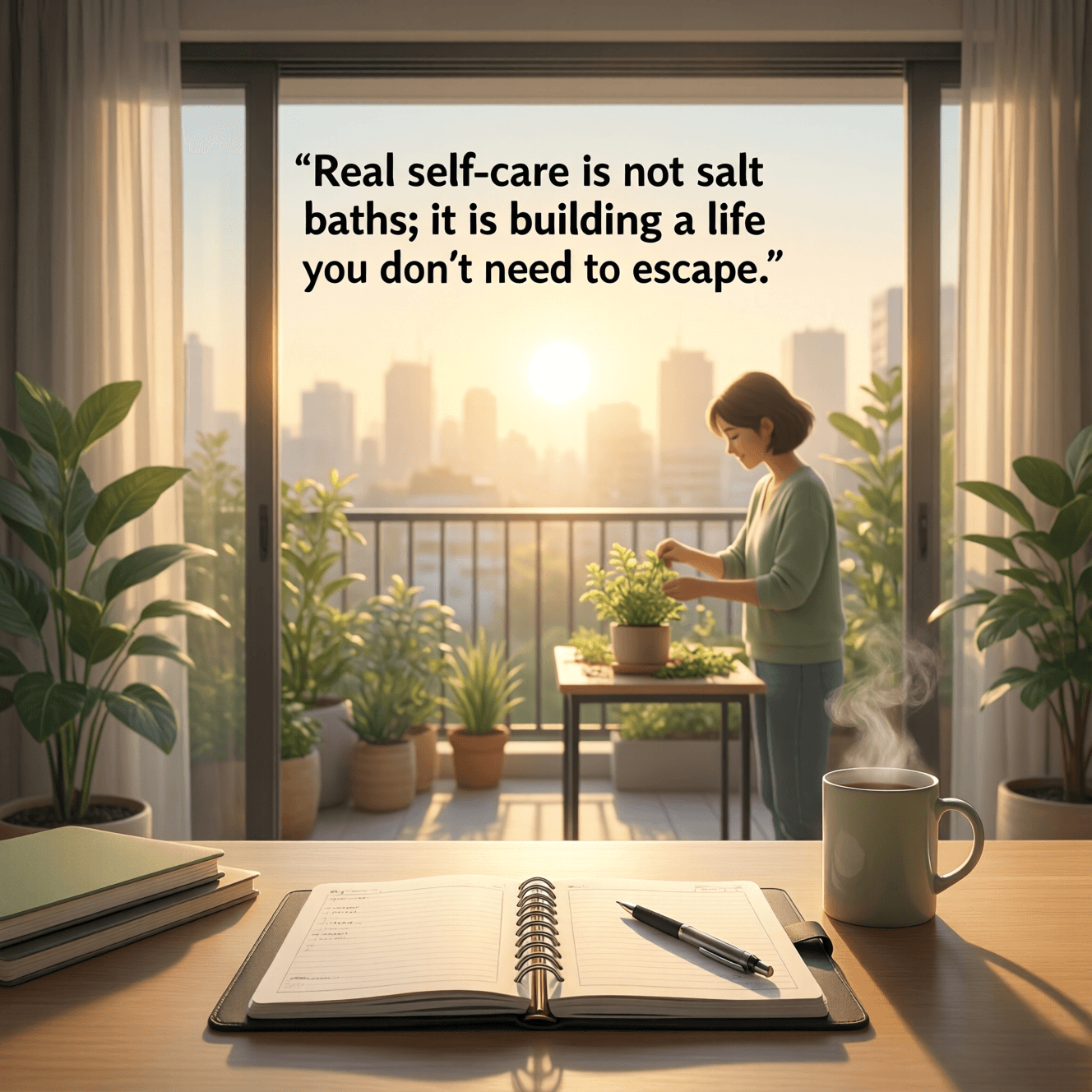
Real self-care is not salt baths; it is building a life you don't need to escape. — Brianna Wiest
—What lingers after this line?
Reframing the Meaning of Self-Care
Brianna Wiest’s line draws a sharp boundary between self-care as a soothing activity and self-care as a structural choice. Salt baths, candles, and quiet evenings can be pleasant, but she implies they are often treated as substitutes for deeper changes. In that sense, the quote functions like a reality check: if your main relief comes from temporary escapes, the real work may lie elsewhere. From this starting point, her definition pivots self-care away from consumer-friendly rituals and toward the long-term conditions of everyday life—how you spend your hours, what drains you, and what keeps repeating despite your best intentions.
The Escape Trap: When Relief Becomes a Loop
If self-care is primarily about “getting through” the day, it can quietly become part of the same cycle that caused the stress in the first place. You feel depleted, you recover just enough to return to the source, and then you need to escape again. Wiest’s phrasing—“a life you don’t need to escape”—highlights how familiar this loop is in modern work culture and in strained relationships. This doesn’t mean small comforts are worthless; rather, it suggests they’re incomplete when they serve as the only counterbalance. The more urgent question becomes: what are you repeatedly trying to outrun?
Systems Over Symptoms
The quote nudges us to treat chronic stress like a design problem, not merely a mood problem. In practical terms, that means examining the system: the job demands, the boundaries, the financial strain, the social environment, or the internal rules you live by (like perfectionism). Just as public health focuses on prevention rather than only emergency response, Wiest argues for preventative self-care—changing conditions so distress is less frequent in the first place. Once you adopt that lens, “self-care” can include the unglamorous decisions: renegotiating workload, ending a one-sided friendship, or setting a bedtime that protects your next day.
Building a Life with Fewer Emergency Exits
Creating a life you don’t need to escape doesn’t imply a life without hardship; it implies a life with support beams. That might look like routines that reduce decision fatigue, relationships that don’t require constant self-abandonment, or work that aligns better with your values and capacities. Even small structural shifts—like planning meals, automating bills, or scheduling recovery time—can reduce the background pressure that makes “escape” feel necessary. In other words, the goal is not nonstop comfort but a baseline of livability, where rest is restorative rather than merely reparative.
Agency, Boundaries, and Honest Trade-Offs
Wiest’s message also carries an implicit call to agency: you are allowed to prioritize the shape of your days. Boundaries become a central form of self-care because they prevent predictable harm—saying no, asking for help, limiting availability, or refusing dynamics that keep you anxious. Often, the cost is short-term discomfort: disappointing someone, earning less temporarily, or being seen as “difficult.” Yet this is where the quote becomes practical rather than inspirational: building a life you don’t need to escape usually requires trade-offs, and the courage to choose the long-term version of relief.
Integrating Rituals into a Sustainable Life
Finally, the point isn’t to abandon salt baths; it’s to put them in their proper place. Rituals can be meaningful when they complement a healthy structure—like a weekly walk that reinforces a calmer schedule, or journaling that helps you notice patterns before they become crises. In that integrated model, small comforts stop being life rafts and become simple pleasures. By ending on “building,” Wiest frames self-care as ongoing construction: adjusting, maintaining, and redesigning as you grow. The ultimate measure is straightforward—whether your ordinary life feels like somewhere you can actually live.
One-minute reflection
What feeling does this quote bring up for you?
Related Quotes
6 selectedReal self-care is building a life you don’t need to escape from. — Brianna Wiest
Brianna Wiest
Brianna Wiest’s line reframes self-care as something far sturdier than occasional treats or temporary relief. If your routines are mainly designed to numb stress—endless scrolling, retail therapy, nightly wine—then “care...
Read full interpretation →You can't pour from an empty cup. Take care of yourself first. — Arianna Huffington
Arianna Huffington
At its heart, Arianna Huffington’s line turns self-care into an image anyone can understand: a cup cannot nourish others if it has nothing left to give. The metaphor is gentle, but its message is firm.
Read full interpretation →Taking time out each day to relax and renew is essential to living well. — Judith Hanson Lasater
Judith Hanson Lasater
Judith Hanson Lasater’s words begin with a simple but often neglected truth: well-being is not sustained by effort alone. To live well, a person must also step back, soften, and allow the body and mind to recover.
Read full interpretation →Do not let your mind bully your body into believing it must carry the weight of the world. — Astrid Alauda
Astrid Alauda
Astrid Alauda’s quote speaks with the calm urgency of a reminder many people need: the mind can become a harsh taskmaster. It creates stories of obligation, guilt, and endless responsibility, then persuades the body to l...
Read full interpretation →The most loving thing I ever did was say no to things that were killing me slowly. — Prentis Hemphill
Prentis Hemphill
At first glance, Hemphill’s line sounds simple, yet it redefines love as an act of protection rather than mere tenderness. Saying no becomes the deepest form of care when a person recognizes that certain habits, relation...
Read full interpretation →Setting boundaries is the way we care for ourselves. It is not a way to push others away, but a way to keep ourselves whole. — Melody Beattie
Melody Beattie
At its core, Melody Beattie’s statement reframes boundaries as an act of care rather than rejection. People often fear that saying no, asking for space, or naming limits will appear cold; however, Beattie suggests the op...
Read full interpretation →More From Author
More from Brianna Wiest →Your choices must begin to reflect not just the person you are, but also the one you are becoming. — Brianna Wiest
At its core, Brianna Wiest’s statement reframes identity as something unfinished. Rather than treating the self as a fixed fact, she suggests that who we are is continually revised through action.
Read full interpretation →You cannot expect to heal a life you are still actively poisoning with the same habits that broke you in the first place. — Brianna Wiest
Brianna Wiest’s quote turns on a sharp contradiction: healing cannot take root while the very behaviors that caused the damage are still being repeated. In other words, recovery is not only about wanting change; it is ab...
Read full interpretation →The cost of your new life is your old one. — Brianna Wiest
Brianna Wiest’s line frames transformation as a direct trade: to step into a “new life,” you must pay with the familiar structures of the “old one.” Rather than promising effortless reinvention, the quote insists that me...
Read full interpretation →Real self-care is building a life you don’t need to escape from. — Brianna Wiest
Brianna Wiest’s line reframes self-care as something far sturdier than occasional treats or temporary relief. If your routines are mainly designed to numb stress—endless scrolling, retail therapy, nightly wine—then “care...
Read full interpretation →