
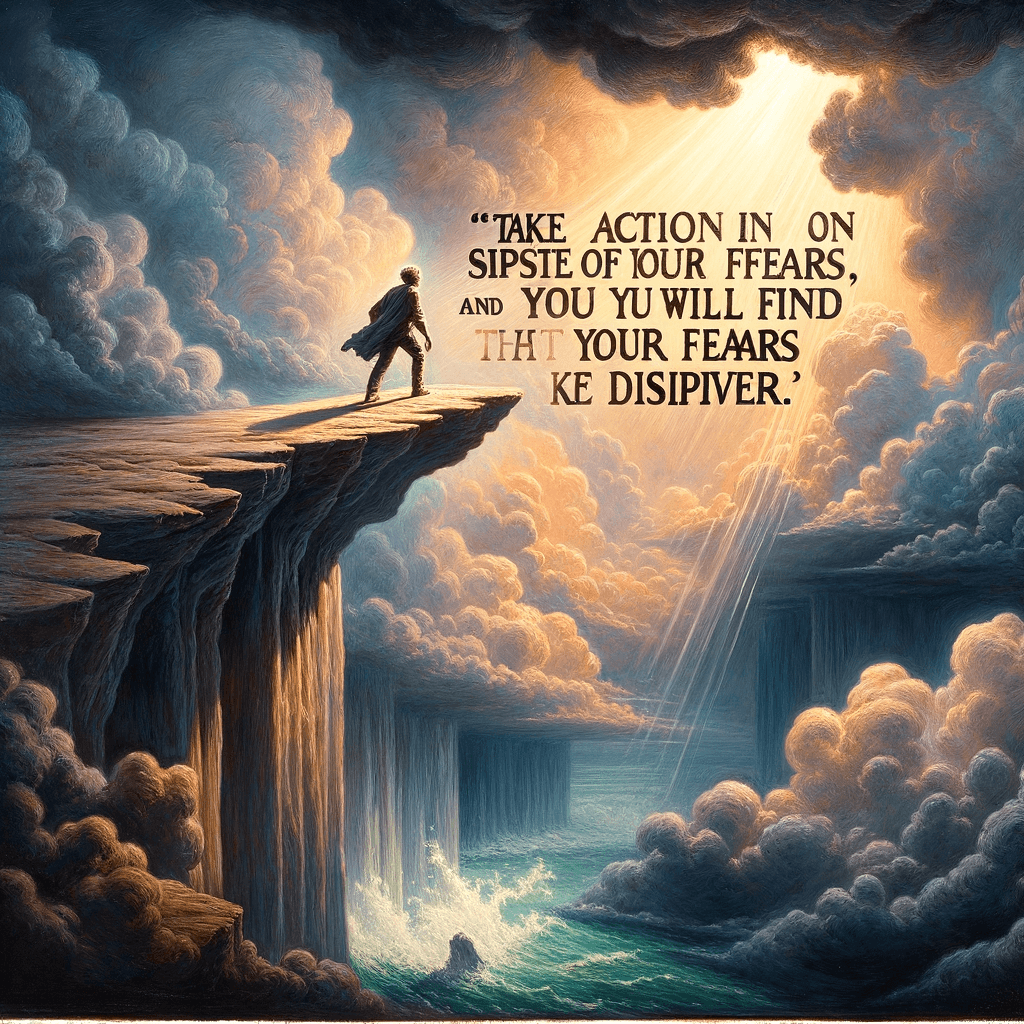
Take action in spite of your fears, and you will find that your fears will disappear. — Tony Robbins, United States.
—What lingers after this line?
Confronting Fears
This quote emphasizes the importance of confronting fears head-on. By taking action despite feeling afraid, individuals can break the cycle of fear that often holds them back.
The Illusion of Fear
Robbins suggests that fears are often based on perception rather than reality. By acting despite these fears, individuals may discover that their fears are unfounded or exaggerated.
Empowerment through Action
Taking action can be empowering. Each step taken despite fear builds confidence and resilience, transforming fear into a motivating force.
Fear as a Catalyst for Growth
This quote implies that fear, rather than being a barrier, can act as a catalyst for personal growth and development when one chooses to act against it.
Context of Personal Development
Tony Robbins is a renowned life coach and motivational speaker known for his work in personal development and self-help. His teachings focus on overcoming limitations and fostering a mindset geared towards action and achievement.
One-minute reflection
What does this quote ask you to notice today?
Related Quotes
6 selectedThe way to do a great deal is to keep on doing a little. The way to do nothing at all is to be continually resolving that you will do everything. — C.H. Spurgeon
C.H. Spurgeon
Spurgeon’s statement begins with a practical paradox: great accomplishments are rarely born from dramatic bursts of effort, but from the steady repetition of small acts. By saying that “a great deal” is done by “doing a...
Read full interpretation →To be courageous is to act with the heart. — Molière
Molière
Molière’s line suggests that courage is not merely the absence of fear, but the decision to move despite it. By connecting courage with the heart, he frames bravery as an emotional and moral act rather than a simple disp...
Read full interpretation →The best people possess a feeling for beauty, the courage to take risks, the discipline to tell the truth, the capacity for sacrifice. — Ernest Hemingway
Ernest Hemingway
Hemingway’s line presents goodness not as politeness or success, but as a demanding inner code. The “best people” are those who combine sensitivity, bravery, honesty, and self-denial—qualities that do not always coexist...
Read full interpretation →No matter how full a reservoir of maxims one may possess, if one has not taken advantage of every concrete opportunity to act, one's character may remain entirely unaffected. — William James
William James
At first glance, William James draws a sharp line between knowing and becoming. A person may store up countless moral sayings, noble principles, and wise resolutions, yet these remain largely ornamental if they never pas...
Read full interpretation →If you are not willing to look stupid, nothing great is ever going to happen to you. — Julia Cameron
Julia Cameron
Julia Cameron’s remark begins with a hard truth: many people do not fail because they lack talent, but because they fear embarrassment. In that sense, ‘looking stupid’ becomes shorthand for being seen trying, stumbling,...
Read full interpretation →You don't have to bully yourself out of feeling fear. You just have to move while it's still there. — Annie Wright
Annie Wright
At its core, Annie Wright’s quote challenges the common belief that courage begins only after fear has disappeared. Instead, it reframes fear as something that can accompany action rather than prevent it.
Read full interpretation →More From Author
More from Tony Robbins, United States. →