
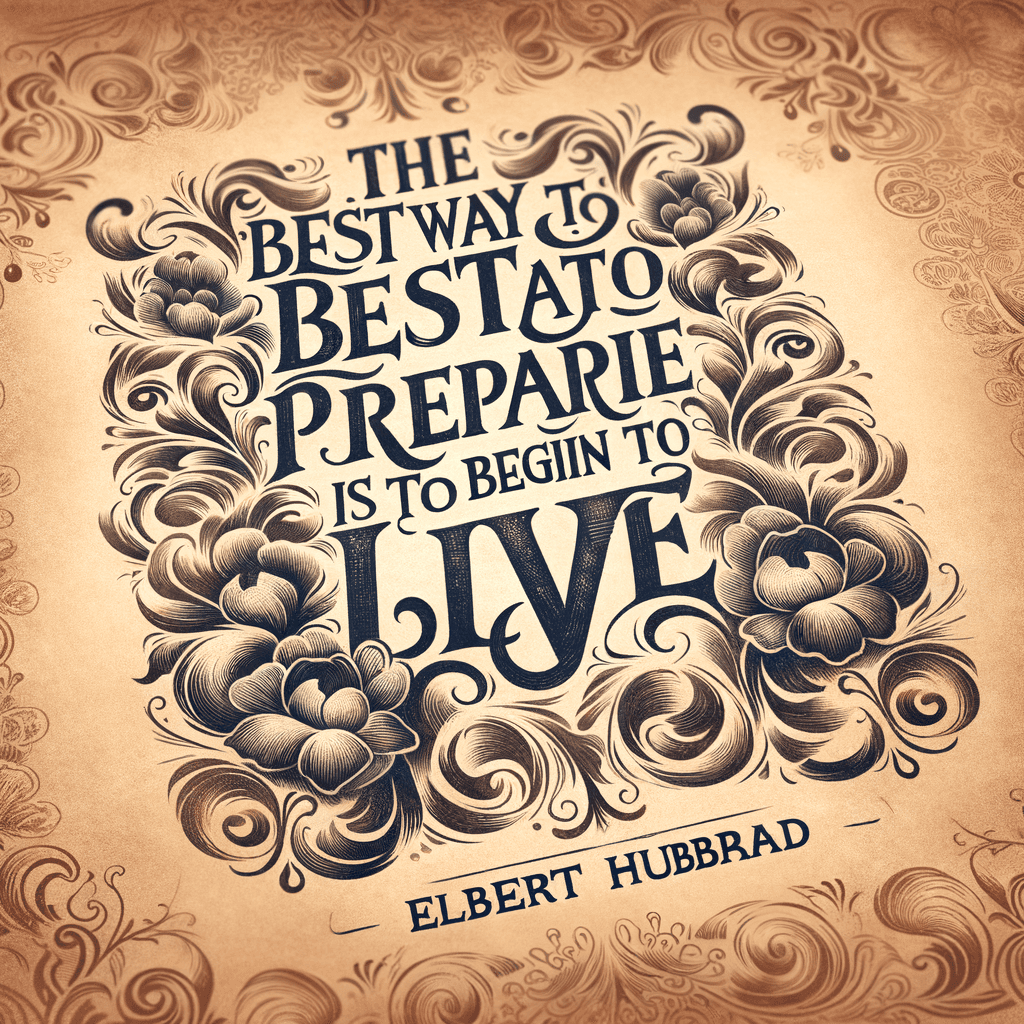
The best way to prepare for life is to begin to live. — Elbert Hubbard
—What lingers after this line?
Active Engagement
This quote encourages individuals to actively engage in life rather than passively waiting for the right moment. By living fully in the present, people can better prepare themselves for future challenges and opportunities.
Practical Experience
It emphasizes the importance of gaining practical experience. Learning and growth come not just from planning and theorizing but from actually doing and experiencing life firsthand.
Overcoming Fear
The quote suggests that waiting for the perfect moment or conditions can often be a form of procrastination. Facing and overcoming the fear of starting is a crucial step in truly preparing for life's journey.
Mindfulness and Presence
Living in the moment is a practice of mindfulness. Being present and mindful can lead to a richer, more fulfilling life and better preparation for future uncertainties.
Philosophical Insight
Elbert Hubbard, an American writer, philosopher, and artist, often shared insights on living a meaningful life. This quote reflects his belief in the value of practical wisdom and direct action.
One-minute reflection
What's one small action this suggests?
Related Quotes
6 selectedNo matter how full a reservoir of maxims one may possess, if one has not taken advantage of every concrete opportunity to act, one's character may remain entirely unaffected. — William James
William James
At first glance, William James draws a sharp line between knowing and becoming. A person may store up countless moral sayings, noble principles, and wise resolutions, yet these remain largely ornamental if they never pas...
Read full interpretation →A garden is not made by singing 'Oh, how beautiful,' and sitting in the shade. — Rudyard Kipling
Rudyard Kipling
Kipling’s line immediately cuts through passive appreciation. Simply admiring a garden, however sincerely, does nothing to plant seeds, pull weeds, or carry water.
Read full interpretation →Talent means nothing, while experience, acquired in humility and with hard work, means everything. — Patrick Süskind
Patrick Süskind
At first glance, Patrick Süskind’s statement seems deliberately extreme, because few people truly believe talent means nothing at all. Yet that sharp phrasing serves a purpose: it shifts attention away from natural gifts...
Read full interpretation →You cannot afford to live in potential for the rest of your life; at some point, you have to unleash it. — Eric Thomas
Eric Thomas
Eric Thomas’s quote begins with a stark warning: potential is not a place to live, only a promise of what might be. In other words, talent, intelligence, or ambition mean very little if they remain dormant.
Read full interpretation →The way to do is to be. — B.K.S. Iyengar
B.K.S. Iyengar
At first glance, B.K.S. Iyengar’s line seems to invert common advice.
Read full interpretation →It is by acts and not by ideas that people live. — Anatole France
Anatole France
At its core, Anatole France’s remark argues that life is sustained by what people actually do, not merely by what they think or proclaim. Ideas may inspire, guide, or justify, yet they remain inert until translated into...
Read full interpretation →More From Author
More from Elbert Hubbard →Art is not a thing; it is a way. — Elbert Hubbard
Elbert Hubbard’s line immediately shifts attention away from paintings, sculptures, or books as isolated products. Instead, he suggests that art lives in the manner of seeing, choosing, and shaping experience.
Read full interpretation →The love we give away is the only love we keep. — Elbert Hubbard
At first glance, Elbert Hubbard’s line seems to contradict common sense: how can love that is given away be the only love we keep? Yet the paradox is precisely the point.
Read full interpretation →Do your work with your whole heart, and you will succeed. — Elbert Hubbard
This quote stresses the significance of being fully dedicated to one's work. A wholehearted approach often leads to higher levels of effort and a stronger commitment to achieving success.
Read full interpretation →To avoid criticism say nothing, do nothing, be nothing. — Elbert Hubbard
This quote highlights the tendency of individuals to become paralyzed by the fear of criticism. It suggests that by avoiding action or expression, one attempts to shield themselves from the judgment of others.
Read full interpretation →