
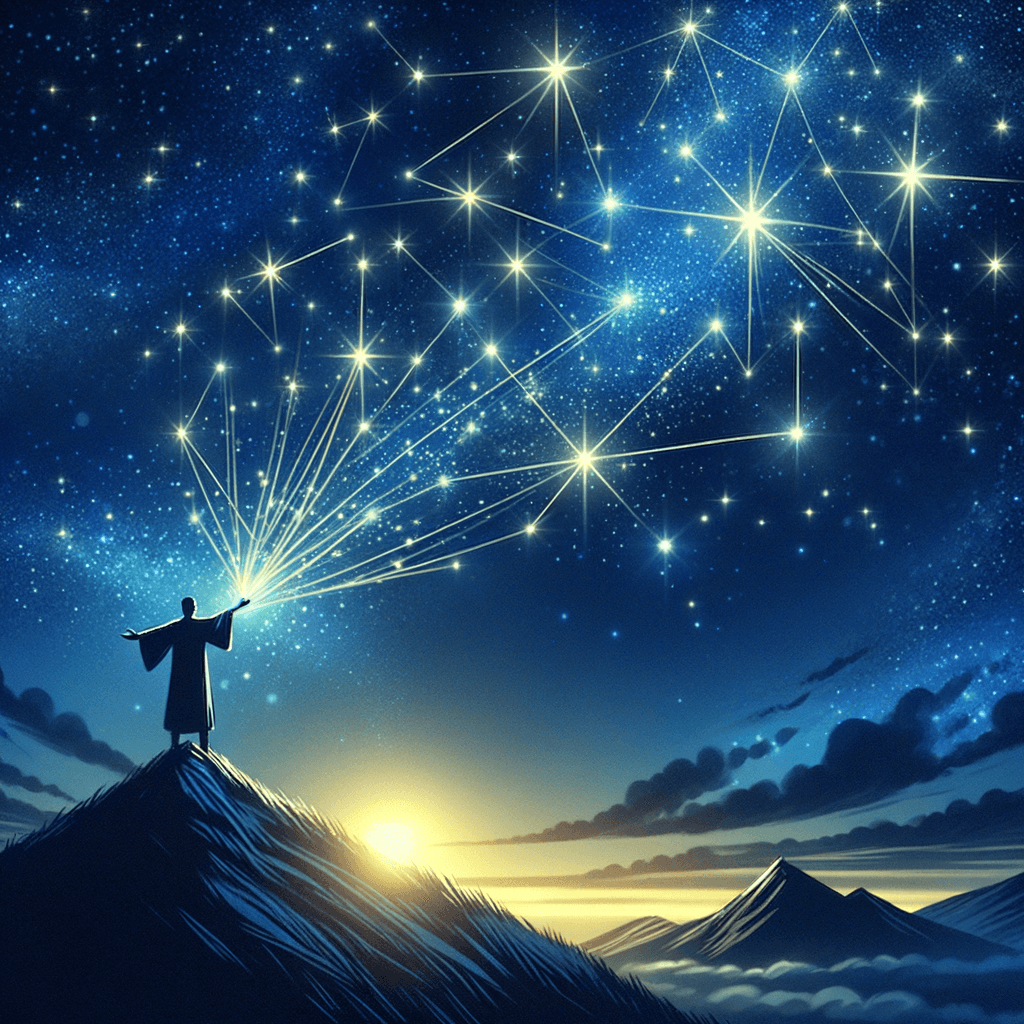
The stars are not in their places, but you can place them there. — Mikhail Lermontov
—What lingers after this line?
Empowerment and Control
This quote inspires a sense of personal agency and control. It suggests that even if life’s circumstances seem disordered, we have the power to create order and change our reality.
Ambition and Aspirations
The reference to 'placing the stars' symbolizes the pursuit of dreams and aspirations. It emphasizes our ability to reach for greatness, even when it feels unattainable.
Overcoming Challenges
The line acknowledges that life may not naturally align with our desires, but it encourages perseverance and the belief that we can shape our futures through determination.
Philosophical Reflection
On a deeper level, the quote offers a perspective on existential agency, implying that individuals have the power to impose meaning and structure on an otherwise chaotic universe.
Literary Context
Mikhail Lermontov, a 19th-century Russian poet and novelist, often explored themes of existentialism, fate, and human potential in his works. This quote reflects his literary focus on the human spirit's capacity to confront and shape destiny.
One-minute reflection
What's one small action this suggests?
Related Quotes
6 selectedYou cannot command things, but you can command yourself. — Michael D. Pollock
Michael D. Pollock
At first glance, Michael D. Pollock’s line draws a sharp boundary between the outer world and the inner one.
Read full interpretation →Everything in the world is full of signs. All events are coordinated. All things depend on each other. Everything breathes together. — Plotinus
Plotinus
At first glance, Plotinus presents the world not as a collection of isolated objects, but as a living whole in which every part participates in a larger order. His claim that everything is full of signs suggests that rea...
Read full interpretation →A boundary is not a wall; it is a door with a lock that you control. — Annie Wright
Annie Wright
At first glance, Annie Wright’s quote corrects a common misunderstanding: people often treat boundaries as acts of distance or punishment, when in fact they are tools of intentional relationship. A wall shuts everyone ou...
Read full interpretation →When you feel like you are at a dead end, remember that you are at a place where you can choose a different path. — Haemin Sunim
Haemin Sunim
At first glance, a dead end feels like failure, as though movement itself has been denied. Yet Haemin Sunim’s insight gently reverses that impression: what seems like a wall may actually be a point of decision.
Read full interpretation →The boundaries of your life are merely a creation of the self. — Robin Sharma
Robin Sharma
Robin Sharma’s line reframes “boundaries” as something less like a fence in the world and more like a frame in the mind. What we often call limits—who we are, what we can do, what we deserve—can be stories we repeat unti...
Read full interpretation →You are the author of your own story. You don't need permission to begin. — Ctrl+Alt+Write
Ctrl+Alt+Write
The quote opens with a bracing premise: your life is not merely something that happens to you, but something you shape. By calling you “the author,” it reframes identity from a fixed description into an ongoing draft—rev...
Read full interpretation →More From Author
More from Mikhail Lermontov →