
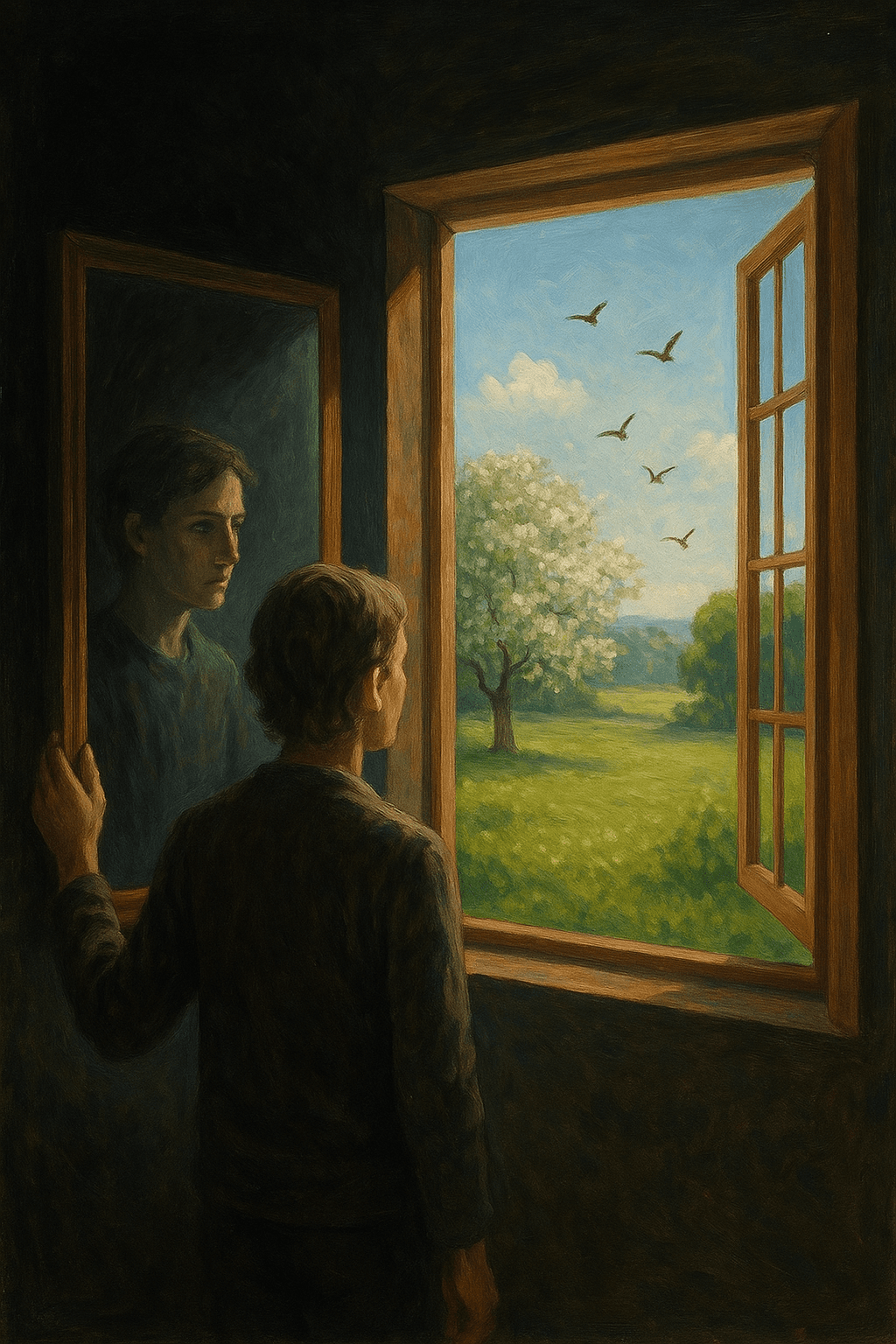
The whole purpose of education is to turn mirrors into windows. — Sydney J. Harris
—What lingers after this line?
From Self-Reflection to Broader Perspective
At the heart of Sydney J. Harris’s metaphor lies a profound progression: education redirects our gaze from self-absorption to outward exploration. While mirrors confine us to our own image and preconceptions, windows unveil a world beyond ourselves, inviting curiosity about the unknown. This shift marks the difference between insular thinking and open-minded discovery, emphasizing how education challenges us to look past our immediate selves.
Historical Shifts in Educational Goals
Reflecting further, the purpose of education has historically moved beyond rote learning towards nurturing critical thinkers. Thinkers like John Dewey, in 'Democracy and Education' (1916), championed experiential learning, urging students to engage with and question their surroundings. This aligns with Harris’s vision: true education doesn't just reinforce what we already know—it dismantles boundaries, exposing learners to fresh ideas and perspectives.
Breaking the Boundaries of Assumptions
Building upon these ideals, the educational process often serves as a means to confront and overcome our biases. Left unchecked, it is easy for our minds to reflect only what is familiar—a mirror feeding back our existing beliefs. Yet, when educators provide ‘windows’ into new cultures, disciplines, or modes of thinking, students are encouraged to question the status quo and appreciate diversity, as seen in multicultural curricula worldwide.
The Role of Curiosity and Empathy
Transitioning to the personal level, Harris’s metaphor also underscores the development of curiosity and empathy. By looking through windows rather than at mirrors, learners become attuned to other lives and experiences. For example, literature classes that expose students to authors from varied backgrounds help cultivate empathy, while science education often starts with wonder about the world outside oneself.
Education as a Lifelong Opening
Ultimately, the window is not static—education is a lifelong invitation to expand our horizons. Graduates, lifelong learners, and anyone engaged in self-improvement repeatedly find that every new skill or insight further pushes open the panes of their understanding. In this way, Harris’s words serve as a reminder: education’s true triumph is measured by how widely it opens our windows onto the world.
One-minute reflection
Why might this line matter today, not tomorrow?
Related Quotes
6 selectedWhere you stand determines what you see and what you do not see; a change in where you stand changes everything. — Søren Kierkegaard
Søren Kierkegaard
Kierkegaard’s insight begins with a simple but unsettling claim: vision is never neutral. Where we stand—socially, emotionally, spiritually, or intellectually—determines not only what comes into view but also what remain...
Read full interpretation →The point is to have a long-term perspective. — Dalai Lama XIV
Dalai Lama XIV
At its core, the Dalai Lama XIV’s remark urges us to lift our eyes from the pressures of the present moment and consider the wider arc of life. A long-term perspective does not deny today’s difficulties; rather, it place...
Read full interpretation →Sometimes all it takes is a tiny shift of perspective to see something familiar in a totally new light. — Dan Brown
Dan Brown
At first glance, Dan Brown’s quote seems simple, yet its force lies in how little it asks of us: not a total reinvention, but a slight adjustment in viewpoint. He suggests that familiarity can dull perception, making peo...
Read full interpretation →Everything is a season, and this is just a chapter, not your whole story. — Glennon Doyle
Glennon Doyle
At its core, Glennon Doyle’s quote reframes hardship and change by comparing life to the natural cycle of seasons. Just as winter does not cancel spring, a painful or uncertain period does not define a person forever.
Read full interpretation →Sometimes you just have to stop, take a deep breath, and put things into perspective. — Katrina Mayer
Katrina Mayer
At its core, Katrina Mayer’s remark highlights the quiet power of interruption. In moments of stress, urgency often convinces us that we must react immediately, yet the simple act of stopping can break that spell.
Read full interpretation →We must look at the lens through which we see the world, as well as the world we see. — Sarah Ban Breathnach
Sarah Ban Breathnach
Sarah Ban Breathnach’s line reminds us that perception is never a simple act of receiving reality; it is also an act of interpretation. We do not merely look outward at events, people, and circumstances—we also look thro...
Read full interpretation →More From Author
More from Sydney J. Harris →