
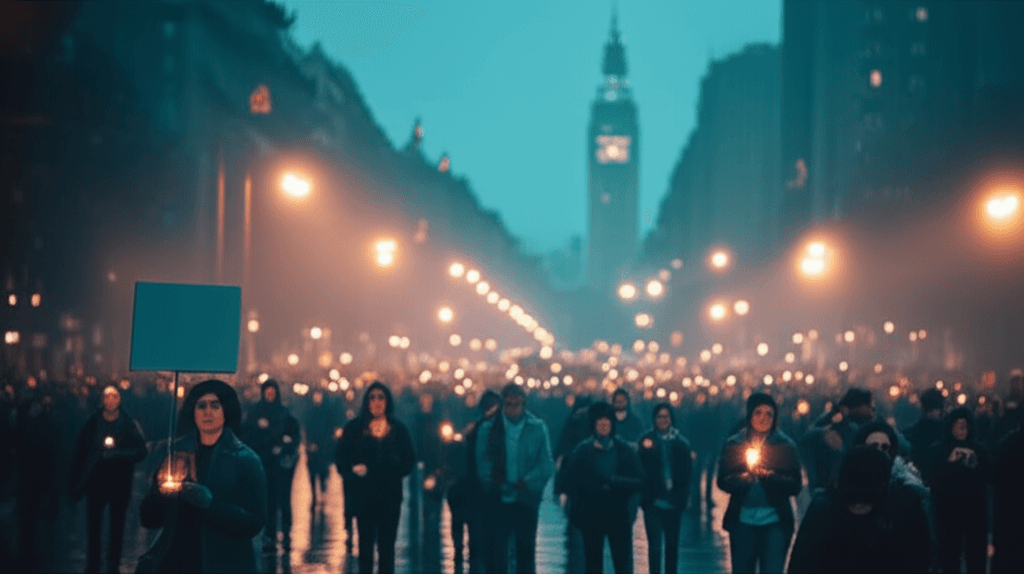
There may be times when we are powerless to prevent injustice, but there must never be a time when we fail to protest. — Elie Wiesel
—What lingers after this line?
Wiesel’s Imperative of Witness
Elie Wiesel distills a hard truth learned in extremity: we may not always stop harm, but we must never forfeit our voice. As a Holocaust survivor, his memoir "Night" (1956) and his Nobel Lecture (1986) insist that neutrality aids the oppressor while silence abandons the victim. Protest, then, is not merely tactical; it is a moral refusal to be complicit when outcomes feel beyond our control. From this starting point, Wiesel reframes protest as a duty of conscience. Even when power is absent, witnessing can preserve dignity, signal solidarity, and plant the seeds of future change—effects that often outlast the immediate crisis.
Protest as a Moral Record
When prevention fails, protest still shapes the story that future generations inherit. The White Rose students in Munich (1942–43) circulated leaflets exposing Nazi crimes; their courage did not topple the regime, yet it created an indelible record that later taught millions how conscience speaks under terror. Similarly, courier Jan Karski’s reports to Allied leaders (1943) documented the annihilation of Polish Jews, ensuring the facts could not be erased. This memorial function reaches beyond wartime. Frederick Douglass’s oration, "What to the Slave Is the Fourth of July?" (1852), protested the nation’s hypocrisy, archiving a prophetic standard against which later reforms would be measured. Thus, protest becomes history’s ledger when power is lacking.
From Symbols to Structural Change
Moral records can ripen into movements. The Montgomery Bus Boycott (1955–56) began as a local refusal yet reshaped U.S. law, while "Letter from Birmingham Jail" (1963) articulated why nonviolent tension exposes unjust systems. Abroad, anti-apartheid activism—from Soweto’s student protests (1976) to global divestment campaigns in the 1980s—converted witness into leverage that helped dismantle a regime. Even small, persistent protests exert pressure. The Mothers of the Plaza de Mayo (from 1977) asked one devastating question—Where are our children?—undermining a dictatorship’s secrecy. Step by step, symbolic acts can accumulate into structural change, especially when they keep attention alive until conditions shift.
Breaking the Machinery of Silence
Psychology explains why protest must pierce quiet. Darley and Latané’s experiments (1968) on the bystander effect show how people freeze when responsibility feels diffused, while Elisabeth Noelle-Neumann’s "spiral of silence" (1974) argues that perceived isolation suppresses speech. A lone voice can disrupt both spirals by modeling that dissent is possible. Digital cascades make this visible: #MeToo (2017) turned individual disclosures into a collective reckoning, altering norms in workplaces and law. Thus, speaking up is not only expressive; it is catalytic, converting private conviction into public courage.
Strategy, Nonviolence, and Risk
Because protest cannot always prevent harm, it must be strategic. Gene Sharp’s "The Politics of Nonviolent Action" (1973) catalogs methods—from strikes to boycotts—that withdraw cooperation from unjust power. Building on this, Erica Chenoweth and Maria Stephan’s "Why Civil Resistance Works" (2011) finds nonviolent campaigns more likely to achieve durable change, partly by attracting broad participation. Yet protest carries risk; discipline matters. Clear goals, truthful messaging, and coalition-building help maintain legitimacy when opponents provoke. In this way, protest preserves both the moral message and the practical avenues for reform once opportunities arise.
Everyday Ways to Refuse Injustice
What can one person do when prevention seems out of reach? Document and corroborate; amplify affected voices; donate, accompany, and provide legal or medical support; use institutional channels—ethics offices, unions, courts—when available. Whistleblowing, as Daniel Ellsberg did with the Pentagon Papers (1971), shows that truth-telling can reframe public understanding even at personal cost. Crucially, refusal starts close to home: decline complicity at work, challenge demeaning jokes, and vote or organize for protections that reduce future harms. As John Lewis urged, make “good trouble” when conscience calls. In that spirit, Wiesel’s mandate endures: when we cannot stop injustice, we can still deny it our silence.
Recommended Reading
As an Amazon Associate, we earn from qualifying purchases.
One-minute reflection
What feeling does this quote bring up for you?
Related Quotes
6 selectedThe time is always right to do what is right. — Martin Luther King Jr.
Martin Luther King Jr.
This quote underscores that there is never an inappropriate time to act morally and ethically. One should always strive to do what is right, regardless of the circumstances.
Read full interpretation →Act in such a way that you treat humanity, whether in your own person or in the person of any other, always at the same time as an end and never merely as a means. — Immanuel Kant
Immanuel Kant
Kant emphasizes the necessity of seeing every individual as an intrinsic value rather than as a tool for personal gain. This moral duty underlines the importance of respecting the dignity of all humans.
Read full interpretation →You may be the only person left who can help someone else. Don't waste your opportunities to be that person. — Chris Gardner
Chris Gardner
This quote highlights the importance of recognizing that sometimes individuals have the unique power to make a difference in someone else's life. It calls for a sense of responsibility towards others in need of help.
Read full interpretation →In doing what we ought, we deserve no praise, because it is our duty. — C.S. Lewis
C.S. Lewis
This quote emphasizes that fulfilling one's duties and responsibilities should be seen as the baseline of moral behavior rather than something extraordinary or praiseworthy.
Read full interpretation →With great power comes great responsibility. — Peter Parker (Spider-Man)
Man
This quote implies that having power comes with the duty to use it responsibly. Those who possess influence or ability must act in ways that benefit others and avoid misuse of their powers.
Read full interpretation →Do not be daunted by the enormity of the world’s grief. Do justly now, love mercy now, walk humbly now. You are not obligated to complete the work, but neither are you free to abandon it. — The Talmud
The Talmud
The quote acknowledges the vast scale of suffering in the world, encouraging readers not to be paralyzed or discouraged by its enormity.
Read full interpretation →More From Author
More from Elie Wiesel →Responsibility is the price of freedom. — Elie Wiesel
This quote highlights the idea that true freedom comes with the obligation to act responsibly. It suggests that being free entails making choices that consider the well-being of oneself and others.
Read full interpretation →To seek that which is just and not simply what it is easy. — Elie Wiesel
This quote emphasizes the importance of pursuing justice over convenience. It calls on individuals to make ethical decisions, even when they are difficult or unpopular.
Read full interpretation →Resilience is forged in the fire of hardship. — Elie Wiesel
Resilience refers to the ability to recover quickly from difficulties or adversity.
Read full interpretation →To seek is to risk not knowing the answer; to not seek is the greatest risk of all. — Elie Wiesel
The quote highlights the importance of seeking answers, even though searching can lead to uncertainty.
Read full interpretation →