
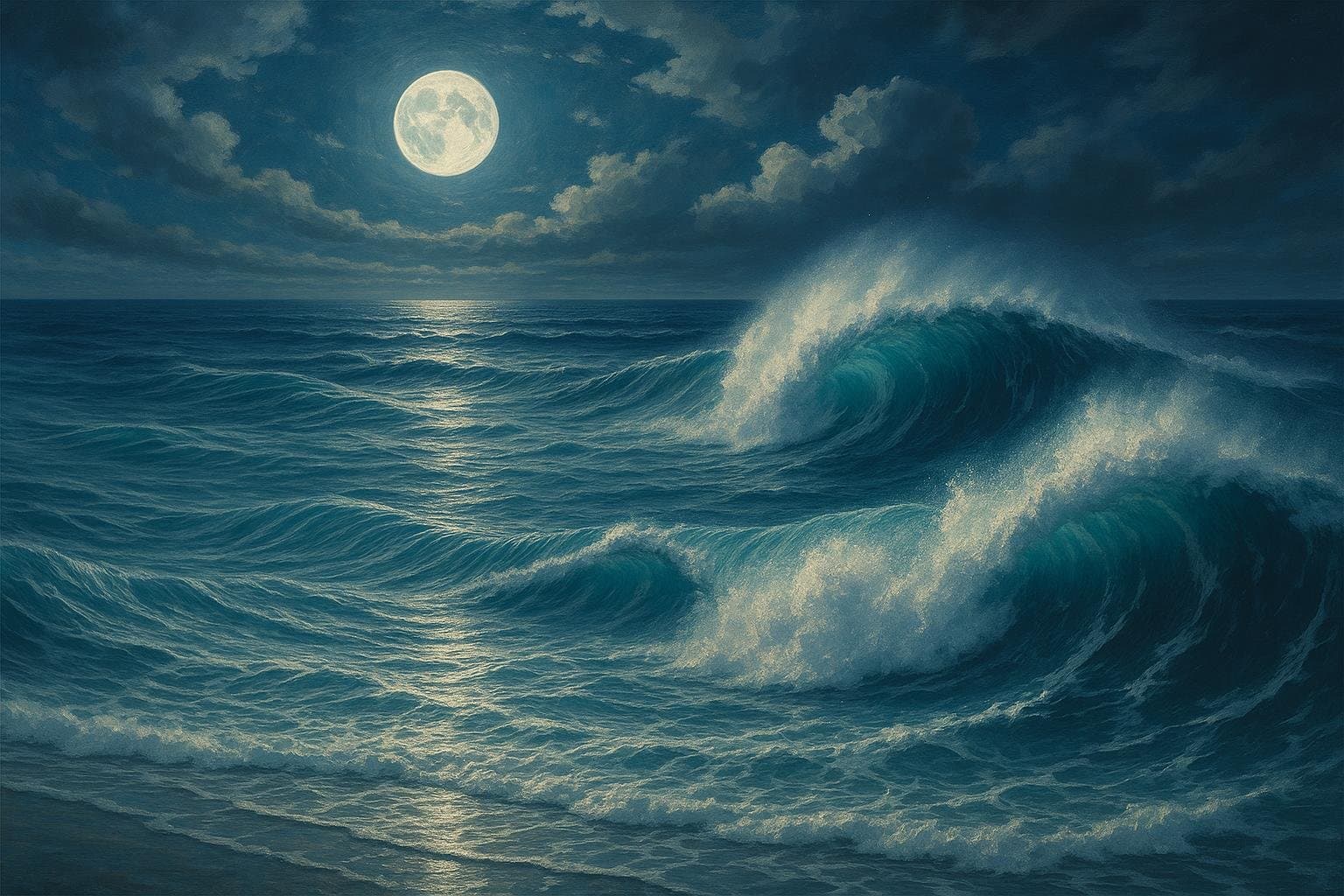
Waves are the voices of tides; tides are life’s endless movement. — Miyamoto Musashi
—What lingers after this line?
Nature’s Voices: Understanding Waves and Tides
Miyamoto Musashi’s poetic expression invites us to see waves as the articulations—almost the language—of the tides. Just as human speech manifests inner thoughts, waves are the visible and audible evidence of the deeper, unseen forces that drive the ocean. In this sense, Musashi connects the rhythmic sound of waves crashing ashore to the larger, cyclical movement of the tides, drawing us into nature’s own way of communicating its vitality.
Tides as Symbols of Life’s Continuity
Building upon this metaphor, Musashi describes tides as life's endless movement. Historically, tides have been powerful symbols of eternity and renewal—constantly rising and falling, yet never truly ceasing. In literature and philosophy, these cycles often parallel human existence, reminding us that while individual moments may ebb and flow, life as a whole endures, always in motion, always returning anew.
Philosophical Foundations in Musashi’s Worldview
Musashi, a famed samurai and thinker, was deeply influenced by Zen philosophy, which stresses the impermanence and perpetual flow of all things. His analogy between tides and life echoes Buddhist teachings from texts like the Dhammapada, which compare the process of living to rivers that never remain the same. In Musashi’s own writings—such as the *Book of Five Rings* (1645)—he often urges adaptability, suggesting wisdom lies in moving with, rather than against, life’s natural currents.
Interconnectedness Through Movement
This concept also points to the interconnectedness of everything within the universe. Just as waves arise from the movement of tides, so do individual actions and moments stem from the grander flow of existence. From the migration of animals to the cycles of seasons, nature is a tapestry of perpetual motion shaping all life. Such a worldview encourages humility and awe, reminding us that each voice—each wave—is a fleeting expression of something much larger.
Applying the Metaphor: Lessons for Daily Life
Finally, Musashi’s metaphor offers practical wisdom for daily living. By recognizing that life is in constant flux, we become better equipped to embrace change and uncertainty. Just as sailors learn to read the tides and navigate by the sound of waves, individuals can find harmony by accepting life’s uncertainties. This acceptance encourages resilience, patience, and a deeper appreciation for the beauty found in ceaseless movement.
One-minute reflection
What's one small action this suggests?
Related Quotes
6 selectedNature does not hurry, yet everything is accomplished; find your own rhythm, not the rhythm of the screen. — Fritz Schumacher
Fritz Schumacher
At its core, the quotation contrasts two tempos: the unforced pace of nature and the relentless pulse of digital life. Nature does not rush, yet seasons turn, seeds sprout, and rivers carve valleys over time.
Read full interpretation →Optimization is a cage with silver bars; true health is the wild, unmeasured rhythm of your own breath. — Unknown
Unknown
“Optimization is a cage with silver bars” points to a modern paradox: the pursuit of better health can become a refined form of confinement. The “silver” suggests something attractive—clean data, wearable metrics, discip...
Read full interpretation →Nature does not hurry, yet everything is accomplished. — Lao Tzu
Lao Tzu
Lao Tzu’s line points to a simple but counterintuitive observation: nature rarely looks busy, yet its outcomes are vast and reliable. Seasons turn, rivers carve valleys, and forests regenerate without frantic effort.
Read full interpretation →Nature does not hurry, yet everything is accomplished. — Lao Tzu
Lao Tzu
Lao Tzu’s line presents a subtle contrast: nature never appears frantic, yet it reliably reaches its ends. Seasons change, rivers carve valleys, and forests regenerate without any visible urgency.
Read full interpretation →In the gentle tapping of every raindrop, the heartbeat of the earth is hidden.
Unknown
This quote suggests that nature is interconnected and alive, with every raindrop symbolizing a part of the earth's 'heartbeat' or life force. It implies a profound connection between natural phenomena and the living plan...
Read full interpretation →Nature does not hurry, yet everything is accomplished. — Lao Tzu
Lao Tzu
This quote highlights the idea that everything in nature unfolds at its own pace. There is a natural rhythm to life, and rushing often disrupts this flow, suggesting that patience is essential for achieving goals.
Read full interpretation →More From Author
More from Miyamoto Musashi →There is nothing outside of yourself that can ever enable you to get better, stronger, richer, or smarter. — Miyamoto Musashi
Miyamoto Musashi’s line begins by stripping away a common hope: that some external thing—money, teachers, circumstances, even luck—will finally “enable” a person to improve. Instead, he argues that the decisive source of...
Read full interpretation →Today is victory over yourself of yesterday; tomorrow is your victory over lesser men. — Miyamoto Musashi
Musashi’s line opens by redefining “victory” as an inward contest rather than a public spectacle. Instead of measuring success by applause, rank, or trophies, he points to a quieter benchmark: whether you are stronger, w...
Read full interpretation →You must train day and night in order to make decisions. — Miyamoto Musashi
Miyamoto Musashi’s line compresses a lifetime of martial experience into a single principle: sound decisions are not improvised—they are earned. When he says you must train “day and night,” he points to a kind of prepara...
Read full interpretation →Do nothing which is of no use. — Miyamoto Musashi
Miyamoto Musashi’s line, “Do nothing which is of no use,” reads like a blunt filter for everyday life: if an action doesn’t serve a real aim, drop it. Rather than celebrating busyness, he points to a stricter standard—us...
Read full interpretation →