
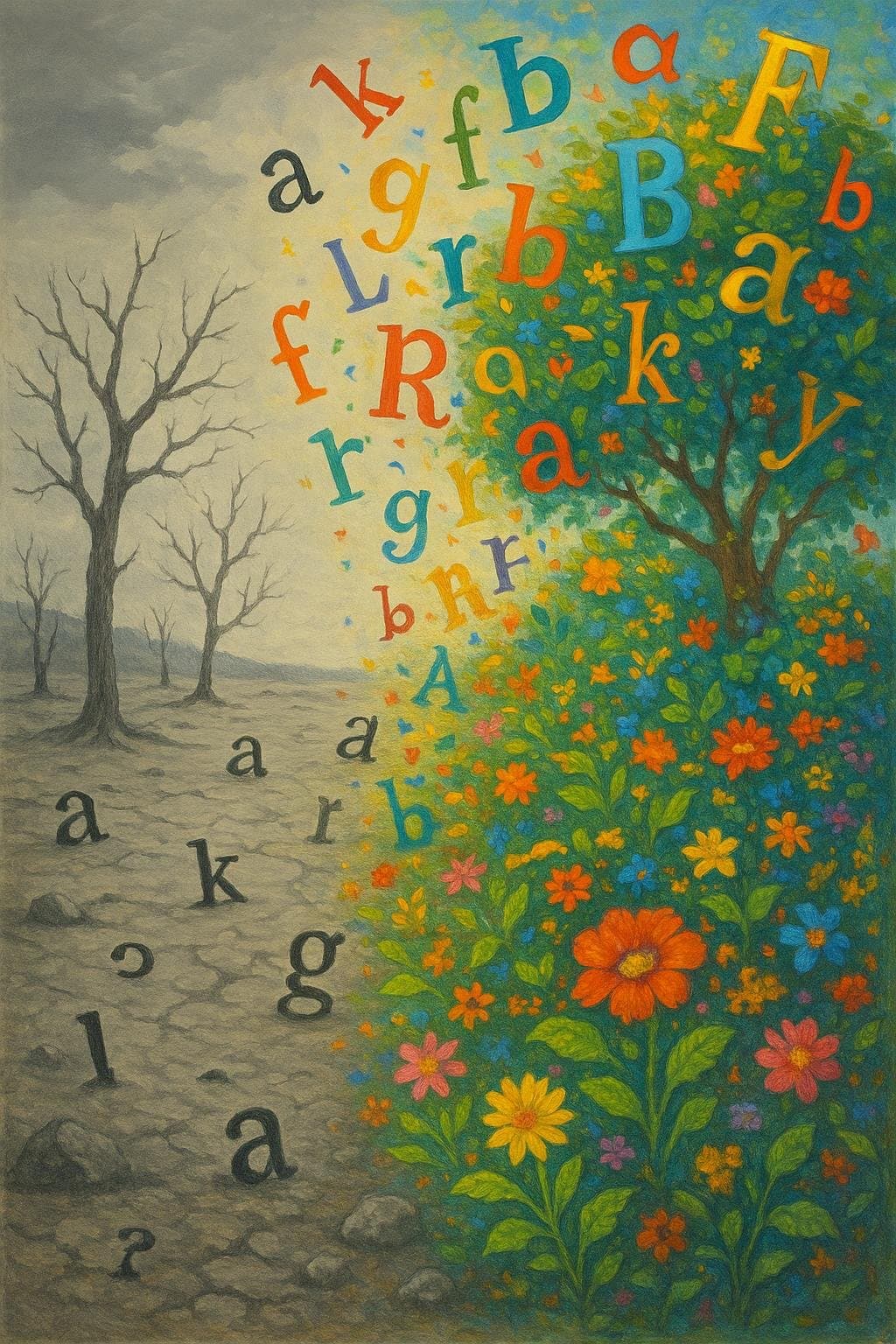
When ideas fail, words come in very handy. — Johann Wolfgang von Goethe
—What lingers after this line?
Goethe’s Insight Into Communication
Goethe’s observation suggests a wry recognition of the limits inherent in human creativity and thought. When genuine inspiration or clear concepts elude us, the temptation is to fill the void with eloquence or verbosity. Rather than allowing silence or confusion, people often resort to words as placeholders, providing the illusion of substance even when ideas are lacking.
Historical Contexts of Eloquence Over Substance
Throughout history, this phenomenon has often surfaced in the realms of politics and rhetoric. For instance, Cicero’s orations—while celebrated for their style—sometimes masked a lack of concrete solutions, relying instead on persuasive language. This trend persists, as public figures occasionally employ grand speeches that captivate but do not necessarily clarify, echoing Goethe’s pointed remark.
The Psychology of Talking Without Thinking
Building on this, psychologists have observed that people frequently use language as a defense mechanism to obscure uncertainty. In moments of discomfort or intellectual discomfort, filling silences with words can help maintain authority or control. This aligns with the concept of ‘empty talk’ described by social psychologist Irving Janis, where group dynamics encourage verbose but shallow discussion when true consensus is absent.
Literary Reflections on Words Versus Meaning
Literature offers numerous examples of words compensating for—instead of clarifying—meaning. In Lewis Carroll’s ‘Through the Looking-Glass’ (1871), the character Humpty Dumpty famously declares, "When I use a word, it means just what I choose it to mean," highlighting how language can obscure as much as it reveals. Such instances reinforce Goethe’s contention that words, while powerful, are sometimes deployed to mask the absence of real ideas.
Embracing Silence and Genuine Thought
Ultimately, Goethe’s statement invites us to reflect on the value of thoughtful silence over facile verbosity. Rather than fearing the pauses that come when ideas are slow to form, embracing them can lead to deeper insight and authenticity. In a world saturated with words, Goethe reminds us of the importance of substance over style—encouraging a mindful approach to both thought and speech.
One-minute reflection
What does this quote ask you to notice today?
Related Quotes
6 selectedWords are, of course, the most powerful drug used by mankind. — Rudyard Kipling
Rudyard Kipling
Kipling emphasizes that words hold immense power in how they influence thoughts, emotions, and actions. Just like a potent drug, words can deeply affect and change individuals.
Read full interpretation →The pen is mightier than the sword only if the sword is very short, and the pen is very sharp. — Terry Pratchett
Terry Pratchett
Terry Pratchett’s quip takes aim at the familiar adage, ‘the pen is mightier than the sword,’ by injecting it with witty skepticism. Traditionally, this maxim holds that words, persuasion, or writing exert greater influe...
Read full interpretation →The simpler we can make it, the more eloquent our life becomes. — Robin Wall Kimmerer
Robin Wall Kimmerer
Robin Wall Kimmerer's observation urges us to consider simplicity not merely as an aesthetic, but as an approach to living deeply and meaningfully. In a world often crowded with distractions, clutter, and ever-increasing...
Read full interpretation →A really great talent finds its happiness in execution. — Johann Wolfgang von Goethe
Johann Wolfgang von Goethe
Goethe’s remark shifts attention away from talent as mere possession and toward talent as practice. A gift, however impressive, remains incomplete until it is exercised; in this sense, happiness does not come from being...
Read full interpretation →Everybody wants to be somebody; nobody wants to grow. — Johann Wolfgang von Goethe
Johann Wolfgang von Goethe
At first glance, Goethe’s remark exposes a quiet contradiction in human desire: people long for significance, recognition, and identity, yet often resist the difficult transformation such becoming requires. To ‘be somebo...
Read full interpretation →The most original of authors are not so because they advance what is new, but more because they know how to say something as if it had never been said before. — Johann Wolfgang von Goethe
Johann Wolfgang von Goethe
Goethe begins by shifting originality away from mere invention and toward expression. In his view, a writer does not become original simply by producing unheard-of thoughts; rather, originality emerges when familiar trut...
Read full interpretation →More From Author
More from Johann Wolfgang von Goethe →A really great talent finds its happiness in execution. — Johann Wolfgang von Goethe
Goethe’s remark shifts attention away from talent as mere possession and toward talent as practice. A gift, however impressive, remains incomplete until it is exercised; in this sense, happiness does not come from being...
Read full interpretation →Everybody wants to be somebody; nobody wants to grow. — Johann Wolfgang von Goethe
At first glance, Goethe’s remark exposes a quiet contradiction in human desire: people long for significance, recognition, and identity, yet often resist the difficult transformation such becoming requires. To ‘be somebo...
Read full interpretation →The most original of authors are not so because they advance what is new, but more because they know how to say something as if it had never been said before. — Johann Wolfgang von Goethe
Goethe begins by shifting originality away from mere invention and toward expression. In his view, a writer does not become original simply by producing unheard-of thoughts; rather, originality emerges when familiar trut...
Read full interpretation →In nature we never see anything isolated, but everything in connection with something else which is before it, beside it, under it and over it. — Johann Wolfgang von Goethe
Goethe’s remark begins with a simple observation and expands into a profound worldview: nothing in nature exists alone. Every plant, stone, current, and creature belongs to a web of relations shaped by time, place, and s...
Read full interpretation →