
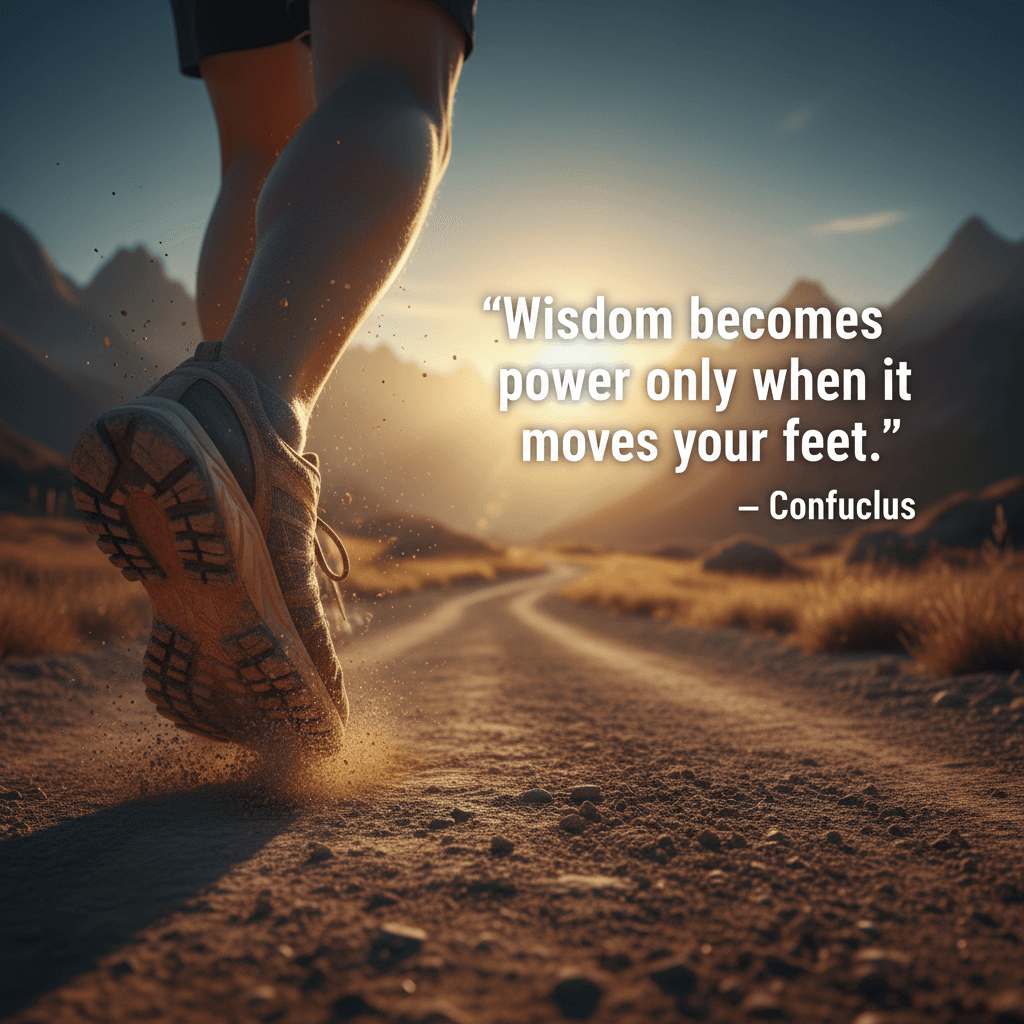
Wisdom becomes power only when it moves your feet. — Confucius
—What lingers after this line?
From Insight to Kinetic Power
At its core, the saying insists that knowledge is inert until it compels motion. Advice, plans, and principles may illuminate paths, but only steps taken convert potential into power. Thus, wisdom becomes less about what we can recite and more about what we can carry into the world. By shifting focus from contemplation to movement, the line reframes intelligence as a force measured by outcomes, not by eloquence.
Confucian Roots of Doing Over Saying
Historically, the sentiment aligns with Confucian ethics, which prize embodied virtue. The Analects cautions that the exemplary person is ‘modest in speech but exceeds in actions’ (Analects 14.27) and that ‘seeing what is right and not doing it is a lack of courage’ (Analects 2.24). Later, Wang Yangming sharpened this into the doctrine of the unity of knowledge and action, arguing that knowing divorced from doing is incomplete (Instructions for Practical Living, c. 1520). In this lineage, wisdom matures only when it is practiced.
Leadership: Steps, Not Speeches
In practice, leadership proves the rule. Amid London’s 1854 cholera outbreak, John Snow’s insight about contaminated water did not gain power until he walked to Broad Street and removed the pump handle. That small, physical act translated contested knowledge into community protection. Likewise, effective leaders habitually transform briefings into behaviors—deploying pilots, shipping prototypes, or visiting front lines—because motion cuts through ambiguity and mobilizes others.
Closing the Intention–Action Gap
Psychologically, many people stall between knowing and doing. Research on implementation intentions shows that if–then plans (‘If it is 7 a.m., then I run’) markedly increase follow-through (Peter Gollwitzer, 1999). Meta-analyses confirm that intentions alone often explain far less behavior than we expect (Paschal Sheeran, 2002). Moreover, habit studies indicate that consistent repetition in stable contexts automates actions over time (Phillippa Lally et al., 2010). Thus, wisdom gains power when we engineer situations where action becomes the default.
Translating Wisdom into Motion
Consequently, practical translators matter more than grand resolutions. Define the next visible step, not the whole journey; time-box it on a calendar so the when is decided; reduce friction by laying out tools in advance; and enlist social commitment with a public promise or a partner. Even micro-steps—two-minute starters, quick drafts, tiny experiments—convert abstract insight into irreversible momentum. Once the feet move, the mind entrains to keep pace.
Courage: The Moral Motor
Yet movement is not merely mechanical; it is moral. Analects 2.24 ties right action to courage, implying that hesitation often masks fear, not prudence. History’s pivotal shifts underscore this: Rosa Parks’s refusal to yield her seat (Montgomery, 1955) and Gandhi’s Salt March (1930) were modest motions that crystallized vast principles into public power. In each case, wisdom crossed the threshold of risk—and thereby changed the world.
Make It a Loop, Not a Leap
Finally, power deepens when action cycles back into learning. Pragmatism, as William James argued in Pragmatism (1907), holds that ideas are validated in their consequences; outcomes thus refine the next act. By iterating—act, observe, adjust—we convert initial wisdom into durable capability. In this loop, movement is not the end of thought but its amplifier, ensuring that what we know keeps improving how we walk.
One-minute reflection
What feeling does this quote bring up for you?
Related Quotes
6 selectedStudy the small step, for wisdom grows in the practice of doing. — Confucius
Confucius
This saying distills a pragmatic truth: progress begins with the smallest actionable move. Rather than equating wisdom with passive contemplation, it insists that understanding is matured in the furnace of doing.
Read full interpretation →Wisdom begins in wonder and blooms in action. — Confucius
Confucius
Confucius’ phrase underscores a timeless truth: before wisdom can flourish, it must be ignited by wonder. Human curiosity, that deep questioning spirit, serves as the foundation for all knowledge.
Read full interpretation →Wisdom grows when you test it in the field of doing rather than the comfort of thought. — Confucius
Confucius
Confucius binds knowledge to action, insisting that understanding matures only when exercised. The Analects opens with delight in practice: “Is it not a pleasure to learn and practice what is learned at due times?” (Anal...
Read full interpretation →Harvest wisdom from each sunrise and sow action by noon; virtue is grown through doing. — Confucius
Confucius
At daybreak, the image of harvesting wisdom invites a daily audit of thought and motive. Confucian self-cultivation begins here: noticing what the night clarified and what the day will demand.
Read full interpretation →It is by acts and not by ideas that people live. — Anatole France
Anatole France
At its core, Anatole France’s remark argues that life is sustained by what people actually do, not merely by what they think or proclaim. Ideas may inspire, guide, or justify, yet they remain inert until translated into...
Read full interpretation →Sharpen your mind with action and temper your will with mercy — C.S. Lewis
C.S. Lewis
C.S. Lewis’s line works like a paired instruction: cultivate a mind that cuts cleanly, and shape a will that does not crush.
Read full interpretation →More From Author
More from Confucius →Learning is a lifelong process of unlearning the need for immediate results. Patience is the discipline of trusting the slow, quiet compounding of your efforts. — Confucius
At its core, this saying presents learning not as a race toward instant achievement, but as a gradual reshaping of expectation. The phrase “unlearning the need for immediate results” suggests that education is not only a...
Read full interpretation →Anything worth having is worth waiting for, and everything worth doing is worth doing with patience. — Confucius
At its core, this saying ties value to delay. Confucius suggests that truly meaningful things do not arrive instantly; instead, they ask us to endure uncertainty, effort, and time.
Read full interpretation →A common man marvels at uncommon things. A wise man marvels at the commonplace. — Confucius
Confucius draws a quiet but profound distinction between two kinds of attention. The common man, in this saying, is captivated by what appears exceptional—spectacle, rarity, or public greatness.
Read full interpretation →To learn is to admit you do not know. The moment you stop being a student is the moment your growth ends. — Confucius
Confucius frames learning not as the display of knowledge but as the honest recognition of its limits. In that sense, to learn is to begin with humility: one must first admit, without shame, that there is something missi...
Read full interpretation →