
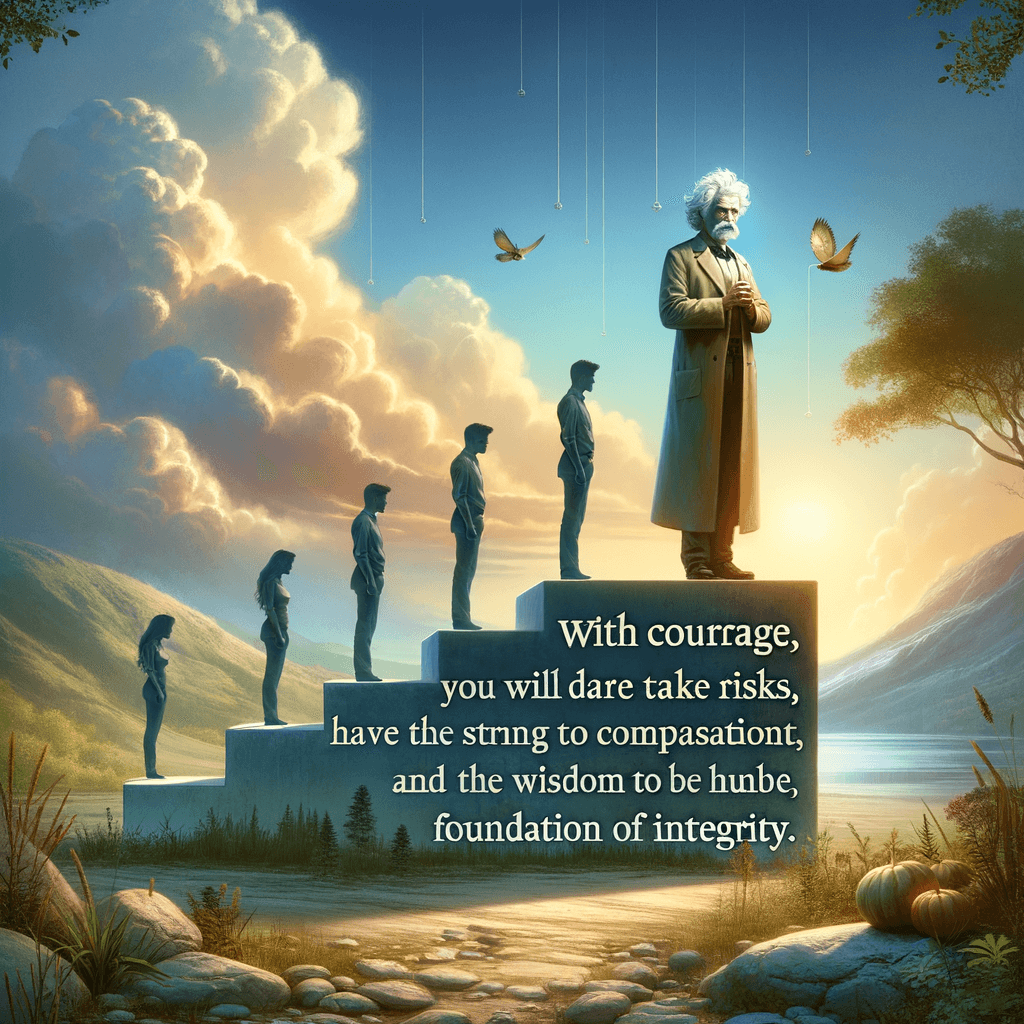
With courage, you will dare to take risks, have the strength to be compassionate, and the wisdom to be humble. Courage is the foundation of integrity. — Mark Twain
—What lingers after this line?
Taking Risks
This quote emphasizes that courage is essential for taking risks. It suggests that without courage, one may never venture into the unknown or seize opportunities that involve potential failure.
Strength to Be Compassionate
Courage is linked to compassion in this quote. It implies that being compassionate often requires bravery, as it involves understanding, supporting, and sometimes standing up for others, even in difficult situations.
Wisdom to Be Humble
The quote associates courage with humility. It suggests that true courage includes the wisdom to recognize one’s limitations and the grace to stay humble despite accomplishments or authority.
Foundation of Integrity
By declaring that 'courage is the foundation of integrity,' Mark Twain highlights that a person's moral and ethical behavior is rooted in courage. It takes bravery to consistently uphold one's principles, especially when faced with opposition or temptation.
Mark Twain's Perspective
Mark Twain, a renowned American writer known for his wit and wisdom, often explored human virtues and flaws. This quote reflects his belief in the integral role of courage in shaping character and ethical conduct.
One-minute reflection
Where does this idea show up in your life right now?
Related Quotes
6 selectedTo be courageous is to act with the heart. — Molière
Molière
Molière’s line suggests that courage is not merely the absence of fear, but the decision to move despite it. By connecting courage with the heart, he frames bravery as an emotional and moral act rather than a simple disp...
Read full interpretation →Saying no is an act of integrity. It aligns what you do with what you believe. — Annie Wright
Annie Wright
Annie Wright’s statement reframes the word “no” not as rejection, but as moral clarity. At its core, saying no is a way of protecting the space between one’s values and one’s actions.
Read full interpretation →The best people possess a feeling for beauty, the courage to take risks, the discipline to tell the truth, the capacity for sacrifice. — Ernest Hemingway
Ernest Hemingway
Hemingway’s line presents goodness not as politeness or success, but as a demanding inner code. The “best people” are those who combine sensitivity, bravery, honesty, and self-denial—qualities that do not always coexist...
Read full interpretation →If you are not willing to look stupid, nothing great is ever going to happen to you. — Julia Cameron
Julia Cameron
Julia Cameron’s remark begins with a hard truth: many people do not fail because they lack talent, but because they fear embarrassment. In that sense, ‘looking stupid’ becomes shorthand for being seen trying, stumbling,...
Read full interpretation →How much time he gains who does not look to see what his neighbour says or does or thinks, but only at what he does himself, to make it just and holy. — Marcus Aurelius
Marcus Aurelius
Marcus Aurelius argues that a great deal of life is wasted in watching other people—what they say, what they do, and even what they might be thinking. Instead, he recommends a disciplined inward turn: focus on your own c...
Read full interpretation →You don't have to bully yourself out of feeling fear. You just have to move while it's still there. — Annie Wright
Annie Wright
At its core, Annie Wright’s quote challenges the common belief that courage begins only after fear has disappeared. Instead, it reframes fear as something that can accompany action rather than prevent it.
Read full interpretation →More From Author
More from Mark Twain →We can secure other people's approval if we do right and try hard; but our own is worth a hundred of it. — Mark Twain
At its heart, Mark Twain argues that external approval is attainable through good conduct and honest effort, yet it remains secondary to a deeper judgment: our own. Praise from others can reassure us, but it is often cha...
Read full interpretation →Grief can take care of itself, but to get the full value of a joy you must have somebody to divide it with. — Mark Twain
Mark Twain’s remark begins with a striking contrast: grief, he says, can sustain its own weight, while joy needs companionship to reach its fullest meaning. In other words, sorrow often folds inward, making us solitary,...
Read full interpretation →Work consists of whatever a body is obliged to do, and that Play consists of whatever a body is not obliged to do. — Mark Twain
At first glance, Mark Twain’s line seems almost playful in its simplicity, yet it cuts directly to the heart of human motivation. Work, in his framing, is not defined by effort alone but by obligation: it is what a perso...
Read full interpretation →Eat a live frog first thing in the morning and nothing worse will happen to you the rest of the day. — Mark Twain
Mark Twain’s line is meant to jolt: the grotesque image of eating a live frog isn’t culinary advice but a metaphor for confronting the most unpleasant task first. By exaggerating the discomfort, Twain makes the underlyin...
Read full interpretation →