
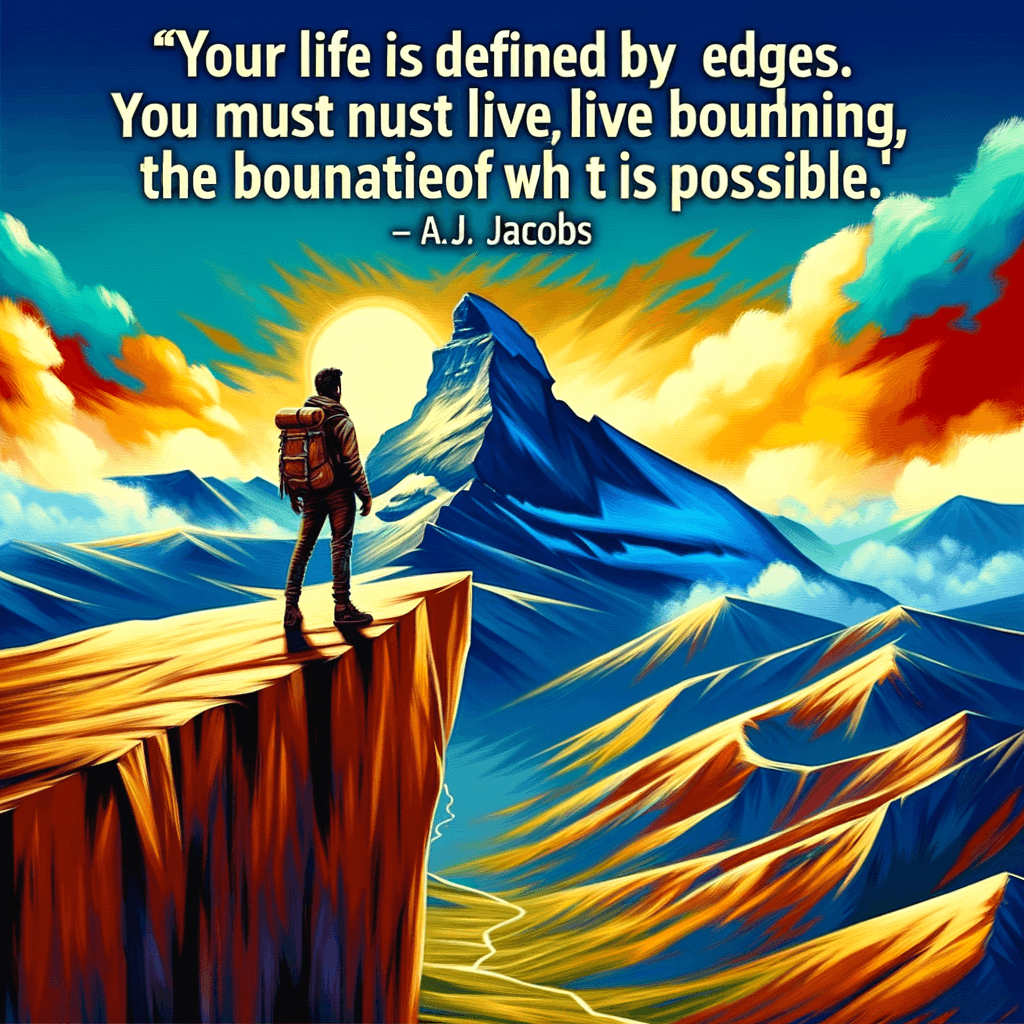
Your life is defined by its edges. You must live boldly, pushing the boundaries of what is possible. — A.J. Jacobs
—What lingers after this line?
Embracing Boldness
This quote encourages individuals to embrace boldness and take risks. By pushing one's limits, they can discover their true potential and expand their horizons.
Defining Boundaries
The 'edges' referred to in the quote represent the boundaries in one's life. It suggests that these boundaries shape experiences and personal growth, emphasizing the importance of exploring beyond them.
Potential for Growth
Jacobs highlights that living boldly allows for the exploration of new opportunities and the possibility of achieving one’s dreams, reinforcing the idea that growth often happens outside of comfort zones.
Mindset Shift
This statement advocates for a mindset shift where individuals view challenges as opportunities rather than obstacles. Living boldly can transform one’s outlook on life and lead to greater fulfillment.
A.J. Jacobs' Perspective
A.J. Jacobs is known for his unique approach to life and the exploration of various themes in his writing. His insights often encourage readers to reflect on their existence and how they can lead more adventurous and meaningful lives.
One-minute reflection
What does this quote ask you to notice today?
Related Quotes
6 selectedIf you're not doing some things that are crazy, then you're doing the wrong things. — Francis Ford Coppola
Francis Ford Coppola
At first glance, Francis Ford Coppola’s remark sounds like a celebration of recklessness, yet its deeper point is more demanding than that. He suggests that meaningful work often requires choices that appear irrational t...
Read full interpretation →Life is too short to be subtle — Mary Quant
Mary Quant
Mary Quant’s line begins with a blunt accounting: life is finite, and that fact should change how we show up in the world. If time is scarce, then excessive restraint can become a kind of self-sabotage—postponing honest...
Read full interpretation →I'd rather be a lightning rod than a seismograph. — Ken Kesey
Ken Kesey
Ken Kesey’s line hinges on two instruments that represent opposing ways of moving through life. A seismograph registers tremors; it is designed to detect, record, and translate distant shocks into readable marks.
Read full interpretation →One can never consent to creep when one feels an impulse to soar. — Simone de Beauvoir
Simone de Beauvoir
Simone de Beauvoir’s line begins with a quiet rebellion: once you feel the tug of possibility, “consenting to creep” becomes intolerable. The word consent matters, because it frames smallness as a choice we are pressured...
Read full interpretation →A bold refusal to give up reshapes the world more than a thousand cautious plans. — Seneca
Seneca
Seneca’s line pivots on a surprising claim: reality bends less to elaborate planning than to a person’s unyielding decision not to surrender. A “bold refusal” is not mere stubbornness; it is a moment when someone stops n...
Read full interpretation →Make your art of living loud enough that doubt cannot hear it. — Langston Hughes
Langston Hughes
Langston Hughes urges us to treat living as a creative act, not a passive experience. Rather than viewing art as something confined to canvases or stages, he suggests that our daily choices, habits, and values can become...
Read full interpretation →More From Author
More from A. J. Jacobs →Changing the world begins with the simple act of caring. — A. J. Jacobs
This quote highlights the profound impact that acts of kindness and compassion can have on the world. It suggests that even small gestures of caring can lead to significant changes.
Read full interpretation →Life is made up of a series of moments. Living involves making each moment matter. — A.J. Jacobs
This quote highlights the fact that life is composed of various moments, both big and small. Each one contributes to the broader experience of being alive, emphasizing the importance of appreciating them as they come.
Read full interpretation →The limitations you embrace today dictate the opportunities you unlock tomorrow. — A. J. Jacobs
This quote emphasizes the idea that current limitations, often in the form of discipline, focus, or learning, can lead to greater opportunities in the future. By 'embracing' temporary boundaries, we lay the foundation fo...
Read full interpretation →The beautiful thing about fear is that when you run away from it, it runs away from you. — A. J. Jacobs
This quote highlights the paradoxical nature of fear. It suggests that fear is often a creation of our own mind and can lose its power when we confront it or refuse to engage with it.
Read full interpretation →