
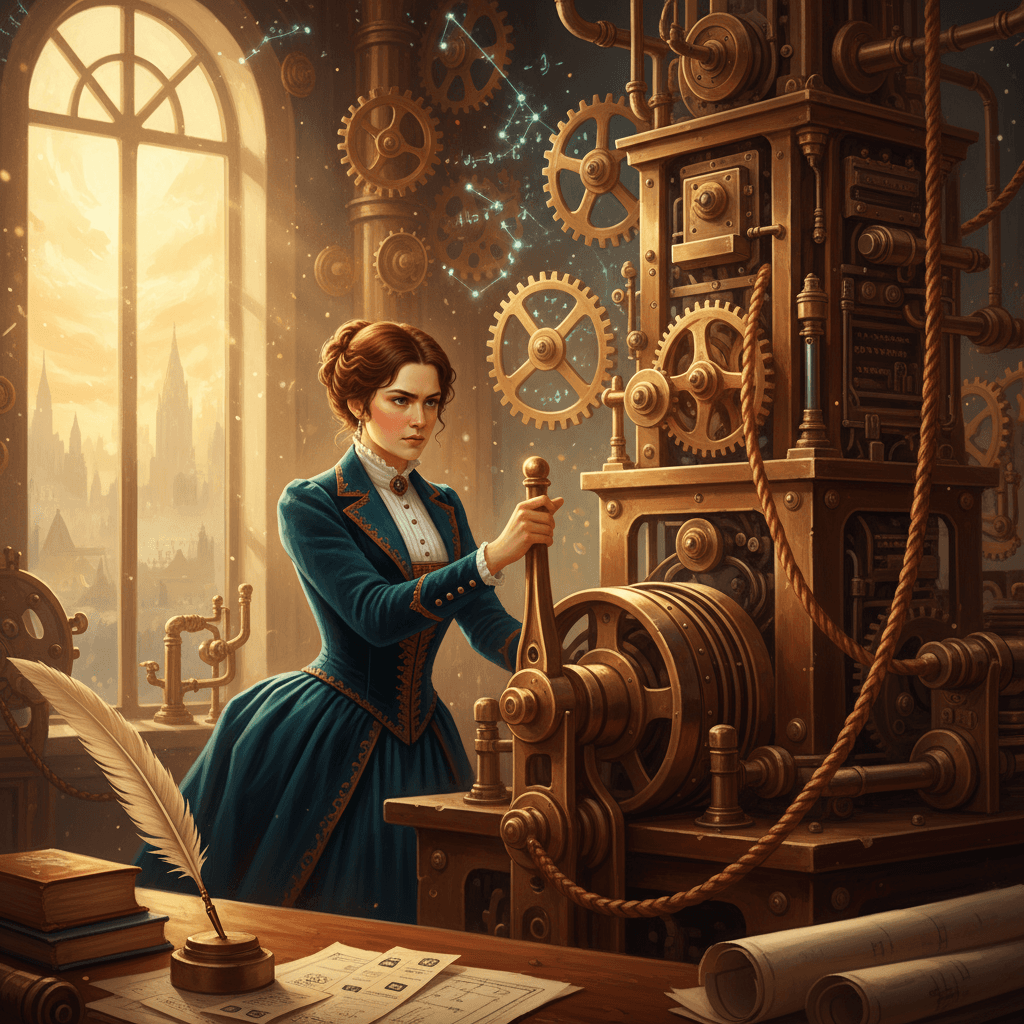
Curiosity turned into action is the core of invention. — Ada Lovelace
—What lingers after this line?
From Wonder to Working Mechanism
Curiosity asks why; invention asks how. Ada Lovelace’s insight reminds us that questions become engines only when inquiry moves our hands. Wonder alone sketches possibilities, but action drafts schematics, builds prototypes, and tests assumptions. Thus, the core of invention is not the spark itself, but the disciplined conversion of that spark into a repeatable process. As soon as a hunch is framed as an experiment, curiosity gains traction. This shift from passive fascination to deliberate making is where breakthroughs begin, and it sets the stage for Lovelace’s own methodical imagination.
Lovelace’s Analytical Engine Vision
From this vantage, Lovelace’s contribution becomes vivid. Translating Menabrea’s paper, she expanded it with extensive notes, including the famed Note G, which outlined an algorithm for the Analytical Engine to compute Bernoulli numbers (1843). Her commentary does more than marvel at a machine; it operationalizes curiosity by specifying steps, inputs, and outcomes—what we now call programming. Moreover, she foresaw that the Engine could manipulate symbols beyond numbers, anticipating modern computing’s breadth. By naming her approach “poetical science,” Lovelace fused imaginative inquiry with executable procedure, illustrating how curiosity, when structured, becomes invention in action.
Curiosity as Method: From Questions to Experiments
Extending that thread, the scientific method is curiosity’s conveyor belt. Francis Bacon’s Novum Organum (1620) codified the move from speculative questions to systematic trials. Later, Michael Faraday’s laboratory notebooks trace the same arc: questions about electromagnetism crystallize into repeatable setups and measurements (“Experimental Researches in Electricity,” 1831–1855). Even Charles Darwin’s “I think” sketch in his 1837 notebook converts a wondering into a testable tree of life. These practices reveal a rhythm: ask, model, test, revise. Curiosity supplies the hypotheses, but experiments translate them into evidence and mechanism, preparing ideas for the workshop of invention.
Prototyping and Iteration in Practice
On the ground, iteration is curiosity’s most honest form. The Wright brothers, dissatisfied with received lift data, built a wind tunnel to test hundreds of airfoils (1901–1902), turning doubt into controlled trials that made flight feasible. Likewise, Thomas Edison’s Menlo Park notebooks document thousands of filament experiments before the practical incandescent lamp and U.S. Patent 223,898 (1880). In both cases, questions were not merely pondered; they were embodied in measurable trials. Each prototype posed a sharper question to reality, and each failure collapsed uncertainty. Thus, iteration channels curiosity into momentum, where learning compounds into invention.
Ecosystems that Convert Ideas to Impact
Zooming out, environments determine whether curiosity scales. Bell Labs’ blend of theory, tooling, and cross-disciplinary teams yielded the transistor (1947), translating quantum hunches into solid-state devices. ARPANET’s early packets (1969) show how funded curiosity plus engineering rigor seeded the internet. More recently, open-source communities—from Linux (1991) to GitHub’s collaborative workflows—convert questions into shared code, while makerspaces let novices prototype in hours what once took months. These ecosystems institutionalize Lovelace’s progression: they lower the cost of testing, reward iteration, and preserve learning, so curiosity is continuously recycled into action and, ultimately, invention.
The Ethical Direction of Inventive Action
Ultimately, action must be steered. The Manhattan Project’s aftermath, captured in J. Robert Oppenheimer’s reflections (1945), warns that curiosity without ethics can outrun wisdom. Conversely, the Asilomar Conference on recombinant DNA (1975) exemplifies restraint, aligning inquiry with safeguards so progress remains humane. Today, debates around AI and gene editing echo the same imperative: curiosity should be yoked to accountability. In Lovelace’s spirit, the goal is not to dampen wonder but to direct it—turning imagination into responsible systems that expand human possibility while honoring human values. Invention, then, is curiosity with a conscience and a plan.
One-minute reflection
What does this quote ask you to notice today?
Related Quotes
6 selectedThe glory of invention is in its ability to produce change for the better. — Charles F. Kettering
Charles F. Kettering
This quote emphasizes that the true value of invention lies in its capacity to bring about improvement and progress, rather than simply creating something new for its own sake.
Read full interpretation →Be alone, that is the secret of invention: be alone, that is when ideas are born. — Nikola Tesla
Nikola Tesla
Tesla insisted that seclusion was not a luxury but a method. In My Inventions (1919), he writes, "My method is different...
Read full interpretation →Invent a future that makes your heart beat faster and build toward it. — Ada Lovelace
Ada Lovelace
Ada Lovelace’s line frames the future as something made, not merely awaited. Rather than treating tomorrow as a distant inevitability, she urges a stance of agency: choose a direction, decide what matters, and begin shap...
Read full interpretation →Challenge the ordinary; innovation lives where the crowd won't go. — Ada Lovelace
Ada Lovelace
Ada Lovelace’s line frames innovation as an act of intentional departure: to “challenge the ordinary” is to resist default assumptions and question what everyone else treats as settled. Rather than celebrating novelty fo...
Read full interpretation →Let each sunrise find you resolving to be kinder, braver, truer — Ada Lovelace
Ada Lovelace
Ada Lovelace’s line treats sunrise as more than a daily spectacle—it becomes a reset button for character. By tying resolution to the start of day, she implies that virtue is not a fixed trait but a practice renewed thro...
Read full interpretation →Turn hesitation into an experiment; failure is data, not a verdict. — Ada Lovelace
Ada Lovelace
Ada Lovelace’s line begins by rescuing hesitation from its usual stigma. Instead of treating uncertainty as weakness, she invites us to view it as the natural threshold of discovery, where questions form and assumptions...
Read full interpretation →More From Author
More from Ada Lovelace →Invent a future that makes your heart beat faster and build toward it. — Ada Lovelace
Ada Lovelace’s line frames the future as something made, not merely awaited. Rather than treating tomorrow as a distant inevitability, she urges a stance of agency: choose a direction, decide what matters, and begin shap...
Read full interpretation →Challenge the ordinary; innovation lives where the crowd won't go. — Ada Lovelace
Ada Lovelace’s line frames innovation as an act of intentional departure: to “challenge the ordinary” is to resist default assumptions and question what everyone else treats as settled. Rather than celebrating novelty fo...
Read full interpretation →Let each sunrise find you resolving to be kinder, braver, truer — Ada Lovelace
Ada Lovelace’s line treats sunrise as more than a daily spectacle—it becomes a reset button for character. By tying resolution to the start of day, she implies that virtue is not a fixed trait but a practice renewed thro...
Read full interpretation →Turn hesitation into an experiment; failure is data, not a verdict. — Ada Lovelace
Ada Lovelace’s line begins by rescuing hesitation from its usual stigma. Instead of treating uncertainty as weakness, she invites us to view it as the natural threshold of discovery, where questions form and assumptions...
Read full interpretation →