
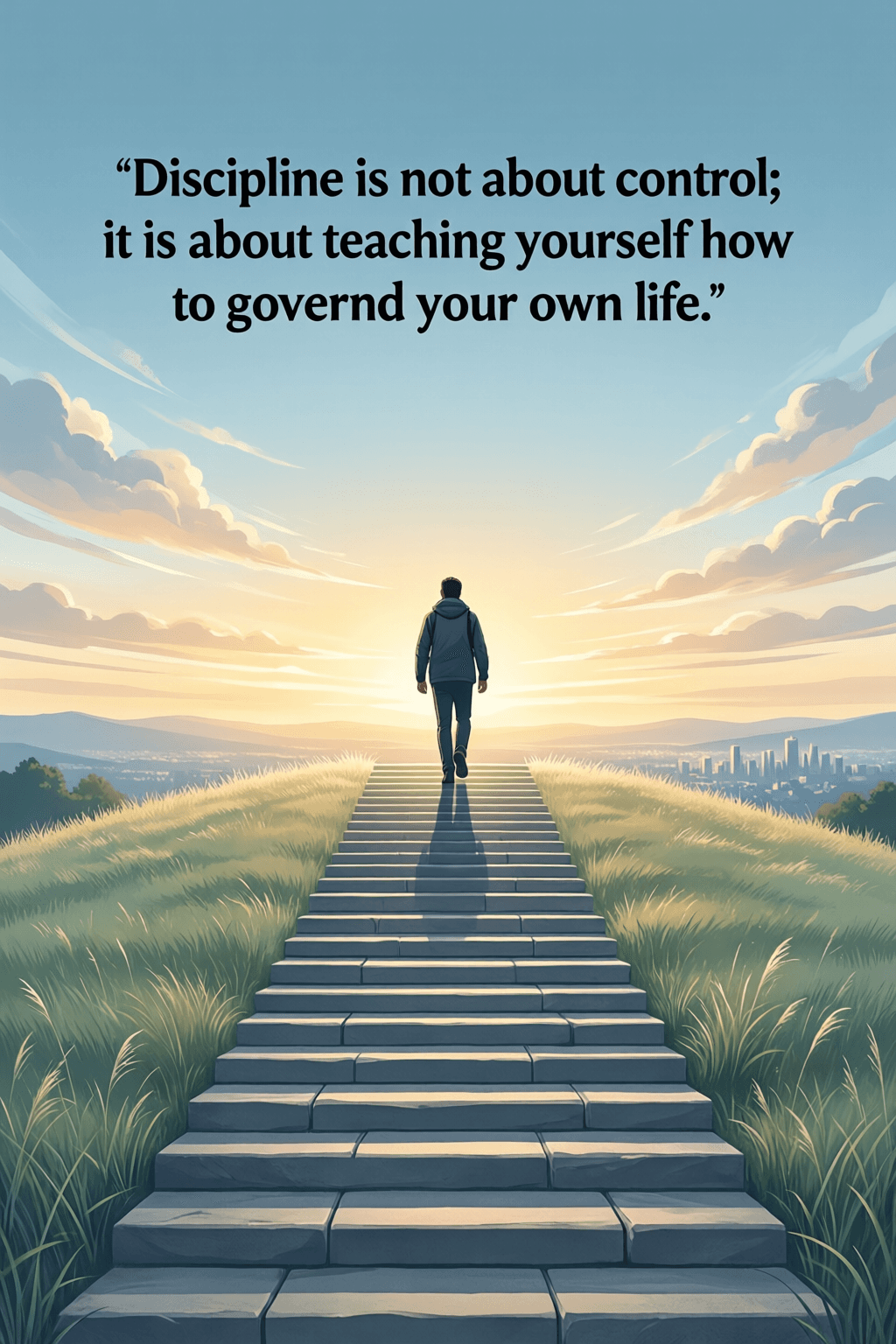
Discipline is not about control; it is about teaching yourself how to govern your own life. — Booker T. Washington
—What lingers after this line?
Beyond Mere Control
At first glance, discipline is often mistaken for external restraint: rules, punishments, and rigid self-denial. Yet Booker T. Washington reframes it as something far more empowering. In his view, discipline is not about suppressing oneself under force, but about learning how to direct one’s own actions with purpose. This shift matters because control imposed from outside can produce obedience, whereas self-government creates character. In that sense, the quote moves the conversation from restriction to responsibility. Rather than asking how tightly a person can hold themselves in check, it asks whether they can choose wisely when no one is watching. Washington’s wording suggests maturity, because governing one’s own life requires judgment, patience, and an inner compass rather than fear of authority.
A Lesson Rooted in Washington’s Life
Seen in context, the quote carries even greater weight because Booker T. Washington’s own life embodied disciplined self-direction. In Up from Slavery (1901), he recounts his rise from enslavement to becoming an educator and founder of Tuskegee Institute, a journey shaped not by ease but by persistent effort. His understanding of discipline was therefore practical: it meant building habits that could transform harsh circumstances into opportunities for growth. As a result, his statement does not sound abstract or moralizing. It reflects lived experience. Washington knew that self-governance could become a path to dignity and advancement, especially for those denied power by society. Thus, discipline emerges not as submission, but as a means of reclaiming agency.
Freedom Through Structure
From there, the quote reveals an apparent paradox: discipline, which many people associate with limitation, is actually a foundation for freedom. A person who cannot govern impulses, time, or priorities is often ruled by distraction, appetite, or circumstance. By contrast, someone who practices discipline gains the ability to act intentionally rather than reactively. This idea echoes Aristotle’s Nicomachean Ethics (c. 350 BC), where virtue is formed through habituated action. In other words, freedom is not simply doing whatever one feels in the moment; it is becoming the kind of person capable of choosing the good consistently. Washington’s insight fits this older tradition, suggesting that structure is not the enemy of liberty but one of its essential conditions.
The Daily Practice of Self-Mastery
Moreover, self-government is rarely achieved through dramatic gestures. More often, it is built in ordinary routines: waking on time, finishing difficult work, keeping one’s word, and resisting short-term comfort for long-term aims. These small acts may seem mundane, yet together they form the architecture of a governed life. Modern psychology supports this gradual view. James Clear’s Atomic Habits (2018), for example, popularized the idea that repeated small behaviors shape identity over time. Washington’s quote anticipates this logic by implying that discipline teaches. It is not an inborn trait possessed by a lucky few, but a skill developed through repetition. Consequently, each deliberate choice becomes both practice and proof of self-rule.
Leadership Begins Within
Furthermore, the quote carries a social dimension. People often think of governance in political or institutional terms, but Washington redirects it inward. Before leading others, one must first learn to lead oneself. This principle appears across traditions: Confucius’s Great Learning links personal cultivation to orderly families and well-governed states, suggesting that broader leadership begins with inner regulation. Therefore, discipline is not merely private self-improvement. It shapes how one shows up in communities, workplaces, and relationships. A person who governs their own life brings steadiness, reliability, and moral clarity to others. Washington’s statement thus broadens discipline from a personal virtue into a civic one, connecting self-mastery with constructive influence.
A Humane View of Growth
Finally, Washington’s wording offers a humane and hopeful understanding of discipline. Because it is framed as teaching yourself, the process allows for learning, correction, and gradual improvement. This is important, since many people abandon discipline when they fail once, treating it as a test of perfection rather than a practice of becoming. By ending on self-government, the quote points toward lifelong development. Governing one’s life does not mean eliminating weakness forever; it means returning, again and again, to intentional choice. In that way, discipline becomes less a harsh regime and more an education in freedom, responsibility, and personal authorship.
Recommended Reading
As an Amazon Associate, we earn from qualifying purchases.
One-minute reflection
What's one small action this suggests?
Related Quotes
6 selectedDiscipline is not about being harsh with yourself; it is about aligning your actions with your purpose. It is a quiet form of freedom. — Ryan Holiday
Ryan Holiday
At first glance, discipline is often mistaken for punishment, deprivation, or relentless self-criticism. Ryan Holiday’s quote overturns that assumption by presenting discipline as a gentler, more intentional force: the p...
Read full interpretation →Discipline is not the art of forcing yourself to move, but the wisdom of knowing when to pause so you can keep going. — Bryan Robinson
Bryan Robinson
At first glance, discipline is often mistaken for relentless pressure—the ability to push through fatigue no matter the cost. Bryan Robinson’s quote challenges that assumption by presenting discipline not as brute force,...
Read full interpretation →Discipline is the highest form of self-love. It is the ability to choose what you want most over what you want right now. — Jim Rohn
Jim Rohn
At first glance, self-love is often associated with kindness, rest, or indulgence, yet Jim Rohn’s quote shifts the meaning in a more demanding direction. He argues that real care for oneself is not merely about feeling g...
Read full interpretation →Self-discipline is a form of freedom. Freedom from the slavery of your own moods. — Nassim Nicholas Taleb
Nassim Nicholas Taleb
Taleb’s line begins by flipping a common assumption: freedom is often imagined as fewer rules, fewer obligations, and maximum spontaneity. Yet he suggests that the more decisive liberty is internal—being able to act acco...
Read full interpretation →Discipline is a choice. It's simply consistently choosing the hard right over the easy wrong. — James C. Collins
James C. Collins
At its core, Collins reframes discipline not as a personality trait but as a repeated act of will. The quote strips away the mystique around self-control and presents it as something practical: each day offers a series o...
Read full interpretation →The discipline of writing something down is the first step toward making it happen. — Lee Iacocca
Lee Iacocca
Lee Iacocca’s remark begins with a simple but powerful observation: ideas remain fragile while they stay in the mind. The moment a goal is written down, however, it gains shape, boundaries, and a sense of seriousness.
Read full interpretation →More From Author
More from Booker T. Washington →Nothing is built in a day, but every small, deliberate action is a stone laid in the foundation of your character. — Booker T. Washington
Booker T. Washington’s statement begins with a simple truth: anything lasting takes time.
Read full interpretation →If you love someone, you will not spare them the discipline they need to become their best self. — Booker T. Washington
At first glance, Booker T. Washington’s statement challenges the comforting idea that love always feels gentle or permissive.
Read full interpretation →You can't hold a man down without staying down with him. — Booker T. Washington
Booker T. Washington’s line turns a physical act—holding someone down—into a moral diagram.
Read full interpretation →There are two ways of exerting one's strength: one is pushing down, the other is pulling up. — Booker T. Washington
Booker T. Washington’s observation draws attention to a simple yet profound truth: the same inner strength can be directed in opposite ways.
Read full interpretation →