
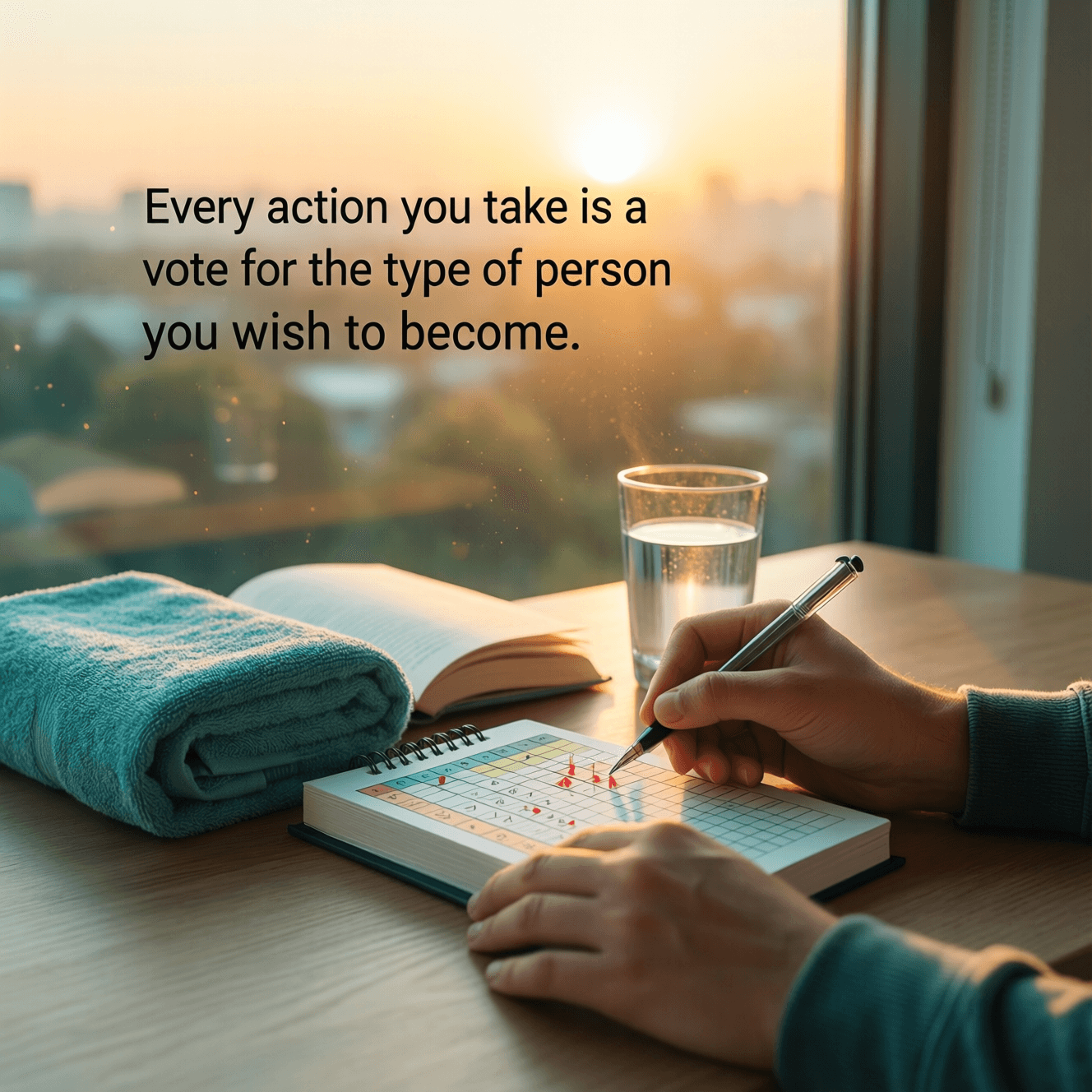
Every action you take is a vote for the type of person you wish to become. — James Clear
—What lingers after this line?
Actions as Identity Choices
James Clear’s line reframes daily behavior as something more consequential than a to-do list: each action is a small ballot cast for the kind of person you are becoming. Instead of focusing only on outcomes—losing weight, writing a book, saving money—the quote pushes attention to identity, the deeper story you repeatedly tell through what you do. From there, the metaphor of “voting” makes change feel both practical and compassionate. You don’t need a flawless record to “win” an identity; you need a pattern. One walk doesn’t make you an athlete, but it does support that candidate, and a string of similar votes gradually turns a self-description into something credible.
Habits as Compounding Evidence
Building on the identity frame, the quote highlights how habits operate like compounding interest: small, repeated choices accumulate into strong evidence about who you are. A single tidy-up is minor, yet repeated, it becomes proof that you are someone who maintains order; a single chapter drafted is small, yet repeated, it becomes proof that you are a writer. This is why Clear’s broader habit philosophy in *Atomic Habits* (2018) emphasizes systems over goals. Goals set direction, but systems supply the repeated votes. Over time, the cumulative effect isn’t just a changed schedule—it’s a changed self-concept that feels earned rather than imagined.
The Power of Tiny, Consistent Wins
Because votes can be small, the quote lowers the barrier to meaningful progress. A five-minute practice session, a glass of water instead of soda, or reading two pages before bed might seem trivial in isolation, yet each is a concrete signal: “This is the person I’m practicing being.” Consider a simple anecdote: someone who wants to become “a runner” starts by putting on running shoes and stepping outside daily, even if they only walk around the block. At first, the physical change is minimal, but the identity vote is clear. As those votes stack, longer runs feel less like a personality mismatch and more like a natural next step.
Recovering from Setbacks Without Shame
The voting metaphor also offers a gentler way to handle failure. A missed workout or an impulsive purchase isn’t a permanent verdict; it’s a single vote for an alternative self. That perspective matters because shame tends to turn mistakes into identity statements—“I’m lazy,” “I’m careless”—which then invites more of the same behavior. Instead, you can return to the ballot box immediately. If identity is shaped by totals rather than isolated moments, then the most important question after a setback becomes, “What does my next vote look like?” In that way, resilience becomes less about willpower and more about quickly restoring the direction of your pattern.
Environment and Social Context as Ballot Designers
Moving from the individual to the surrounding context, it becomes clear that votes are easier or harder to cast depending on what’s around you. If your phone is always within reach, distraction is the default ballot; if fruit is visible on the counter, healthy eating is a simpler vote. Clear’s habit model emphasizes shaping cues, reducing friction, and making desired actions obvious—because the environment quietly proposes choices all day. Social settings matter in the same way. Joining a community where the desired behavior is normal—writers’ groups, gym classes, budgeting circles—turns identity into a shared expectation. You are no longer voting alone; the culture makes certain ballots feel like the obvious option.
Aligning Daily Votes with Long-Term Values
Finally, the quote invites a values check: what kind of person do you actually want to become, beyond external achievements? When actions are treated as votes, you can evaluate them by alignment rather than short-term mood—asking whether today’s choices support qualities like patience, honesty, courage, generosity, or discipline. This is where the idea becomes a practical compass. You don’t need to predict the future to act well in the present; you only need to place a vote consistent with your values. Over months and years, that steady alignment turns aspirations into character, and character into a life that feels intentionally built.
One-minute reflection
What feeling does this quote bring up for you?
Related Quotes
6 selectedEvery action you take is a vote for the type of person you wish to become. — James Clear
James Clear
James Clear’s line reframes behavior as identity-building: each choice is less about a single outcome and more about what it represents. A “vote” doesn’t permanently decide who you are, but it nudges the tally in a direc...
Read full interpretation →Every action you take is a vote for the type of person you wish to become. — James Clear
James Clear
This quote highlights the idea that our daily actions contribute to our ongoing development. Each choice we make reflects our aspirations and the person we are striving to be.
Read full interpretation →If you want to master a habit, you must first master the art of showing up when you least want to. — James Clear
James Clear
At its heart, James Clear’s statement shifts attention away from talent or motivation and toward reliability. A habit is not truly formed when action feels easy; rather, it takes shape when a person follows through despi...
Read full interpretation →You do not need a massive transformation to change your life; you need a tiny, disciplined habit that you refuse to break. — James Clear
James Clear
James Clear’s line challenges a common cultural script: that meaningful change arrives through a dramatic overhaul—new job, new city, new body, new identity. Yet the excitement of a “massive transformation” often fades b...
Read full interpretation →Habits are the compound interest of self-improvement. — James Clear
James Clear
James Clear’s line reframes self-improvement through a financial lens: progress is rarely dramatic in a single moment, but it becomes unmistakable when it accumulates. Just as compound interest turns small deposits into...
Read full interpretation →Measure progress in consistent acts, not sudden epiphanies — James Clear
James Clear
James Clear’s line cautions against a common trap: assuming real change arrives in a dramatic burst of motivation. Epiphanies feel powerful because they are emotional and memorable, but they often fade as soon as ordinar...
Read full interpretation →More From Author
More from James Clear →You cannot fully reset your life without adjusting your environment. — James Clear
James Clear’s observation begins with a simple but often overlooked truth: personal change is rarely just a matter of willpower. Our habits are shaped by the rooms we live in, the people we spend time with, the apps we o...
Read full interpretation →Consistency is the quiet answer to overwhelm. — James Clear
At first glance, James Clear’s line reframes overwhelm not as a dramatic crisis but as a condition that can be softened by steady action. Rather than calling for bursts of motivation, he points to consistency as a quiete...
Read full interpretation →Don't worry about being brilliant; just be consistent. The world is built by people who showed up even when they didn't feel like it. — James Clear
At its core, James Clear’s quote pushes back against the modern obsession with exceptional talent. Rather than glorifying brilliance, it elevates consistency—the humble act of returning to the work again and again.
Read full interpretation →Consistency is the quiet, daily hum of progress that eventually drowns out the noise of doubt and external expectations. — James Clear
At first glance, James Clear’s quote shifts attention away from dramatic breakthroughs and toward something far less glamorous: repetition. By calling consistency a “quiet, daily hum,” he suggests that meaningful progres...
Read full interpretation →