
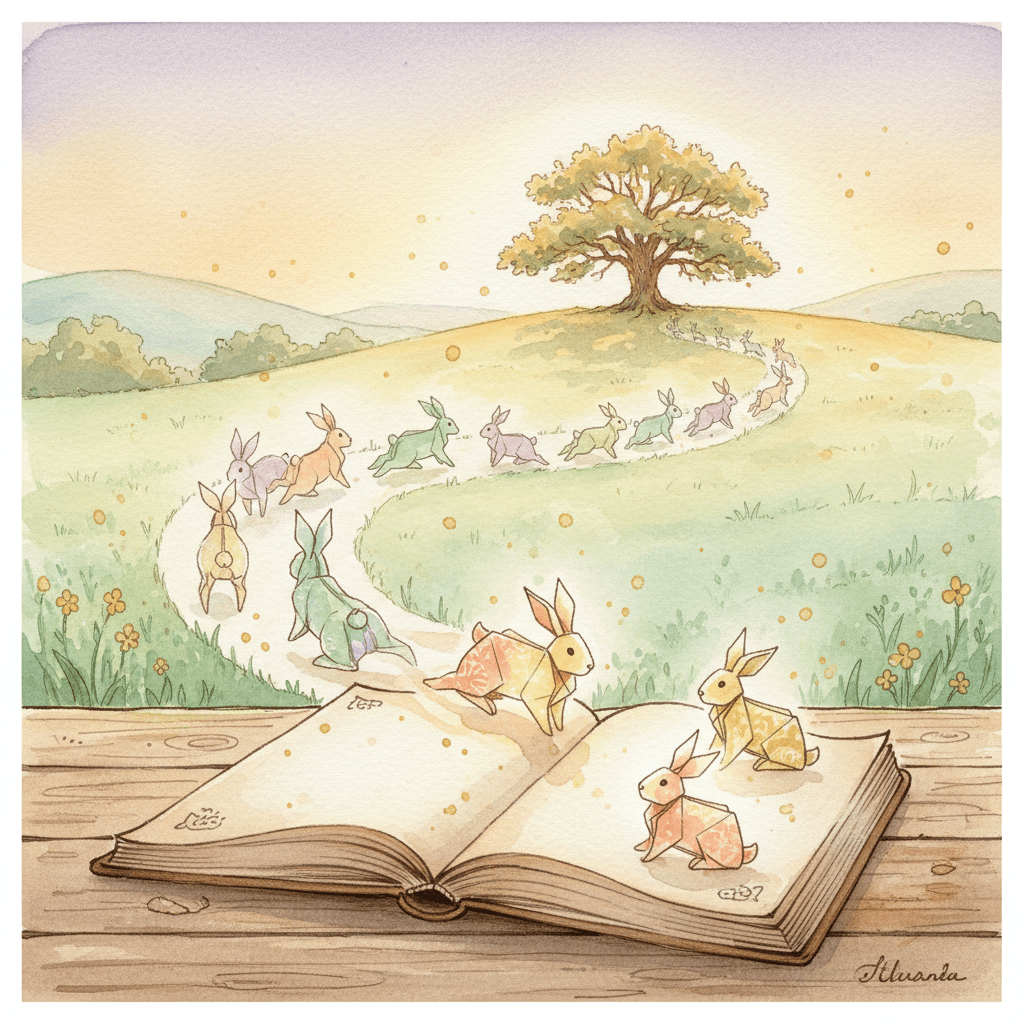
Ideas are like rabbits. You get a couple and learn how to handle them, and pretty soon you have a dozen. — John Steinbeck
—What lingers after this line?
From Pair to Proliferation
Steinbeck’s rabbits capture a truth creatives learn early: ideas reproduce. Once you have a couple and know how to tend them, they start multiplying almost on their own. The metaphor suggests both fecundity and speed; like rabbits, ideas produce litters—unexpected variants and offshoots that fill the mind’s meadow. Yet the punchline isn’t abundance alone; it’s the phrase “learn how to handle them.” Without handling, proliferation devolves into chaos. With it, momentum builds, and the dozen that follows feels less like luck and more like a natural consequence of good care. Thus, the quote frames creativity not as a single lightning strike, but as a living ecosystem that compounds with practice.
Handling: The Craft Behind Creativity
Carrying this forward, handling means building reliable habits for capturing, sorting, and developing sparks. Simple tools—pocket notes, structured notebooks, and scheduled review—turn flashes into seedlings. Darwin’s transmutation notebooks (1837–38) show the method in action: brief observations, questions, and diagrams coalesced into theory through disciplined return and refinement. Similarly, creators who keep a weekly “idea hour” or maintain a kanban of concepts transform inspiration into a pipeline. By lowering the friction between noticing and nurturing, these practices convert the rare event of a single idea into the routine emergence of many. As handling improves, so does fertility.
Combinatorial Breeding of Ideas
Once basic care is in place, multiplication accelerates through combination. New concepts arise when disparate lines crossbreed: a service model meets a novel interface, or a scientific method meets an artistic constraint. Arthur Koestler’s The Act of Creation (1964) called this bisociation—two matrices of thought intersecting to yield surprise. Likewise, Matt Ridley’s The Rational Optimist (2010) describes “ideas having sex,” emphasizing exchange and recombination over solitary genius. In practice, this means deliberately pairing notes, asking “What if X met Y?,” and keeping heterogeneous inputs nearby. The result is not linear addition but geometric growth—litters of hybrids that would not exist in isolation.
Ecologies That Encourage Multiplication
Moreover, environments can be engineered to help ideas breed. Bell Labs famously arranged offices and corridors to increase serendipitous collisions; Jon Gertner’s The Idea Factory (2012) details how proximity catalyzed breakthroughs. In a different domain, Pixar’s Braintrust sessions encourage candid, constructive critique that evolves story fragments into robust narratives (Ed Catmull, Creativity, Inc., 2014). The common thread is structured encounter: regular feedback, low barriers to sharing, and psychological safety. When the habitat rewards cross-pollination and quick iteration, the population grows healthier—not just larger.
The Risk of Overpopulation
Yet as any gardener knows, too many rabbits can strip a field bare. Idea overpopulation consumes attention, the scarcest resource. Herbert Simon warned that “a wealth of information creates a poverty of attention” (1971), and the same is true of ideas. Without curation, momentum fragments into busywork and half-finished projects. The antidote is selective pressure: criteria for what survives, timeboxes for experiments, and exit ramps for the merely interesting. By pruning thoughtfully, you preserve nutrients—time, energy, focus—for the ideas likeliest to thrive.
Cultivating a Sustainable Creative Garden
Consequently, the goal is sustainable fecundity. A practical cadence might include: daily capture, weekly triage, monthly prototypes, and quarterly “kill lists” to retire laggards. Incubate promising but unripe concepts in a dated backlog, then re-evaluate with fresh eyes; many ideas mature off-season. Pair this with collaboration rituals—show-and-tell demos, rotating critique partners—to keep crossbreeding alive. Measured this way, Steinbeck’s dozen becomes a renewable yield: not an accidental swarm, but a stewarded population whose vitality comes from care, combination, and continual selection.
One-minute reflection
Why might this line matter today, not tomorrow?
Related Quotes
6 selectedThe more I paint, the more I like everything. — Pierre-Auguste Renoir
Auguste Renoir
Renoir’s remark suggests that painting is not merely a way of recording the world but a way of learning to love it. As he paints, his attention slows, and ordinary things begin to disclose unexpected richness—light on sk...
Read full interpretation →All the best ideas come out of the process; they come out of the work itself. — Alan Watts
Alan Watts
At its heart, Alan Watts’s statement shifts attention away from waiting for inspiration and toward the act of making. He suggests that strong ideas are rarely fully formed at the beginning; instead, they reveal themselve...
Read full interpretation →Your mind is for having ideas, not holding them. — David Allen
David Allen
David Allen’s line reframes the mind as a generator rather than a warehouse. Instead of using attention to remember every commitment, insight, or worry, he suggests we should use it to create, connect, and decide.
Read full interpretation →Write a brave line each day; someday your chapters will astonish you — Virginia Woolf
Virginia Woolf
Virginia Woolf’s line reads like a gentle instruction and a dare at once: write something brave today, not someday. The emphasis on “each day” shifts artistry away from rare bursts of inspiration and toward a lived pract...
Read full interpretation →Ideation is the key to realization. — N. R. Narayana Murthy
N. R. Narayana Murthy
This quote emphasizes that ideas are fundamental to achieving any goal. Without ideation, the process of forming and developing new ideas, realization of those goals remains unattainable.
Read full interpretation →There’s no shortage of remarkable ideas, what’s missing is the will to execute them. — Seth Godin
Seth Godin
This quote highlights that having great ideas is not enough; success depends on the determination and effort to turn those ideas into reality.
Read full interpretation →More From Author
More from John Steinbeck →There is nothing pleasanter than spading when the ground is soft and damp. — John Steinbeck
At first glance, Steinbeck’s line seems almost modest, yet its pleasure is precise and deeply felt. Spading soft, damp ground turns labor into something nearly sensual: the tool enters easily, the earth yields without re...
Read full interpretation →The work we do with our hands is the best way to keep our hearts from getting restless. — John Steinbeck
At its core, Steinbeck’s line proposes that physical work does more than produce useful things: it calms inner turbulence. By keeping the hands occupied, he suggests, the mind is less likely to drift into anxiety, idlene...
Read full interpretation →The art of resting is a part of the art of working. — John Steinbeck
At first glance, Steinbeck’s remark seems simple, yet it quietly overturns a common assumption: that work and rest are opposites. Instead, he presents them as parts of the same craft.
Read full interpretation →Set your hands to work that honors tomorrow and your feet will find steady ground. — John Steinbeck
Steinbeck’s line ties dignity to direction: “hands” symbolize daily effort, but the effort must “honor tomorrow,” meaning it should be guided by a longer horizon than immediate comfort. Rather than romanticizing busyness...
Read full interpretation →