
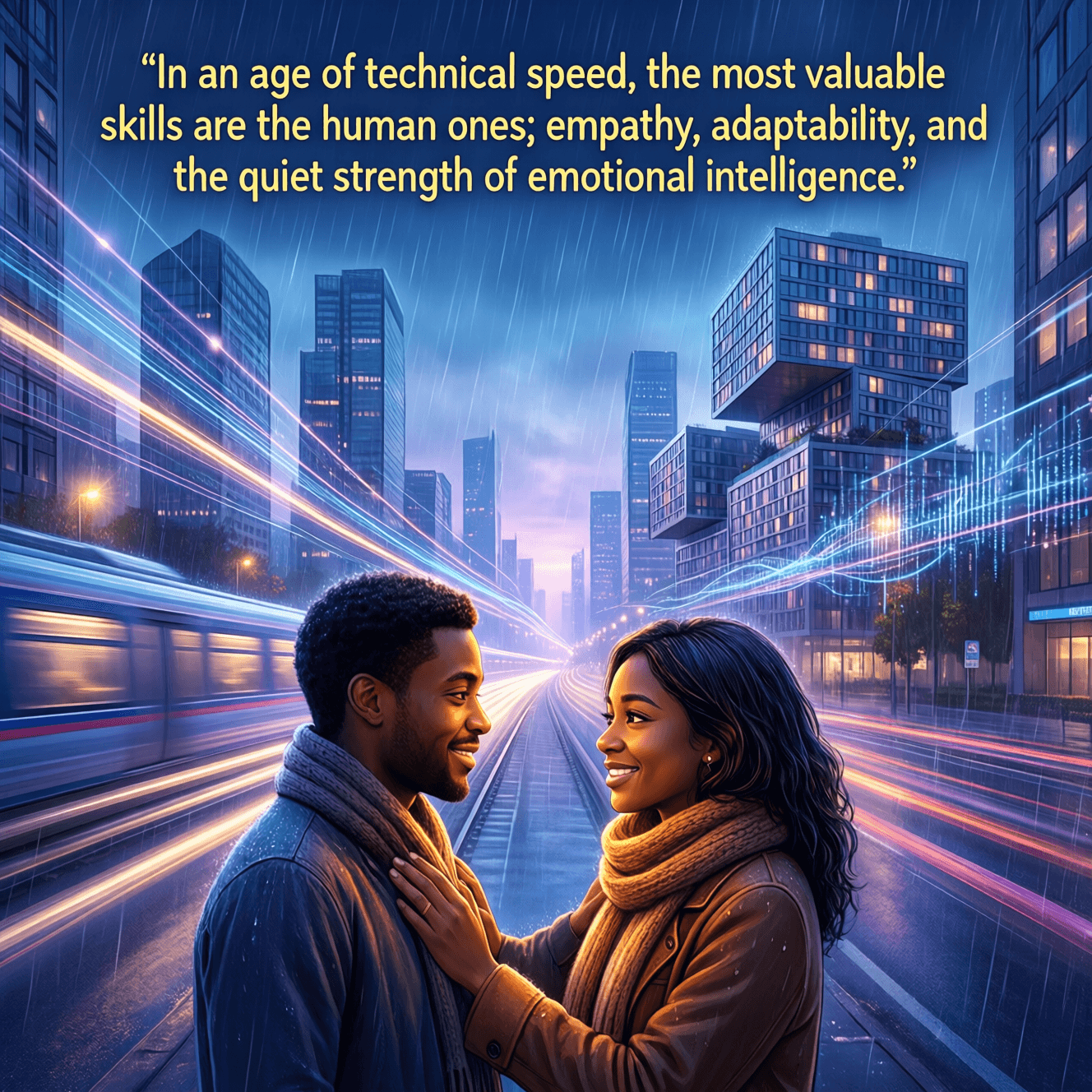
In an age of technical speed, the most valuable skills are the human ones: empathy, adaptability, and the quiet strength of emotional intelligence. — Chamidu Weerasinghe
—What lingers after this line?
Speed as the New Default
Chamidu Weerasinghe’s quote begins with a simple observation: technology accelerates everything—communication, production, decision-making—until speed feels like the natural condition of modern life. Yet as our tools become faster, the surrounding environment grows more complex, and that complexity exposes a gap that raw technical proficiency cannot always fill. As a result, the quote reframes value itself: in a world where many tasks can be automated or optimized, the differentiator shifts from what machines do well to what humans uniquely contribute. The emphasis is not anti-technology, but a reminder that velocity alone doesn’t guarantee clarity, trust, or cohesion.
Empathy as Practical Insight
From that foundation, empathy emerges as more than kindness; it becomes a form of real-time intelligence about other people’s needs, fears, and motivations. When teams move quickly, misunderstandings multiply, and the ability to accurately “read the room” can prevent small frictions from turning into costly conflicts. Consider a product manager under pressure to ship: a purely technical focus may push timelines forward, but empathic listening can reveal that a support team is drowning in customer complaints or that users feel anxious about a change. In this way, empathy functions like an early-warning system—detecting human consequences before they become operational problems.
Adaptability Over Static Expertise
Once we accept that the environment keeps shifting, adaptability becomes the next essential skill. Technical stacks, market expectations, and workplace norms evolve so quickly that expertise can expire, sometimes within a few years or even months. Therefore, the advantage lies in learning agility: the capacity to revise assumptions, update skills, and stay productive during uncertainty. This is not mere flexibility in attitude; it is a disciplined habit of experimentation and feedback. In organizations that iterate rapidly, adaptable people can translate changes into action without becoming paralyzed by ambiguity, helping others move forward without pretending that the future is predictable.
Emotional Intelligence as Quiet Strength
Empathy and adaptability naturally lead into emotional intelligence, which Weerasinghe describes as a “quiet strength.” The phrase matters because emotional intelligence is often invisible when it’s working well: it shows up as steadiness under pressure, an ability to regulate reactions, and a talent for responding instead of snapping back. Daniel Goleman’s Emotional Intelligence (1995) popularized the idea that self-awareness, self-management, social awareness, and relationship skills strongly influence leadership effectiveness. In high-speed settings, emotional intelligence becomes a stabilizer—keeping decisions from being hijacked by stress, ego, or panic, even when deadlines and stakes are escalating.
Why These Skills Gain Value as Automation Rises
The quote’s deeper implication is economic as well as moral: as AI and automation handle more standardized work, human-centered skills become scarcer and thus more valuable. Machines can generate outputs at scale, but they struggle with the subtleties of trust, context, and ethical judgment—especially in situations where values conflict or stakes are personal. Consequently, empathy, adaptability, and emotional intelligence become the connective tissue between powerful tools and real human outcomes. They help translate capability into legitimacy, ensuring that speed serves people rather than overrunning them.
Building a Future That Still Feels Human
Finally, the quote points toward a practical philosophy: the goal is not to outrun change but to grow the human capacities that make change survivable and meaningful. When individuals cultivate empathy, they reduce harm and increase cooperation; when they practice adaptability, they keep learning; and when they develop emotional intelligence, they preserve dignity—both their own and others’—under strain. In this sense, Weerasinghe is offering a guide for modern excellence: let technology handle acceleration, while humans specialize in understanding, resilience, and wise relationship-building. The fastest systems endure best when the people inside them remain deeply, deliberately human.
One-minute reflection
Why might this line matter today, not tomorrow?
Related Quotes
6 selectedEmotional resilience refers to your ability to roll with the punches, adapt to adversity, and bounce back after setbacks. — Bettendorf Counseling Center
Bettendorf Counseling Center
At its core, the Bettendorf Counseling Center’s definition frames emotional resilience as a flexible strength rather than a hard shell. To “roll with the punches” is not to avoid pain or pretend setbacks do not matter; i...
Read full interpretation →The artist is not a solid, static being. The artist is fluid, like water, moving with the tides and changing form. — James McCrae
James McCrae
James McCrae’s image of the artist as fluid immediately challenges the common idea that creative people possess a single, fixed essence. Instead, he suggests that artistry is a process of becoming, not a stable condition...
Read full interpretation →The mind adapts and converts to its own purposes the obstacle to our acting. — Marcus Aurelius
Marcus Aurelius
At its heart, Marcus Aurelius’s line expresses a central Stoic conviction: external events do not fully determine our lives; rather, our judgments about them shape what they become. In his Meditations (c.
Read full interpretation →Adaptability is not imitation. It means power of resistance and assimilation. — Rabindranath Tagore
Rabindranath Tagore
At the heart of Tagore’s statement lies a careful distinction between changing and merely copying. Adaptability, he argues, is not the passive act of becoming like one’s surroundings; rather, it is an active power that a...
Read full interpretation →The capacity to change one's mind in the face of new reality is the highest form of intelligence. — Ursula K. Le Guin
Ursula K. Le Guin
At first glance, Ursula K. Le Guin’s statement shifts intelligence away from raw knowledge and toward responsiveness.
Read full interpretation →Our only security is our ability to change. — John Lilly
John Lilly
At first glance, John Lilly’s statement sounds contradictory: security usually implies stability, while change suggests uncertainty. Yet his insight reverses that assumption by arguing that real safety does not come from...
Read full interpretation →More From Author
More from Chamidu Weerasinghe →