
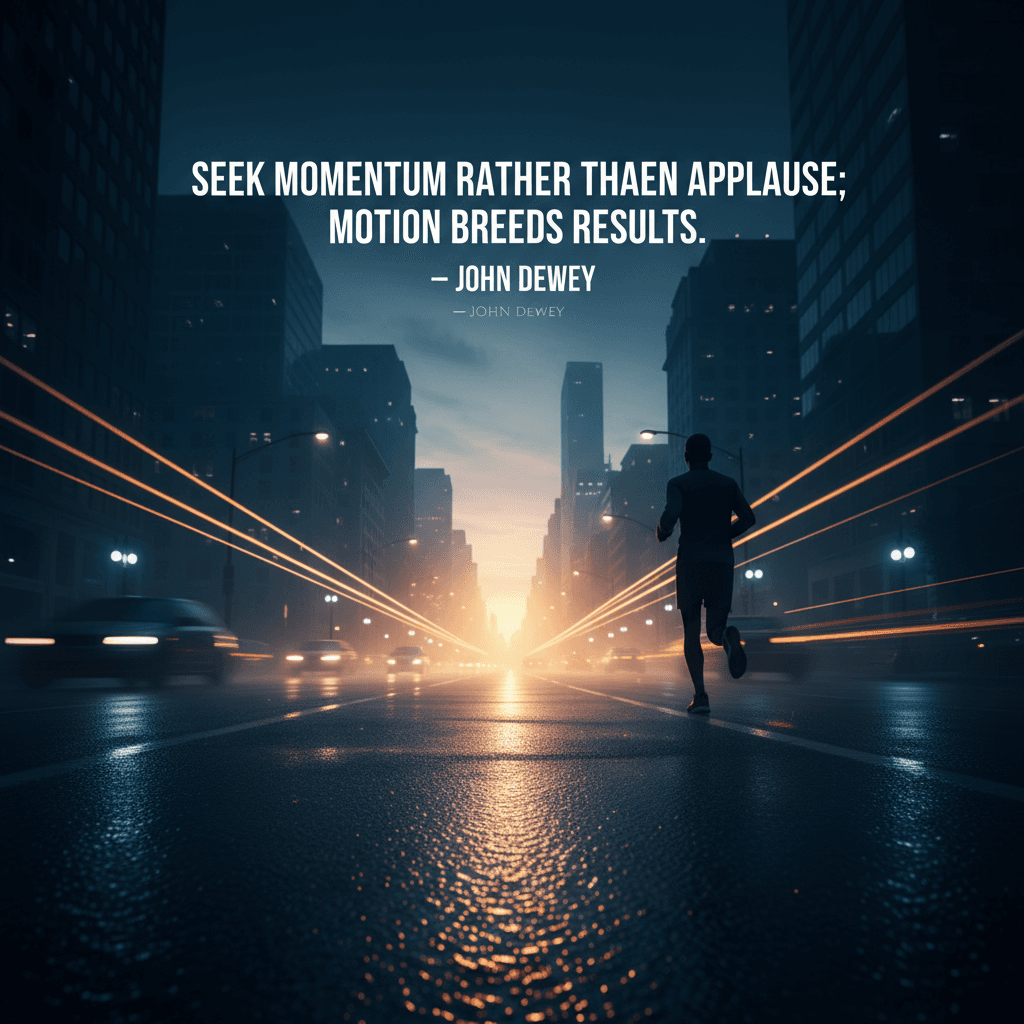
Seek momentum rather than applause; motion breeds results. — John Dewey
—What lingers after this line?
From Applause to Action
Dewey’s injunction prizes the kinetic over the cosmetic: motion, not admiration, produces consequences worth keeping. In the spirit of his pragmatism, value is tested in doing, not in being seen. Democracy and Education (1916) and How We Think (1910/1933) both frame inquiry as a cycle where a problem spurs experimentation, which then refines judgment through consequences. Applause, by contrast, is an external signal that often arrives too early to be informative and too late to be useful. Thus the opening move is a reorientation of attention—from the audience to the activity. When we organize around momentum, we structure work to create continuous, compounding gains. That choice aligns with Dewey’s insistence that ideas earn their worth in practice, where each step produces feedback, and each feedback invites the next step.
Experience as the Engine of Growth
Building on this, Dewey’s learning by doing contrasts passive reception with active engagement. In The School and Society (1899), he argues that the laboratory of experience, not the lecture, develops competence. Experience and Nature (1925) extends the point: knowing emerges as we transact with the world, adjusting our habits when reality resists. This experiential loop—do, reflect, revise, do—creates momentum because each iteration lowers uncertainty. Rather than staging for approval, the learner builds skill by encountering consequences at close range. The more swiftly we translate reflection into a new trial, the more robust our understanding becomes. In this way, motion is not frantic activity; it is structured experimentation that converts ambiguity into knowledge.
The Psychology of Momentum
Extending the argument, research shows that small forward steps amplify motivation. Teresa Amabile and Steven Kramer’s The Progress Principle (2011) documents how even modest daily wins boost engagement and creativity. Karl Weick’s Small Wins (1984) similarly demonstrates that breaking daunting aims into solvable units generates a cascade of achievable actions, building confidence and velocity. Psychologically, progress narrows the gap between effort and feedback, rewarding the brain with cues that effort matters. As wins accumulate, perceived self-efficacy rises, which further increases effort—a virtuous cycle of motion begetting motion. By contrast, applause is intermittent and decoupled from learning, making it a poor regulator of behavior. In short, to keep going, we need evidence of going somewhere, and the surest maker of such evidence is steady, visible progress.
Systems That Reward Motion
In practice, organizations operationalize Dewey’s insight through feedback-rich systems. W. Edwards Deming’s PDSA cycle (Plan–Do–Study–Act) institutionalizes learning loops so that each run informs the next. The Toyota Production System’s kaizen habit (Imai, 1986) favors small-batch flow and rapid problem surfacing, minimizing the distance between action and correction. Agile methods embody the same logic via short sprints, demos, and retrospectives. These designs privilege leading indicators—cycle time, defect discovery rate, iteration cadence—over vanity metrics of popularity. As with Dewey’s inquiry, the point is not to impress observers but to tighten the linkage between hypothesis and outcome. When the system rewards movement with insight, teams naturally select actions that compound, and applause becomes a byproduct rather than a target.
A Historical Illustration: The Wright Brothers
Consider the Wright brothers, whose breakthrough owed more to methodical motion than to public acclaim. Between 1901 and 1903 they ran hundreds of wind-tunnel tests, iteratively refining airfoil designs and control surfaces while recording lift and drag data with homemade instruments. David McCullough’s The Wright Brothers (2015) chronicles how each glide at Kitty Hawk fed the next hypothesis. Their focus on measurable progress—angles, thrust, lift coefficients—created an unstoppable learning curve. Public applause came only after sustained, disciplined iteration. In Deweyan terms, the brothers let consequences teach them, treating each failure as a data-bearing event. Momentum, once established, made success appear sudden; in reality, it was the visible tip of an invisible accumulation.
Avoiding the Applause Trap
Yet chasing applause can distort incentives. Goodhart’s Law (1975) warns that when a measure becomes a target, it ceases to be a good measure. Public approval often rewards spectacle, not substance, tempting teams to optimize for clicks, awards, or headlines. Eric Ries’s The Lean Startup (2011) names these vanity metrics—numbers that rise without improving the engine of learning. To stay aligned with results, organizations can neutralize applause by privileging testable hypotheses and actionable metrics. When success criteria are tied to behavior and outcomes—retention, error rates, time to insight—performative work loses oxygen. In this way, we preserve morale without sacrificing momentum, keeping attention on signals that genuinely predict improvement.
Practical Ways to Build Momentum
Finally, momentum is cultivated through design. Start with the smallest viable action that proves a behavior, then string actions into streaks and streaks into capabilities. Time-box work to create urgency, and close loops quickly with user tests or pilots. Track leading indicators—iteration count per week, turnaround time—so feedback arrives before motivation fades. James Clear’s Atomic Habits (2018) emphasizes environment design: reduce friction for the next step, not the next milestone. Crucially, schedule reflection as part of motion: brief retros move learning from tacit to explicit, enabling the next adjustment. With this cadence—act, learn, adjust—applause becomes incidental. Results emerge not from grand gestures but from a steady architecture of progress.
One-minute reflection
What's one small action this suggests?
Related Quotes
6 selectedAction generates momentum. Start with five minutes and simply begin. — Dominic Alvernaz
Dominic Alvernaz
Dominic Alvernaz’s quote centers on a deceptively simple truth: action often comes before motivation, not after it. By urging us to begin with just five minutes, he lowers the emotional and mental barrier that makes diff...
Read full interpretation →Turn hesitation into rehearsal, and action will follow. — Simone de Beauvoir
Simone de Beauvoir
Simone de Beauvoir’s line reframes hesitation not as failure, but as raw material. Instead of treating uncertainty like a wall, she implies it can be treated like a doorway—an early stage of becoming capable.
Read full interpretation →Turn small courage into steady motion, and mountains will learn your name — Rumi
Rumi
Rumi starts by shrinking courage down to size, as if to insist that bravery doesn’t need to arrive as a dramatic surge. “Small courage” implies the first honest admission—trying again, speaking once, beginning once—befor...
Read full interpretation →Breathe, decide, and move — momentum begins the moment you commit. — John Steinbeck
John Steinbeck
Steinbeck’s line treats momentum not as something you find, but something you generate. The key phrase is “the moment you commit,” which reframes progress as an internal decision rather than an external condition.
Read full interpretation →Turn hesitation into a single deliberate step, and mountains start to look like stones. — Haruki Murakami
Haruki Murakami
Murakami’s line hinges on a simple conversion: hesitation becomes action. Hesitation is not just waiting; it is often a form of self-protection that keeps desire and risk safely separated.
Read full interpretation →Begin with what you can finish today; completion is the wick that lights the next flame. — C. S. Lewis
C.S. Lewis
C. S.
Read full interpretation →More From Author
More from John Dewey →The more I read, the more I meditate, and the more I acquire, the more I am enabled to continue to think and reflect. — John Dewey
John Dewey expresses that learning becomes a virtuous cycle. The more knowledge one gains through reading and reflection, the more one’s capacity for continued thinking, analyzing, and learning increases.
Read full interpretation →Acting on a belief often leads to discovery. — John Dewey
This quote emphasizes that taking action based on one's beliefs can lead to new understanding or knowledge. Learning often comes not from theory alone, but from real-world experiences and activities.
Read full interpretation →Consider the rights of others before your own feelings, and the feelings of others before your own rights. — John Dewey
This quote highlights the importance of empathy in our interactions with others. Dewey suggests that prioritizing the rights and feelings of others fosters moral responsibility and strengthens social harmony.
Read full interpretation →To know what you can now do, is to know what you should do. — John Dewey
This quote suggests that understanding our capabilities comes with a sense of responsibility. Once we recognize what we are capable of, we should take action accordingly.
Read full interpretation →