
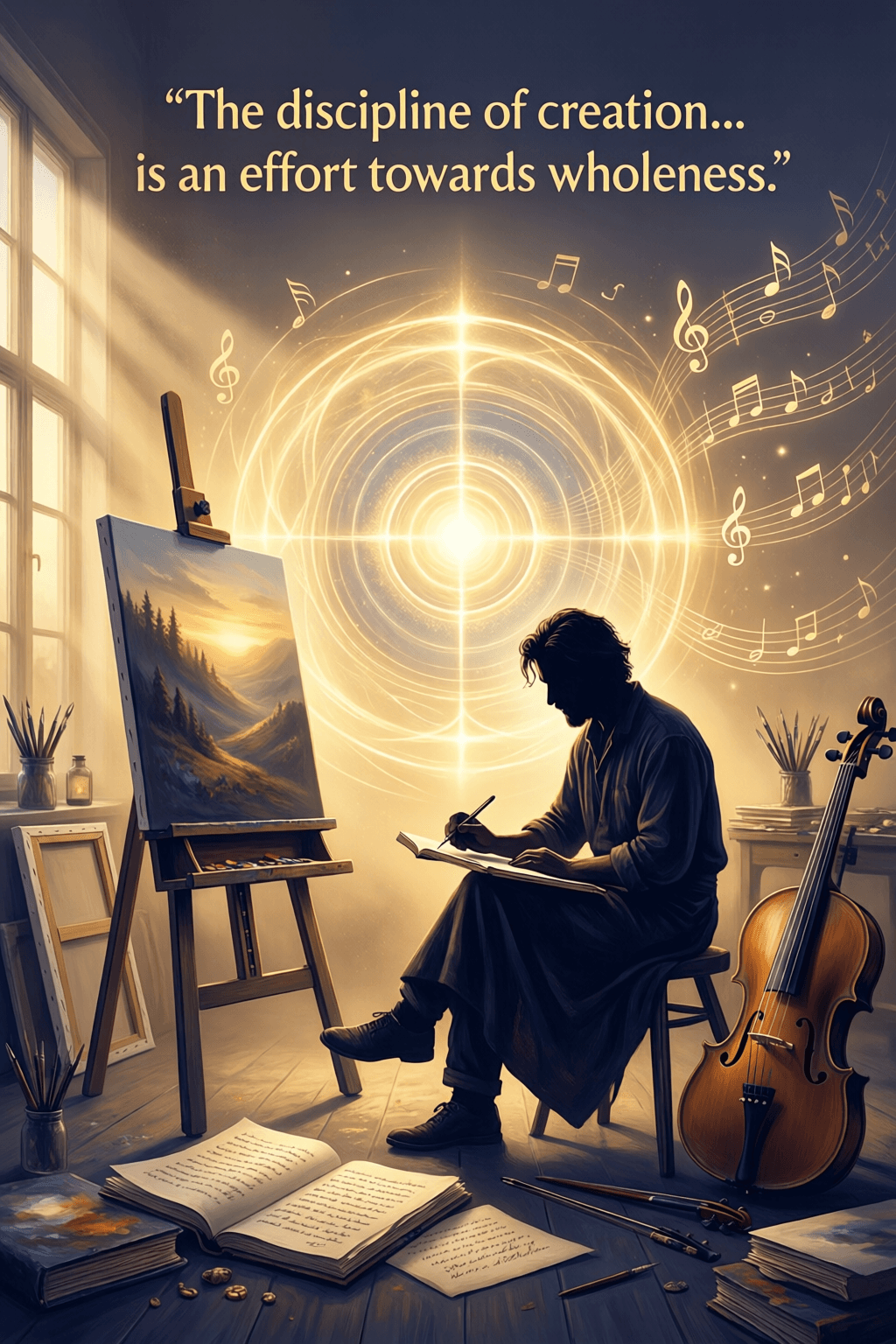
The discipline of creation, be it to paint, compose, write, is an effort towards wholeness. — Madeleine L'Engle
—What lingers after this line?
Art as a Unifying Practice
Madeleine L'Engle’s insight frames creation not as mere self-expression but as a disciplined movement toward inner completeness. To paint, compose, or write is to gather scattered thoughts, emotions, and experiences into form. In that sense, creativity becomes an act of integration: the artist does not simply make an object, but gradually makes a more coherent self. From this starting point, her choice of the word “discipline” matters. It suggests that wholeness rarely arrives in a burst of inspiration alone; rather, it is pursued through repetition, patience, and attention. What emerges, then, is a vision of art as both practice and pilgrimage.
Why Discipline Matters
Seen this way, discipline is not the enemy of imagination but its structure. A composer returning daily to unfinished measures or a writer revising a stubborn paragraph learns that freedom often depends on form. Igor Stravinsky argued in his Poetics of Music (1942) that limitation can sharpen invention, and L'Engle’s statement follows a similar logic: the creative life becomes whole through committed labor. Moreover, discipline steadies the artist against fragmentation. In a distracted world, the regular act of making asks a person to remain present long enough for insight to deepen. Thus, the routine itself becomes restorative, binding intention to action.
Creation Against Inner Fragmentation
L'Engle’s remark also implies that human beings often begin from a state of incompleteness. We carry conflicting desires, private wounds, and half-formed perceptions that resist easy understanding. Through creation, however, these fragments can be arranged into pattern. A poem may give shape to grief; a painting may reconcile memory and perception; a piece of music may hold tensions that ordinary speech cannot resolve. In this respect, art resembles a healing process. Carl Jung’s reflections in Modern Man in Search of a Soul (1933) often describe symbol-making as part of psychic integration. Likewise, L'Engle suggests that creative discipline helps the person become less divided and more fully present to life.
The Spiritual Dimension of Making
As the idea develops, L'Engle’s language of wholeness opens into something spiritual as well as psychological. Her own writing frequently joined artistic work with faith, implying that creation can align the self with a deeper order. To make something carefully is to participate in meaning rather than chaos, as though art were a response to the brokenness of the world. This perspective has deep roots. Plato’s Timaeus (c. 360 BC) imagines creation itself as the bringing of order out of disorder, and later Christian thinkers often treated human artistry as an echo of divine making. Accordingly, L'Engle’s sentence can be read as a quiet theology of art: disciplined creation restores connection between the inner life and a larger reality.
Wholeness Is Never Instant
Yet L'Engle does not promise that wholeness is easily won. Because creation is an “effort,” the process is ongoing, imperfect, and sometimes painful. Drafts fail, melodies collapse, and canvases resist intention. Still, these struggles are not incidental; they are part of the very path by which the self is refined. The artist becomes whole not by avoiding difficulty but by working through it. Consequently, unfinished work has its own dignity. Rainer Maria Rilke’s Letters to a Young Poet (1903–1908) repeatedly urges patience with uncertainty, and that patience fits L'Engle’s vision well. Wholeness is less a final possession than a continuing practice of becoming.
A Broader Lesson for Any Life
Finally, the quotation extends beyond professional artists. Anyone who cooks thoughtfully, gardens attentively, or builds a meaningful life can recognize this movement toward wholeness. Creation, in the broadest sense, asks a person to bring care, order, and imagination to what is incomplete. The result is not perfection but greater coherence between what one feels, believes, and does. Therefore, L'Engle offers more than a comment on art; she offers a philosophy of living. By treating creation as disciplined effort, she reminds us that making something beautiful or true can also make us more fully ourselves.
One-minute reflection
What feeling does this quote bring up for you?
Related Quotes
6 selectedHealing is not the absence of pain—it's a steady return to wholeness despite it. — Mark Nepo
Mark Nepo
Mark Nepo’s reflection begins by challenging a common assumption: that healing means pain has disappeared. Instead, he suggests that pain may remain present while healing is still underway.
Read full interpretation →Healing is the return of the memory of wholeness. — Deepak Chopra
Deepak Chopra
At first glance, Deepak Chopra’s line reframes healing as something larger than the disappearance of pain or illness. To call healing “the return of the memory of wholeness” suggests that wellness is not newly manufactur...
Read full interpretation →She could never go back and make some of the details pretty. All she could do was move forward and make the whole beautiful. — Terri St. Cloud
Terri St. Cloud
At its heart, Terri St. Cloud’s line begins with a hard truth: some parts of life cannot be revised.
Read full interpretation →I'm not interested in being a 'perfect' person. I am interested in being a whole person. — Haruki Murakami
Haruki Murakami
Murakami’s distinction begins by exposing how “perfect” often means polished, acceptable, and free of visible flaws. That standard is typically external—set by culture, family expectations, or the quiet pressure to appea...
Read full interpretation →I write when I'm inspired, and I see to it that I'm inspired at nine o'clock every morning. — Peter De Vries
Peter De Vries
Peter De Vries frames his line as a wry paradox: he writes “when” inspiration strikes, yet he also schedules it for nine every morning. The humor lands because it punctures the romantic myth that good work depends on unp...
Read full interpretation →Begin each day by matching imagination with disciplined action. — Sun Tzu
Sun Tzu
To begin, the maxim urges a morning pact between vision and execution. Imagination sets direction—what could be—while discipline choreographs the first steps—what must be done now.
Read full interpretation →More From Author
More from Madeleine L’Engle →Inspiration usually comes during work, rather than before it. — Madeleine L'Engle
This quote highlights the idea that creativity often arises through active engagement in a task. Inspiration is not something you wait for passively but something that emerges as you take action.
Read full interpretation →Without departure, there is no arrival. — Madeleine L’Engle
Madeleine L’Engle’s quote spotlights the idea that to reach any destination—literal or metaphorical—one must first leave something behind. This seemingly simple truth forms the backbone of personal and collective growth.
Read full interpretation →Without departure, there is no arrival. — Madeleine L’Engle
Madeleine L’Engle’s succinct observation highlights an essential truth of life: every meaningful arrival is preceded by leaving something behind. This principle applies not only to physical journeys but also to emotional...
Read full interpretation →