
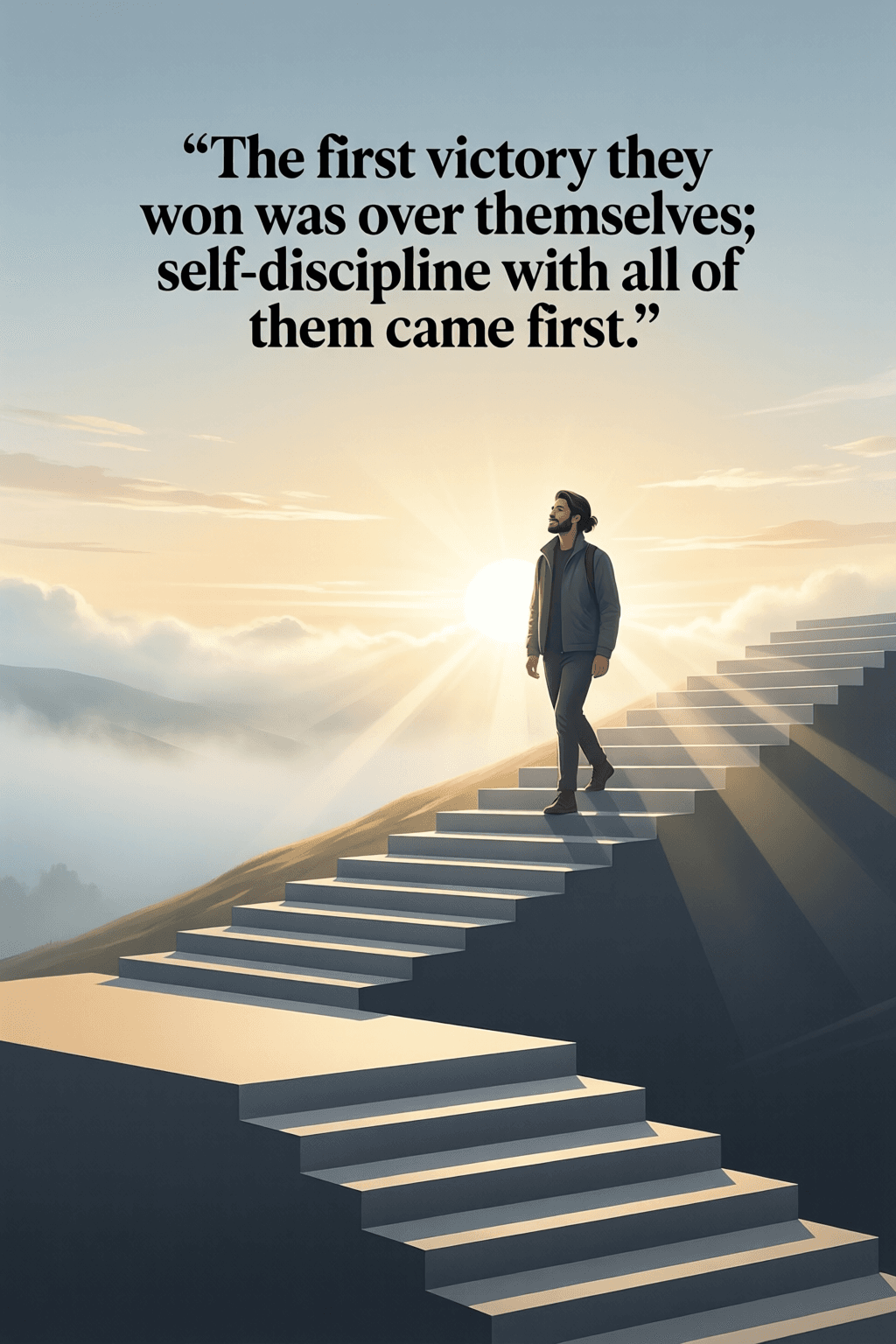
The first victory they won was over themselves; self-discipline with all of them came first. — Harry S. Truman
—What lingers after this line?
The Meaning of an Inner Triumph
Harry S. Truman’s statement begins with a striking reversal of how victory is often imagined. Instead of praising conquest over rivals, he points to the harder and more foundational achievement: mastering oneself. In this view, the first real battle is internal, fought against impulse, laziness, fear, and distraction long before any public success becomes visible. This idea matters because it reframes greatness as a matter of character rather than circumstance. Truman suggests that the people we admire did not begin with spectacular wins; rather, they began by forming habits of restraint and purpose. As a result, outward accomplishment appears not as luck or talent alone, but as the natural extension of inward order.
Why Self-Discipline Comes Before Success
From there, the quote explains why self-discipline must come first: without it, ambition remains unstable. A person may possess intelligence, resources, or opportunity, yet still fail if they cannot direct their own behavior consistently. Self-discipline turns scattered desire into sustained effort, allowing goals to survive boredom, setbacks, and temptation. In practical terms, this is why so many biographies of accomplished figures emphasize routine. Benjamin Franklin’s daily schedules and moral accounting, recorded in his autobiography (1791), show that disciplined repetition often matters more than dramatic inspiration. Truman’s insight therefore rests on a simple truth: before one can lead events, one must first learn to lead oneself.
Historical Models of Self-Mastery
Seen in a wider historical light, Truman’s remark echoes ancient moral philosophy. Aristotle’s Nicomachean Ethics (4th century BC) argues that virtue is built through habituation; people become disciplined by repeatedly choosing the good until it becomes part of their character. Likewise, the Stoic philosopher Epictetus taught in the Discourses (2nd century AD) that freedom begins when one governs one’s own mind rather than being ruled by appetite or circumstance. These traditions help clarify Truman’s wording. To win over oneself is not to suppress personality, but to align action with principle. Thus, self-discipline appears not as punishment, but as liberation—the condition that makes integrity, courage, and perseverance possible.
The Quiet Battle Behind Achievement
Moreover, Truman’s quote draws attention to the invisible labor behind visible excellence. Public victories—whether in politics, science, athletics, or art—are usually preceded by private acts of discipline that no audience sees. The athlete rises early, the writer revises again, and the leader holds back anger when rashness would be easier. In each case, the decisive contest occurs in ordinary moments. A useful illustration appears in the life of Abraham Lincoln, whose letters and presidential conduct during the Civil War reveal remarkable restraint under immense pressure; Doris Kearns Goodwin’s Team of Rivals (2005) highlights how Lincoln repeatedly governed his temper for the sake of larger ends. In that sense, self-discipline is not glamorous, yet it is often the hidden architecture of achievement.
A Lesson for Everyday Character
Finally, the quote endures because it applies not only to famous individuals but to anyone trying to live well. Most people will never command armies or hold high office, yet everyone faces the daily challenge of choosing patience over irritation, duty over delay, and principle over convenience. Truman’s words suggest that these small decisions are not minor at all; they are the earliest forms of victory. Consequently, self-discipline becomes a democratic virtue, available to anyone willing to practice it. It is built in repeated choices: keeping one’s word, finishing difficult work, and remaining steady when emotions surge. By placing this inner conquest first, Truman offers a demanding but hopeful message: lasting success begins where no applause is heard, in the disciplined governance of the self.
One-minute reflection
What does this quote ask you to notice today?
Related Quotes
6 selectedThe more self-discipline you have, the more you do the things you should do, the happier your future self will be. — Maxime Lagacé
Maxime Lagace
Maxime Lagacé’s quote frames self-discipline not as punishment, but as a quiet act of generosity toward the person we are becoming. Each difficult choice—saving money, exercising, studying, apologizing, or resting on tim...
Read full interpretation →The discipline of desire is the backbone of character. — Will Durant
Will Durant
At first glance, Will Durant’s line suggests that character is not built by suppressing desire, but by governing it. Desire is the engine of human action: it pushes us toward pleasure, ambition, recognition, and comfort.
Read full interpretation →Discipline is a choice. It's simply consistently choosing the hard right over the easy wrong. — James C. Collins
James C. Collins
At its core, Collins reframes discipline not as a personality trait but as a repeated act of will. The quote strips away the mystique around self-control and presents it as something practical: each day offers a series o...
Read full interpretation →The discipline of writing something down is the first step toward making it happen. — Lee Iacocca
Lee Iacocca
Lee Iacocca’s remark begins with a simple but powerful observation: ideas remain fragile while they stay in the mind. The moment a goal is written down, however, it gains shape, boundaries, and a sense of seriousness.
Read full interpretation →How much time he gains who does not look to see what his neighbour says or does or thinks, but only at what he does himself, to make it just and holy. — Marcus Aurelius
Marcus Aurelius
Marcus Aurelius argues that a great deal of life is wasted in watching other people—what they say, what they do, and even what they might be thinking. Instead, he recommends a disciplined inward turn: focus on your own c...
Read full interpretation →It is easier to discipline yourself now than to regret your lack of discipline later. — Jim Rohn
Jim Rohn
Jim Rohn’s saying turns discipline into a simple comparison of costs. On one side is the discomfort of acting now: waking up early, saving money, studying longer, or saying no to distraction.
Read full interpretation →More From Author
More from Harry S. Truman →