
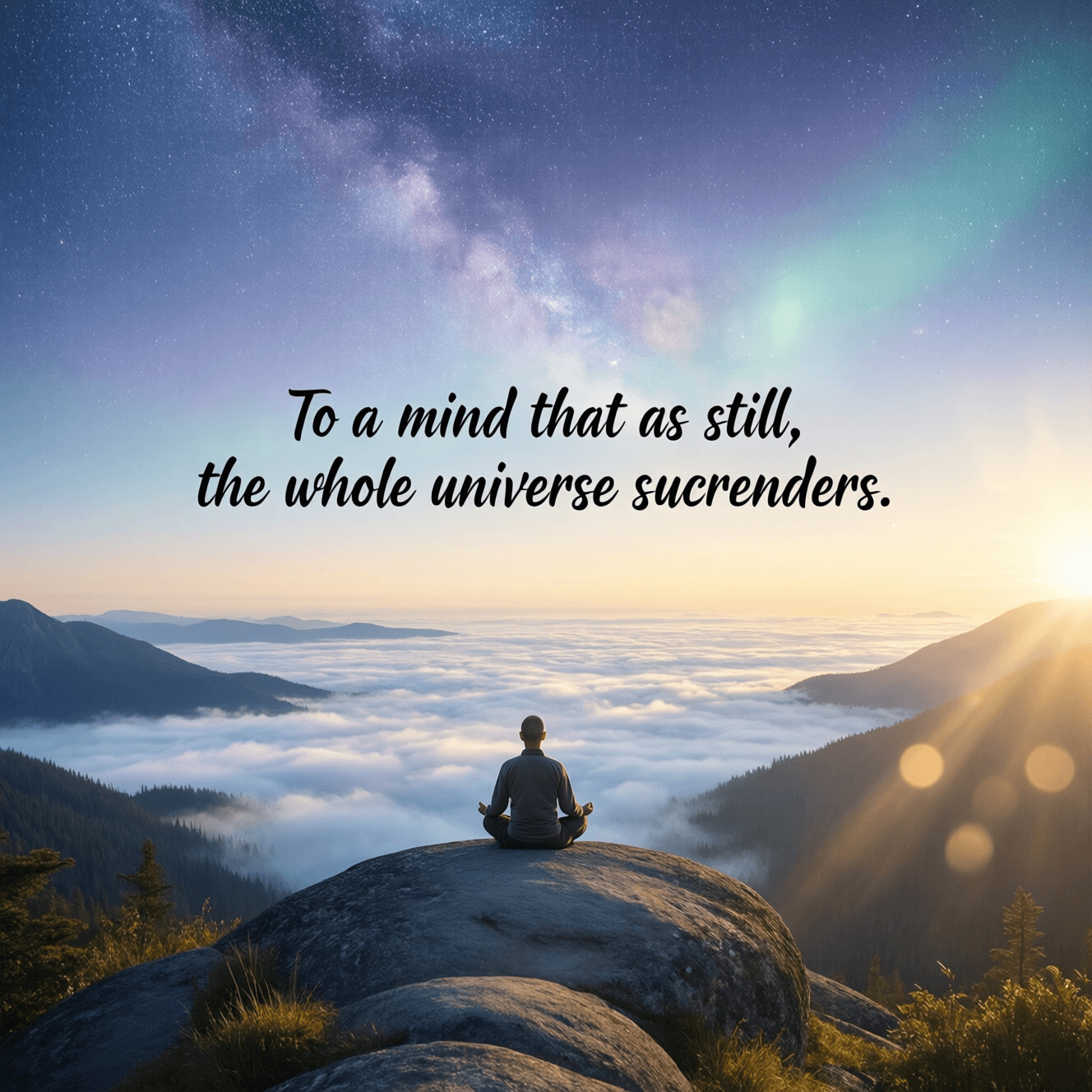
To a mind that is still, the whole universe surrenders. — Lao Tzu
—What lingers after this line?
A Quiet Power in Lao Tzu’s Claim
Lao Tzu’s line suggests that mastery does not begin with force, argument, or speed, but with inner stillness. When the mind stops chasing every thought and reaction, experience becomes clearer, as if the world itself is no longer obscured by mental noise. From this starting point, “the universe surrenders” reads less like magical control and more like receptive understanding: reality becomes easier to meet, interpret, and respond to when we aren’t constantly fighting it. Stillness, in other words, is presented as a form of alignment rather than domination.
Taoist Non-Striving and the Flow of Things
Building on that, the quote aligns with the Taoist preference for wu wei—often translated as “non-action” or “effortless action.” In the Tao Te Ching (attributed to Lao Tzu, c. 4th century BC), wisdom repeatedly appears as yielding, patient, and unforced, like water shaping stone over time. Seen through this lens, stillness is not passivity; it is a refusal to thrash against the current. When the mind becomes quiet, one can sense the natural contours of a situation and act with fewer missteps. The “surrender” of the universe can then mean that life becomes less resistant because we stop colliding with it.
Perception Changes When Thought Settles
Next, the statement points to a practical shift in perception: mental agitation distorts what we notice and how we interpret it. A restless mind selects evidence to confirm its fears or desires, while a calmer mind can take in more of what is actually present. Consider a common anecdote: during an argument, people often “know” what the other person means before they finish speaking, and they respond to assumptions rather than words. When the mind is still enough to listen without rehearsing a counterattack, the conversation changes—almost as if the situation itself has softened. What surrendered was not the other person’s will, but our compulsive framing.
Stillness as Emotional Regulation and Freedom
From perception, it’s a natural step to emotion. Stillness helps loosen the grip of impulsive reactions—anger, envy, panic—so that feelings can be experienced without immediately becoming commands. Modern psychological approaches often emphasize this gap between stimulus and response; Viktor Frankl’s Man’s Search for Meaning (1946) famously argues that in that space lies human freedom. In that light, the universe “surrenders” because circumstances lose some of their power to dictate our inner state. We may not control events, but we can reduce how violently the mind is thrown by them, and that stability changes what choices remain available.
The Paradox: Less Control, More Influence
Then comes the paradox at the heart of the quote: seeking control directly often produces rigidity and conflict, while letting the mind become still can increase real influence. Leaders, parents, and negotiators often discover that the calmest person in the room sets the emotional temperature; composure becomes a quiet authority. This echoes older philosophical themes as well. In Plato’s Republic (c. 375 BC), the rational, ordered soul is portrayed as better able to govern life than the soul dragged around by appetite and agitation. Lao Tzu pushes the idea further: by not forcing, we become capable of the most fitting kind of action.
Practicing the Still Mind in Daily Life
Finally, the quote invites practice rather than mere admiration. Stillness can be cultivated through meditation, slow breathing, walking without headphones, or simply pausing before replying—small disciplines that train attention to settle. The point is not to eliminate thought but to stop being owned by it. As this becomes habitual, the “universe” begins to look different: problems become more workable, relationships less reactive, and uncertainty less threatening. What surrenders is the sense of constant opposition between self and world, replaced by a clearer, steadier participation in whatever is happening.
One-minute reflection
What feeling does this quote bring up for you?
Related Quotes
6 selectedTo the mind that is still, the whole universe surrenders. — Lao Tzu
Lao Tzu
Lao Tzu’s line suggests an inversion of the usual struggle for control: rather than conquering life through force or constant effort, a quiet mind somehow makes life feel cooperative. When inner turbulence settles, event...
Read full interpretation →To a mind that is still, the whole universe surrenders. — Lao Tzu
Lao Tzu
Lao Tzu’s line suggests that real influence begins not with force, but with composure. A “mind that is still” is not passive; it is undisturbed by cravings, fears, or the need to win, and that steadiness becomes a kind o...
Read full interpretation →To the mind that is still, the whole universe surrenders. - Laozi
Lao Tzu
This quote highlights the power of inner peace and tranquility. When the mind is calm and free from distractions, one can perceive the true essence of the world around them.
Read full interpretation →To the mind that is still, the whole universe surrenders. - Lao Tzu
Lao Tzu
This quote emphasizes the power and importance of achieving inner peace and stillness of mind. When the mind is calm and clear, one can perceive the world more profoundly.
Read full interpretation →To the mind that is still, the whole universe surrenders. - Lao Tzu
Lao Tzu
This quote implies that attaining inner peace and mental stillness allows one to become more attuned to the world around them. When the mind is calm, it can perceive the universe in a more profound and harmonious way.
Read full interpretation →To the mind that is still, the whole universe surrenders. - Lao Tzu
Lao Tzu
This quote suggests that achieving a state of inner peace and stillness of mind allows one to become more attuned and in harmony with the universe. When the mind is calm, it can perceive the world more clearly and profou...
Read full interpretation →More From Author
More from Lao Tzu →Do you have the patience to wait until your mud settles and the water is clear? — Lao Tzu
Lao Tzu’s question frames patience not as passive delay but as an active kind of wisdom. The image of muddy water settling on its own suggests that confusion often clears not through force, but through restraint.
Read full interpretation →Anything that is living must have a rest. If it does not rest, it will lose its strength. — Lao Tzu
Lao Tzu’s insight begins with a simple observation: all living things move in cycles, not in endless exertion. By saying that anything alive must rest, he frames rest not as laziness but as a biological and spiritual nec...
Read full interpretation →Yield and overcome, bend and be straight. — Lao Tzu
At first glance, Lao Tzu’s line seems contradictory: how can yielding lead to overcoming, or bending result in straightness? Yet this paradox lies at the heart of Taoist thought.
Read full interpretation →Confidence is silent. Insecurities are loud. — (Skipped due to author uncertainty) -> Let's use: A truly strong person does not need to dominate. — Lao Tzu
At its core, Lao Tzu’s saying reframes strength as something inward rather than theatrical. A truly strong person, in this view, does not need to overpower others to prove worth, because genuine power is already settled...
Read full interpretation →