
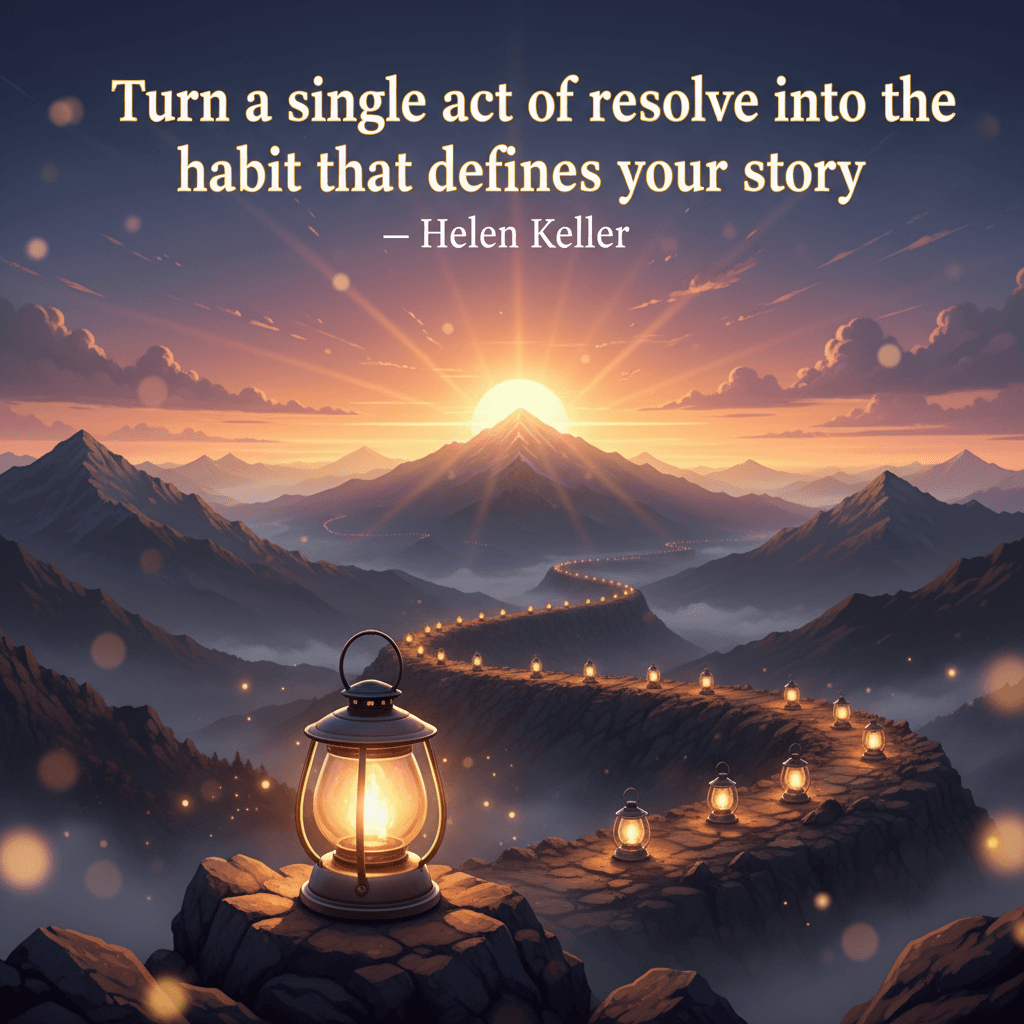
Turn a single act of resolve into the habit that defines your story. — Helen Keller
—What lingers after this line?
The Spark of a Single Decision
Every durable transformation begins with a moment that could have passed unnoticed. Helen Keller’s life offers a vivid illustration: after the 1887 water-pump breakthrough with Anne Sullivan, she converted that flash of comprehension into daily practice—finger-spelling, reading, and relentless study. As she recounts in The Story of My Life (1903), resolve was not a feeling but a choice repeated until it reshaped her world. In this light, the quote nudges us to treat resolve as ignition, not arrival. By honoring one brave decision with consistent action, we give it narrative weight. Rather than waiting for motivation to return, we return to the motion that motivation first enabled. Thus the single act becomes a throughline, stitching together days into a story we can recognize as our own.
How Repetition Becomes Identity
Building on that spark, identity coheres through what we do repeatedly. Aristotle’s Nicomachean Ethics emphasizes that virtues arise from habituated action, not isolated intention; character is the residue of countless choices. Modern narrative psychology echoes this view: Dan P. McAdams (1993) argues we craft a “life story” that integrates past acts into a guiding identity. When a solitary act of resolve is rehearsed into habit, it graduates from event to essence. The repetition says, “This is who I am,” and the story answers back, “Prove it again tomorrow.” In this reciprocal loop, identity and habit reinforce each other, turning the initial decision into a signature.
From Intention to Routine: The Mechanics
Consequently, we need a bridge from decision to daily doing. Implementation intentions—if-then plans studied by Peter Gollwitzer (1999)—provide one: “If it’s 7:00 a.m., then I lace my shoes.” Pair that with a tiny, friction-light starter (BJ Fogg, Tiny Habits, 2019): two minutes of the behavior that can expand once begun. Finally, attach a quick reward to close the loop (cue–routine–reward), as popularized by Charles Duhigg (2012) and elaborated by Wendy Wood (2019). Designing the sequence this way reduces dependence on willpower. The cue remembers for you, the tiny start lowers resistance, and the reward makes return visits likely. Over time, context triggers action directly, and the act of resolve dissolves into something even sturdier: automaticity.
Choose a Keystone That Multiplies
Moreover, not all habits compound equally. Keystone habits, described by Duhigg (2012), create positive spillovers—exercise improves sleep and mood; daily planning clarifies priorities; morning pages (Julia Cameron, The Artist’s Way, 1992) unlock creative flow. Selecting one keystone aligns with Keller’s mandate: let a single disciplined act organize the rest of the day. A practical heuristic is to ask, “Which small behavior, if done consistently, would make other good choices easier?” A five-minute nightly review, for instance, can reduce decision fatigue tomorrow. As this keystone stabilizes, it becomes the spine of your narrative—quietly steering chapters without fanfare.
Design the Path, Not Just the Will
To sustain momentum, shape the environment to favor your choice. Place cues in the open, reduce friction for the desired action, and add friction to the competing one—running shoes by the door; phone in another room at bedtime. Commitment devices help too: schedule with a friend, use a lock-in app, or make a public promise, echoing Odysseus’s self-binding strategy in Homer’s Odyssey. These structures do not replace resolve; they honor it by making the right action the easy action. In doing so, your habit inherits resilience from design rather than sheer effort—allowing the story to keep unfolding on difficult days.
Recover Quickly, Keep the Thread
Finally, the defining habit is not perfect execution but swift repair. A growth mindset (Carol Dweck, 2006) and self-compassion (Kristin Neff, 2003) shorten the distance between a lapse and the next rep. Track streaks for visibility, but emphasize “never twice in a row” over perfectionism. By returning promptly, you protect the narrative arc: the habit remains the protagonist, and setbacks become plot points rather than endings. In this rhythm—decide, design, repeat, repair—one act of resolve matures into the habit that quietly, decisively, defines your story.
One-minute reflection
What does this quote ask you to notice today?
Related Quotes
6 selectedWe will either find a way, or make one. — Hannibal Barca
Hannibal Barca
At its core, Hannibal Barca’s line is a declaration that obstacles do not end the story; they merely change the method. Rather than waiting for ideal conditions, he frames action itself as the answer: if a route exists,...
Read full interpretation →If you have a dream, don’t just sit there. Gather courage to believe that you can succeed and leave no stone unturned to make it a reality. — Roopleen
Roopleen
Roopleen’s quote begins with a refusal of passivity: having a dream is not enough if it remains only a private wish. Instead, the statement urges movement, suggesting that aspiration gains meaning only when paired with d...
Read full interpretation →The brick walls are there for a reason... to give us a chance to show how badly we want something. — Randy Pausch
Randy Pausch
At first glance, Randy Pausch’s line turns frustration into meaning. Rather than treating barriers as pointless interruptions, he frames them as tests that reveal the seriousness of our intentions.
Read full interpretation →If you are not willing to learn, no one can help you. If you are determined to learn, no one can stop you. — Zig Ziglar
Zig Ziglar
Zig Ziglar’s quote begins with a blunt truth: learning cannot be forced from the outside. Teachers, mentors, and books may offer guidance, yet none of them can move a closed mind.
Read full interpretation →Consistency beats intensity every single time. If your morning maintenance takes more than twenty minutes to execute, you will abandon it by July. — Dr. Elliot Ford
Dr. Elliot Ford
At its heart, Dr. Elliot Ford’s quote argues that the best routine is not the most impressive one, but the one a person can actually repeat.
Read full interpretation →Dreams become reality when we put our minds to it. — Queen Rania of Jordan
Queen Rania of Jordan
Queen Rania of Jordan’s statement condenses a hopeful but demanding truth: dreams do not become real through wishing alone, but through focused intention. By saying “when we put our minds to it,” she shifts attention fro...
Read full interpretation →More From Author
More from Helen Keller →True confidence, like deep rivers, flows calmly and silently without the need for continual recognition. — Unknown (Wait: Skipping) -> My limits are not a debate. — Unknown (Wait: Skipping) -> Never bend your head. Always hold it high. Look the world straight in the eye. — Helen Keller
Helen Keller’s line begins with a physical image, yet it quickly opens into a moral one: to hold one’s head high is to move through the world with unshaken self-respect. In that sense, true confidence does not beg for ap...
Read full interpretation →I long to accomplish a great and noble task; but it is my chief duty to accomplish small tasks as if they were great and noble. — Helen Keller
Helen Keller’s words open with a familiar human desire: the longing to do something magnificent. Yet she immediately redirects that ambition toward duty, reminding us that life is rarely built from grand gestures alone.
Read full interpretation →Everything has its wonders, even darkness and silence, and I learn, whatever state I may be in, therein to be content. — Helen Keller
Helen Keller’s line begins by widening the definition of “wonder.” Rather than reserving amazement for bright, dramatic, or easily celebrated experiences, she insists that every aspect of existence contains something wor...
Read full interpretation →Reach with both hands for what you imagine; momentum answers effort. — Helen Keller
Helen Keller’s phrase, “Reach with both hands,” turns imagination into something physical: a posture of full commitment rather than a halfhearted try. Instead of treating a goal as a distant wish, she frames it as someth...
Read full interpretation →