
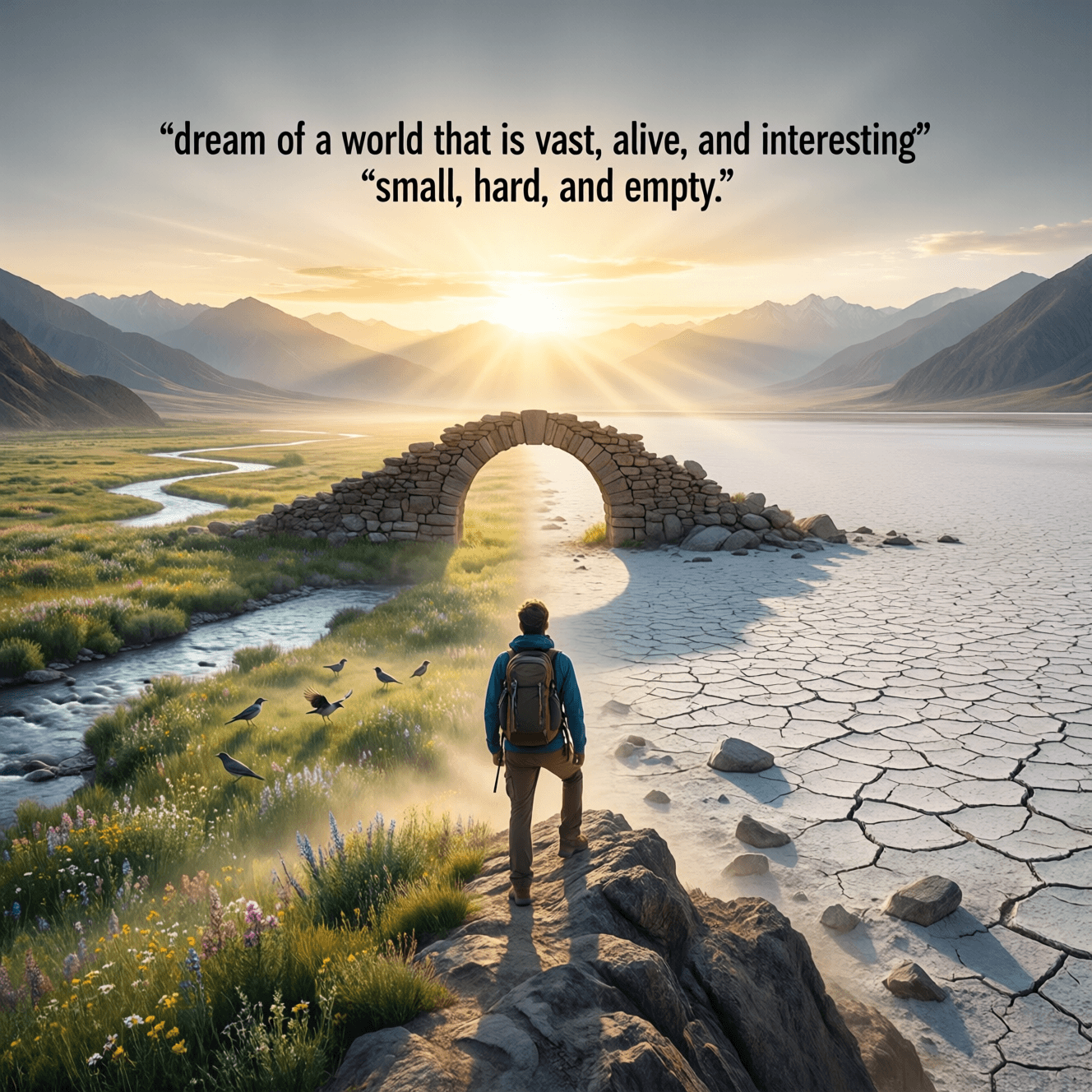
We can dream of a world that is vast, alive, and interesting, or reason it to be small, hard, and empty. — Nick Cave
—What lingers after this line?
The Fork in Perception
Nick Cave frames imagination and reason not as enemies, but as competing habits of perception that shape the world we experience. In his telling, we can live as if reality is spacious and animated, or we can interpret it until it feels cramped and inert. The quote’s power lies in its suggestion that “world” is not only geography or circumstance; it is also the inner lens through which events acquire color, meaning, and possibility. From this starting point, Cave invites a practical question: when we describe the world as bleak or abundant, are we reporting facts—or practicing a style of attention that decides what counts as real?
Dreaming as an Active Discipline
Although “dream” can sound passive, Cave’s contrast implies a deliberate commitment to wonder. Dreaming here resembles what William James described as the selective nature of consciousness in *The Principles of Psychology* (1890): attention does not merely notice reality; it organizes it. When we choose curiosity, we begin to detect patterns, stories, and connections that were previously invisible. As a result, a “vast, alive, and interesting” world is not necessarily a different planet—it is the same place encountered with a readiness to be surprised, the way a familiar street becomes new when you walk it slowly enough to notice small details.
Reason’s Shadow: Reduction and Control
Cave’s warning is not that reason is useless, but that it can become a narrowing instrument when used only to minimize uncertainty. This echoes Max Weber’s account of modern “disenchantment” in “Science as a Vocation” (1917), where rationalization can drain the world of mystery by treating everything as calculable. In that mode, explanation becomes a kind of flattening. Consequently, reason can “make” the world feel small and empty when it is deployed to foreclose meaning—when it insists that only what can be measured matters, and anything ambiguous must be dismissed rather than lived with.
Meaning-Making and the Stories We Inhabit
Because humans interpret experience through narrative, the difference Cave describes often shows up in the stories we tell ourselves. Viktor Frankl’s *Man’s Search for Meaning* (1946) argues that suffering becomes more bearable when placed within a framework of purpose, while meaninglessness intensifies despair. Cave’s “dream” resembles this generative storytelling: it grants texture to life without denying hardship. In turn, when we “reason” the world into emptiness, we may be adopting a story of futility—one that treats joy as naïveté and reduces aspiration to error, until the narrative itself becomes a self-fulfilling atmosphere.
Creativity as a Way of Staying Alive
Given Cave’s life as a songwriter, the quote also reads as an artistic credo: creativity keeps reality porous and responsive. Art does not merely decorate the world; it expands what can be felt and said, much as Cave’s own work often transforms grief into imagery that makes pain speakable. Through this lens, dreaming is a survival skill, not escapism. Therefore, choosing the “alive” world can mean making things—songs, conversations, rituals, small acts of craft—that push back against deadness and restore a sense that experience still has depth and movement.
Living the Choice in Everyday Practice
Ultimately, Cave presents a daily decision: not whether the world contains darkness, but whether our posture toward it is contraction or openness. A practical version might be noticing how cynicism feels like certainty but functions like a closed door, whereas wonder tolerates ambiguity and keeps learning possible. Even a brief habit—asking a better question, reading outside one’s usual taste, listening more carefully—can tilt the inner “world” toward spaciousness. In this way, the quote ends up less like a poetic abstraction and more like an ethical stance: protect the imagination that keeps life interesting, and use reason as a tool for clarity rather than a weapon for reducing the soul’s horizon.
One-minute reflection
Why might this line matter today, not tomorrow?
Related Quotes
6 selectedEverything you can imagine is real. — Pablo Picasso
Pablo Picasso
This quote highlights the extraordinary power of human imagination. It suggests that the act of imagining something gives it a form of reality, even if only in the mental or creative realm.
Read full interpretation →Anxiety is just the imagination working overtime, and most of that overtime is completely unpaid. — Alain de Botton
Alain de Botton
At first glance, Alain de Botton’s remark frames anxiety with disarming humor: the mind behaves like an overworked employee, generating scenarios, rehearsing disasters, and collecting no reward for the effort. By calling...
Read full interpretation →Creativity is not the finding of a thing, but the making something out of it after it is found. — James Russell Lowell
James Lowell
James Russell Lowell’s line shifts attention away from the romantic myth of the sudden genius who invents from nothing. Instead, he argues that creativity truly begins after the initial encounter—after an idea, object, p...
Read full interpretation →What is behind your eyes holds more power than what is in front of them. — Gary Zukav
Gary Zukav
At its core, Gary Zukav’s quote argues that the mind’s inner landscape—beliefs, memories, expectations, and values—has greater influence than external appearances. What we carry ‘behind our eyes’ determines how we interp...
Read full interpretation →There are things known and there are things unknown, and in between are the doors of perception. — Aldous Huxley
Aldous Huxley
Aldous Huxley’s line divides reality into three striking regions: what we know, what we do not know, and the mysterious passage between them. Rather than treating knowledge and ignorance as fixed opposites, he imagines p...
Read full interpretation →We are not here to copy the reality that is already sold to us, but to use our own lenses to reshape the world we see. — Georgia O'Keeffe
Georgia O'Keeffe
Georgia O’Keeffe’s statement begins with a refusal: we are not here merely to reproduce a ready-made version of reality. In that sense, she challenges the passive habit of accepting what culture, commerce, and convention...
Read full interpretation →More From Author
More from Nick Cave →