
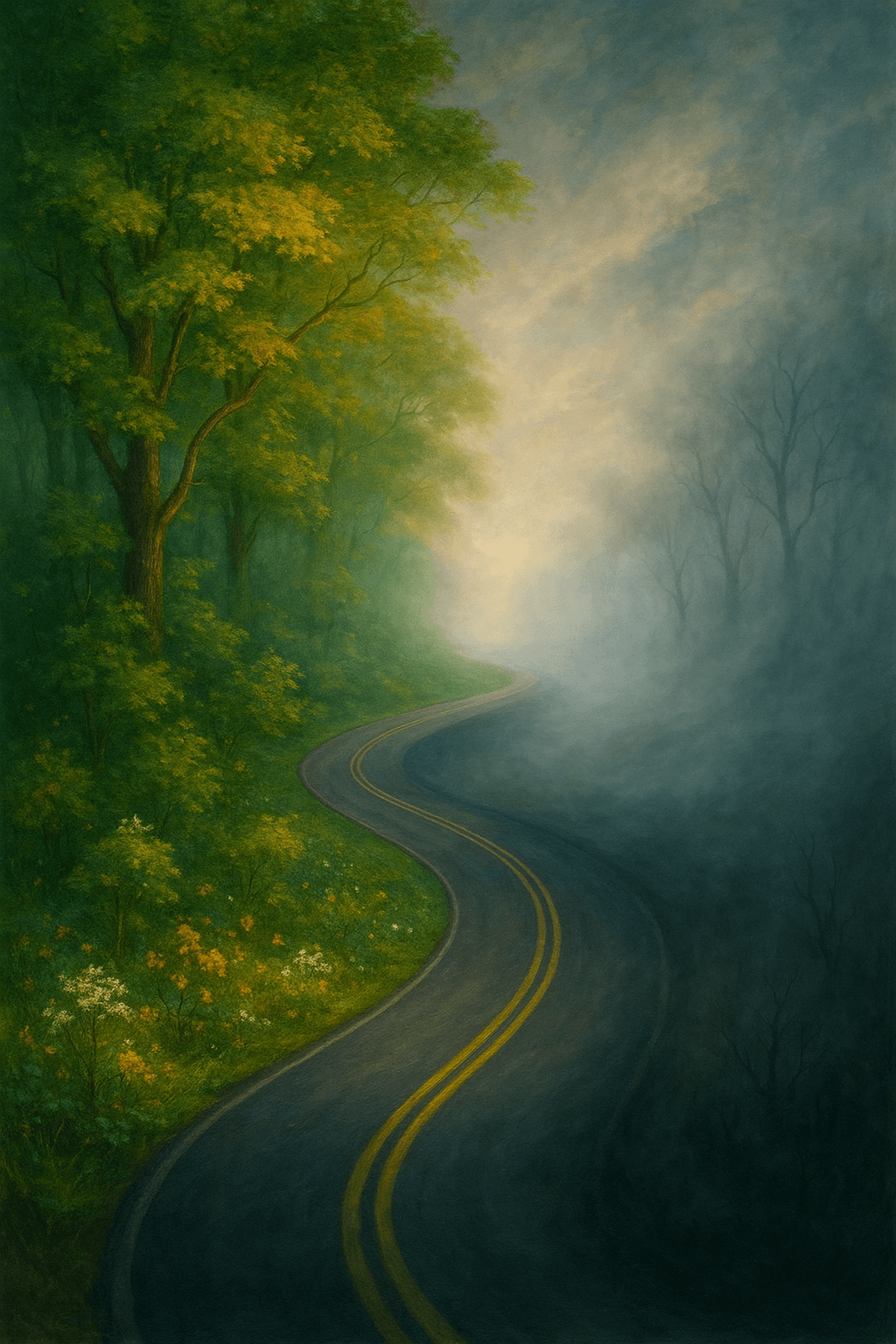
Each person’s life represents a road toward oneself and away from oneself. — Simone Weil
—What lingers after this line?
The Paradox of Self and Otherness
Simone Weil's observation encapsulates the fundamental paradox at the heart of human experience. She suggests that, as we advance through life, we simultaneously move toward our own inner truth and stray from it. This dual movement mirrors the existential struggle: in seeking to understand ourselves, we are often influenced or altered by the expectations of society, relationships, and circumstance.
Historical Reflections on the Inner Journey
Building upon Weil’s insight, philosophical works across history have recognized life as a journey for self-knowledge. For instance, Socrates famously declared, 'Know thyself,' emphasizing introspection as a central life task. Yet, just as Socrates pursued understanding through dialogue with others, our interactions can both illuminate and obscure the path to our inner selves.
The Influence of External Forces
Continuing this theme, Weil’s statement suggests that external influences often pull us away from our authentic core. Consider the Bildungsroman literary tradition—such as in Goethe’s 'Wilhelm Meister's Apprenticeship' (1795)—where protagonists encounter pressures that shape, and sometimes alienate, them from their originary selves. Thus, the outside world can be both a mirror and a mask.
Moments of Self-Realization
Nevertheless, pivotal moments in life often prompt individuals to return to their inner essence. In moments of crisis or reflection, such as described in Viktor Frankl’s 'Man’s Search for Meaning' (1946), people are compelled to revisit their true motivations, beliefs, and values, reaffirming Weil’s notion that the road to oneself is never fully abandoned.
Embracing the Lifelong Process
Ultimately, Weil’s wisdom encourages acceptance of life as an oscillation between self-approach and self-estrangement. Rather than seeing this as failure, we can interpret it as the necessary rhythm of growth. Each detour carries the seed for rediscovery, and every return deepens our understanding, making the journey as vital as the destination.
Recommended Reading
As an Amazon Associate, we earn from qualifying purchases.
One-minute reflection
What does this quote ask you to notice today?
Related Quotes
6 selectedThe only journey is the one within. — Rainer Maria Rilke
Rainer Maria Rilke
This quote underscores the importance of introspection and self-discovery. It suggests that the most significant journey a person can undertake is the exploration of their own thoughts, feelings, and essence.
Read full interpretation →Quietly, I am becoming the woman I was always meant to be. — Mitsuye Yamada
Mitsuye Yamada
Mitsuye Yamada’s line begins not with spectacle, but with stillness. The word “quietly” suggests that the deepest changes in a life often happen away from applause, in private acts of courage, reflection, and endurance.
Read full interpretation →Art and love are the same thing: it's the process of seeing yourself in things that are not you. — Chuck Klosterman
Chuck Klosterman
At first glance, Chuck Klosterman’s line collapses two vast experiences into one elegant idea: both art and love involve recognizing ourselves in something outside us. In this sense, a painting, a song, or another person...
Read full interpretation →You were born a child of light's wonderful secret—you return to the beauty you have always been. — Aberjhani
Aberjhani
At its heart, Aberjhani’s line begins with a reassuring claim about human identity: we are born not in spiritual emptiness, but as “a child of light’s wonderful secret.” In other words, the self is rooted in something ra...
Read full interpretation →The entrance door to the sanctuary is inside you. — Stephen Levine
Stephen Levine
Stephen Levine’s line turns the idea of sanctuary inward, suggesting that refuge is not primarily a place we travel to but a condition we awaken within ourselves. At first glance, the image is simple: a door leading to s...
Read full interpretation →Don't wait until you know who you are to get started. — Austin Kleon
Austin Kleon
Austin Kleon’s line challenges a common hesitation: the belief that we must first discover a fixed, authentic self before we can begin meaningful work. Instead, he implies that identity is not a prerequisite for action b...
Read full interpretation →More From Author
More from Simone Weil →The beauty of the world is that it is a craft, not a product. — Simone Weil
Simone Weil’s remark shifts our attention from the world as a finished object to the world as a living act of making. A product suggests completion, closure, and fixed utility, whereas a craft implies care, patience, rev...
Read full interpretation →Humility is attentive patience. — Simone Weil
At first glance, Simone Weil’s remark seems to redefine humility altogether. Rather than treating it as self-deprecation or mere politeness, she presents it as a disciplined way of being: patient, watchful, and receptive...
Read full interpretation →To pay attention is the most basic and profound form of love we can offer ourselves and our work. — Simone Weil
Simone Weil condenses a demanding ethic into a single sentence: attention is not merely a mental skill, but an act of love. To pay attention to ourselves means noticing our fatigue, motives, fears, and hopes without rush...
Read full interpretation →There is a quiet power in doing one thing well, day after day, until the repetition transforms into grace. — Simone Weil
At first glance, Simone Weil’s line honors a modest kind of excellence: not brilliance displayed all at once, but a patient devotion to doing one thing well. The phrase “quiet power” suggests that true mastery often arri...
Read full interpretation →