
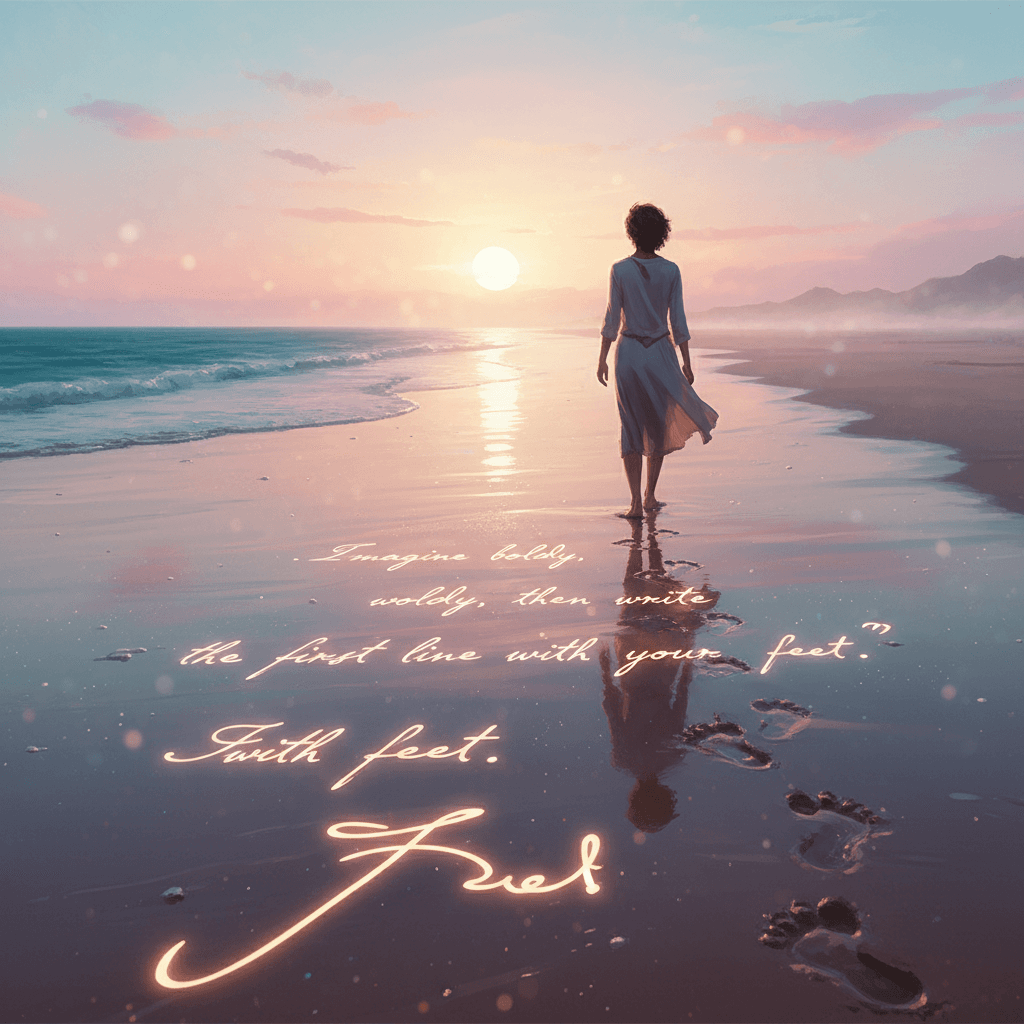
Imagine boldly, then write the first line with your feet. — Gabriel García Márquez
—What lingers after this line?
An Impossible Image That Redefines Creativity
Gabriel García Márquez’s line, “Imagine boldly, then write the first line with your feet,” begins with an impossibility. No one literally writes with their feet, yet the image lingers because it challenges our sense of what is normal in creative work. By invoking this absurd physical act, Márquez invites us to move beyond comfort and conventional technique. The point is not dexterity but daring: if you can envision yourself doing something that outlandish, then ordinary hesitations about beginning a story, painting, or idea suddenly seem small by comparison.
From Timid Daydreams to Bold Imagination
The command to “imagine boldly” comes first for a reason. Many people imagine, but they do so cautiously, trimming ideas to fit what seems realistic or respectable. Márquez reverses this instinct, echoing how magical realism in works like *One Hundred Years of Solitude* (1967) treats flying carpets and raining flowers as matter-of-fact. By starting with audacious images, we widen the field of possibilities. Only then does the second part of the sentence—writing with your feet—make sense as a natural extension of a mind already freed from timid constraints.
The Awkward, Physical Truth of First Drafts
Transitioning from imagination to execution, “write the first line with your feet” captures the clumsy reality of beginning any project. First attempts are rarely elegant; they feel as awkward as trying to sign your name with your toes. Yet Márquez’s phrasing suggests that awkwardness is not a failure but a rite of passage. By exaggerating this clumsiness into a surreal image, he normalizes the messy, uneven quality of first drafts and encourages creators to move anyway, even if their initial steps leave ungainly footprints on the page.
Breaking the Tyranny of Technique and Perfection
From this perspective, the feet become a symbol of defiance against the tyranny of polished technique. Traditional craft says you must have the right tools, training, and posture before you are allowed to begin. Márquez inverts that logic: start with whatever you have, however unrefined. This echoes Picasso’s claim that “inspiration exists, but it has to find you working.” The emphasis shifts from flawless method to active engagement. By metaphorically writing with your feet, you give yourself permission to be imperfect, trusting that grace will follow motion.
Embracing Risk as the Price of Originality
Moreover, the quote frames risk as essential rather than optional. To imagine boldly is to entertain ideas that might seem foolish; to write with your feet is to risk producing something ugly or misunderstood. Yet many breakthrough works—whether Kafka’s unsettling tales or Frida Kahlo’s unflinching self-portraits—began as departures from accepted norms. Márquez’s image therefore functions as a quiet manifesto: originality requires a willingness to look ridiculous at first. By accepting that embarrassment is part of the process, creators open themselves to discoveries that cautious minds never reach.
Turning the Metaphor into a Daily Practice
Finally, the line offers a practical ethic disguised as whimsy. To live it out, one might set a rule: begin each day’s work with a sentence, sketch, or idea that feels slightly too wild, as though metaphorical feet have touched the page before careful hands intervene. Over time, this practice trains you to start before you feel ready, letting bold imagination lead and technique follow. In this way, Márquez’s surreal instruction becomes a concrete habit—an everyday reminder that creativity thrives where courage and playfulness meet.
One-minute reflection
What feeling does this quote bring up for you?
Related Quotes
6 selectedProficiency in a craft is essential to every artist. Therein lies the prime source of creative imagination. — Walter Gropius
Walter Gropius
At first glance, Walter Gropius’s statement may seem to place discipline above inspiration, yet his deeper point is that imagination needs a workable form. An artist who understands materials, structure, and technique ca...
Read full interpretation →To raise new questions, new possibilities, to regard old problems from a new angle, requires creative imagination. — Albert Einstein
Albert Einstein
Einstein’s quote underscores that raising new questions is fundamental to intellectual progress. By challenging the status quo and asking unconventional questions, we sow the seeds of discovery.
Read full interpretation →Make your imagination a workshop, labor there daily, and build the life you envision. — Gabriel García Márquez
Gabriel García Márquez
To begin, the metaphor invites us to treat imagination not as a lounge but as a workshop: a place of tools, shavings, and iterative drafts. Gabriel García Márquez often fused wonder with work; in One Hundred Years of Sol...
Read full interpretation →No one should fear shadows. It simply means there's a light shining somewhere nearby. — Gabriel García Márquez
Gabriel García Márquez
Gabriel García Márquez turns a common source of unease into a quiet reassurance: shadows are not threats in themselves, but evidence. When we fear shadows, we often respond to what is vague, enlarged, or half-seen—our mi...
Read full interpretation →Open one window of wonder each day and the light of possibility will rush in. — Gabriel García Márquez
Gabriel García Márquez
García Márquez frames wonder not as a rare accident, but as something you can choose—one “window” at a time. The image suggests a small, deliberate action: a pause, a question, a moment of attention.
Read full interpretation →Persist like a river: find the cracks and flow through them. — Gabriel García Márquez
Gabriel García Márquez
García Márquez’s image begins with something ordinary but unstoppable: a river. It doesn’t “win” by force or by arguing with the landscape; it keeps moving, day after day, and that continued motion becomes its power.
Read full interpretation →More From Author
More from Gabriel García Márquez →No one should fear shadows. It simply means there's a light shining somewhere nearby. — Gabriel García Márquez
Gabriel García Márquez turns a common source of unease into a quiet reassurance: shadows are not threats in themselves, but evidence. When we fear shadows, we often respond to what is vague, enlarged, or half-seen—our mi...
Read full interpretation →Open one window of wonder each day and the light of possibility will rush in. — Gabriel García Márquez
García Márquez frames wonder not as a rare accident, but as something you can choose—one “window” at a time. The image suggests a small, deliberate action: a pause, a question, a moment of attention.
Read full interpretation →Persist like a river: find the cracks and flow through them. — Gabriel García Márquez
García Márquez’s image begins with something ordinary but unstoppable: a river. It doesn’t “win” by force or by arguing with the landscape; it keeps moving, day after day, and that continued motion becomes its power.
Read full interpretation →Carry a quiet rebellion of joy and let it dismantle doubt brick by brick — Gabriel García Márquez
Gabriel García Márquez’s image of a “quiet rebellion of joy” invites us to imagine resistance that does not shout, but endures. Instead of anger or spectacle, this rebellion chooses delight, gratitude, and tenderness as...
Read full interpretation →