
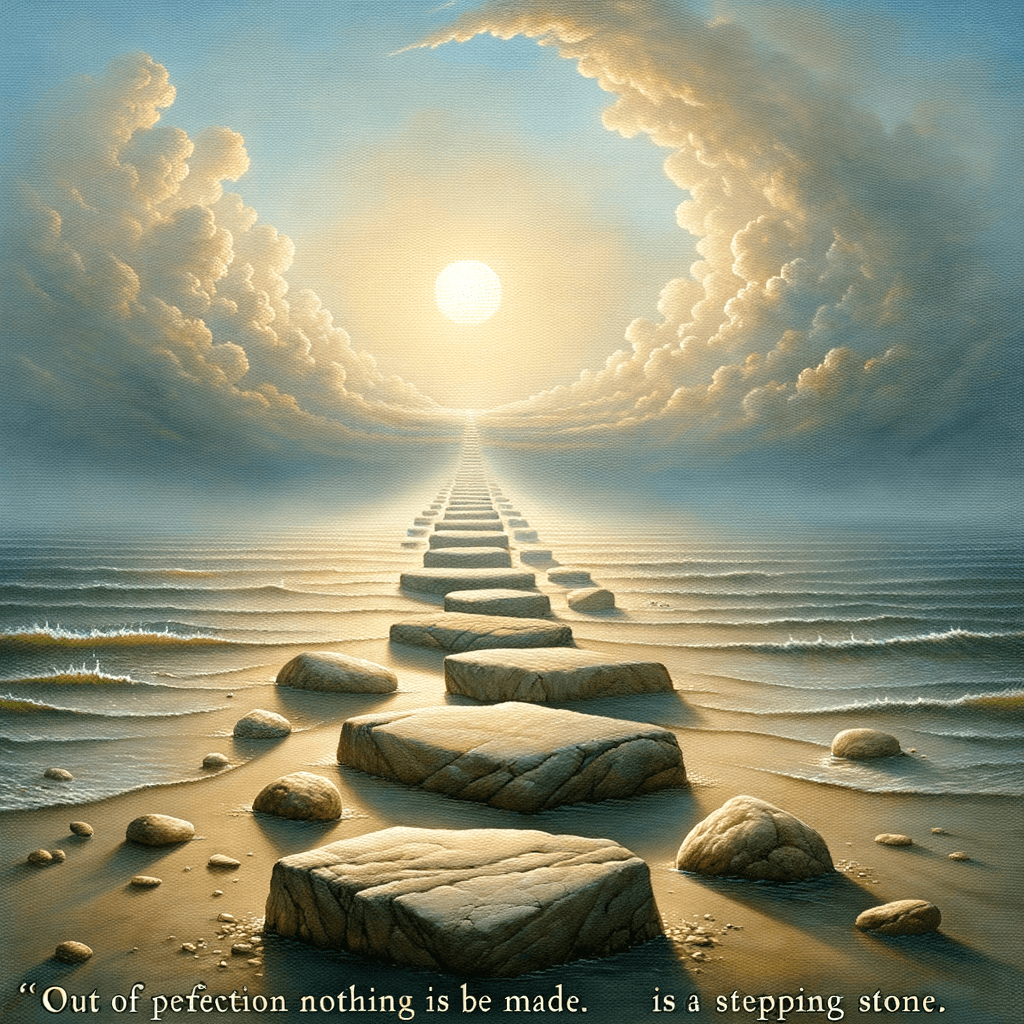
Out of perfection nothing can be made. Every experience, good or bad, is a stepping stone. — Alan Watts
—What lingers after this line?
Reality of Imperfection
This quote signifies that perfection is an unattainable ideal. It suggests that real-life experiences, with all their flaws and shortcomings, are necessary for growth and understanding.
Value of Experiences
Watts emphasizes the importance of every experience, regardless of its nature. Both good and bad experiences provide valuable lessons that contribute to personal development.
Growth through Challenges
Bad experiences are positioned as stepping stones, implying that overcoming difficulties fosters resilience and character in individuals, making them better equipped for future challenges.
Philosophy of Acceptance
The quote advocates for a philosophy of acceptance where one learns to embrace imperfections and failures as integral parts of the human experience rather than viewing them negatively.
Alan Watts' Influence
Alan Watts was a philosopher known for interpreting and popularizing Eastern philosophy for Western audiences. His thoughts often encourage a deeper understanding of existence, meditation, and the interconnectedness of life.
One-minute reflection
Why might this line matter today, not tomorrow?
Related Quotes
6 selectedTo find yourself, you must first be willing to lose the version of yourself you thought you had to be. — Alan Watts
Alan Watts
At first glance, Alan Watts’s statement sounds contradictory: how can losing yourself be the way to find yourself? Yet this paradox lies at the heart of his philosophy.
Read full interpretation →We don't create to be perfect; we create to be present. The imperfections are not errors, but the fingerprints of our humanity. — Wabi-sabi philosophy, via Leonard Koren
sabi philosophy, via Leonard Koren
At its core, this reflection shifts the purpose of creation away from flawless results and toward lived attention. To create ‘to be present’ means engaging fully with the moment, allowing the act itself to matter as much...
Read full interpretation →Learning to love yourself is like learning to walk – essential, life-changing, and the only way to stand tall. — Vironika Tugaleva
Vironika Tugaleva
Vironika Tugaleva’s comparison begins with a simple but powerful truth: self-love is not a luxury, but a basic human necessity. Just as walking allows a child to move through the world with growing independence, learning...
Read full interpretation →The most gifted members of the human species are at their creative best when they cannot have their way, and must compensate for what they miss by realizing and cultivating their capacities. — Bryant H. McGill
Bryant H. McGill
Bryant H. McGill’s observation begins with a striking reversal: gifted people may not reach their highest potential when everything comes easily, but when something blocks their path.
Read full interpretation →I wanted a perfect ending. Now I've learned, the hard way, that some poems don't rhyme, and some stories don't have a clear beginning, middle, and end. — Gilda Radner
Gilda Radner
Gilda Radner’s quote begins with a deeply human wish: the desire for a perfect ending. Most people instinctively want life to resemble a well-made story, with conflicts resolved, wounds explained, and every emotional thr...
Read full interpretation →A mind grows by staying with difficulty long enough for the experience to change it. — Mary Catherine Bateson
Mary Catherine Bateson
Mary Catherine Bateson’s observation begins with a quiet but demanding truth: the mind does not grow merely by encountering difficulty, but by remaining with it. Challenge becomes transformative only when we resist the u...
Read full interpretation →More From Author
More from Alan Watts →You are an aperture through which the universe is looking at and exploring itself. — Alan Watts
At first glance, Alan Watts’s line overturns the ordinary way we think about the self. Instead of imagining a separate individual peering out at a distant world, he suggests that each person is a channel through which th...
Read full interpretation →To find yourself, you must first be willing to lose the version of yourself you thought you had to be. — Alan Watts
At first glance, Alan Watts’s statement sounds contradictory: how can losing yourself be the way to find yourself? Yet this paradox lies at the heart of his philosophy.
Read full interpretation →All the best ideas come out of the process; they come out of the work itself. — Alan Watts
At its heart, Alan Watts’s statement shifts attention away from waiting for inspiration and toward the act of making. He suggests that strong ideas are rarely fully formed at the beginning; instead, they reveal themselve...
Read full interpretation →The meaning of life is just to be alive. It is so plain and so obvious and so simple. — Alan Watts
Alan Watts’s line cuts against the habit of treating life as a riddle to be solved. Instead of offering a grand theory, he points to something embarrassingly direct: the fact of being alive is already the “answer.” In th...
Read full interpretation →