
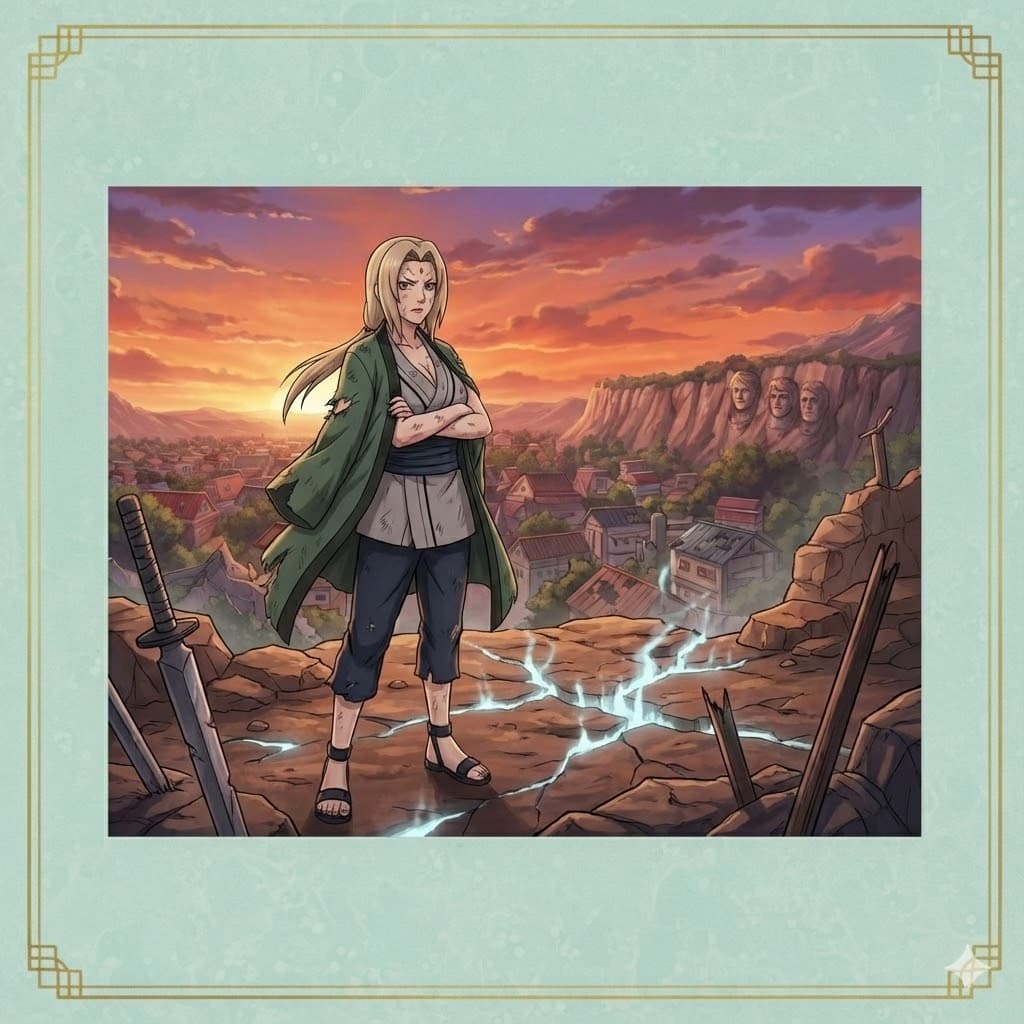
Strength comes from enduring the pain you thought would break you. — Tsunade, Naruto Series
—What lingers after this line?
Pain as a Hidden Forge of Strength
Tsunade’s words suggest that strength is not something we discover in comfort, but something hammered into shape in our most painful moments. What we once believed would destroy us instead becomes the very experience that tempers our character. Rather than portraying pain as purely negative, this view reframes suffering as a forge in which resilience, courage, and self-knowledge are created. In this way, the quote moves us from seeing hardship as an enemy to understanding it as a severe but effective teacher.
Tsunade’s Story as Living Evidence
Within the Naruto series, Tsunade herself embodies this philosophy. She loses loved ones in war, is paralyzed by trauma, and distances herself from the world she once swore to protect. Yet, because she survives these losses, she gradually acquires the strength to return as Hokage and shoulder the village’s burdens. Her journey shows how enduring shattering grief can transform despair into a deeper resolve to protect others, illustrating that the quote is not abstract wisdom but hard-won insight from lived experience.
From Breaking Point to Turning Point
Crucially, the quote focuses on moments when we are convinced we cannot go on. These perceived breaking points often become turning points: a failed exam that redirects a career, a painful breakup that clarifies values, or an illness that inspires new priorities. Much like psychological research on post-traumatic growth suggests, people frequently report increased appreciation for life and stronger relationships after serious adversity. Thus, what seems like the end can quietly mark the start of a stronger, more honest chapter.
Endurance as an Active Choice
Enduring pain is not the same as passively suffering. Tsunade’s idea highlights an active decision to face anguish rather than numb it or run away. This endurance might involve seeking help, training harder, or confronting long-avoided truths. Each small choice to continue—getting out of bed, returning to practice, or apologizing after failure—becomes a brick in the foundation of inner strength. Over time, these choices transform the memory of pain from a symbol of weakness into proof of survival.
Rewriting Your Story of Pain
Ultimately, Tsunade’s insight invites us to reinterpret our own scars. Instead of asking, “Why did this happen to me?” we can begin to ask, “Who did I become because I lived through this?” By shifting the narrative from victimhood to growth, we honor both the reality of the hurt and the power it awakened in us. In doing so, we echo Tsunade’s arc in Naruto: the very wounds we feared would break us become the source of a quieter, more enduring strength.
One-minute reflection
What feeling does this quote bring up for you?
Related Quotes
6 selectedTo love and lose is still better than never to have loved at all. — Tsunade, Naruto Series
Tsunade, Naruto Series
Tsunade’s line, echoing Lord Alfred Tennyson’s famous sentiment, distills a hard-won truth: love is so meaningful that its value survives even after it is gone. In the Naruto series, she speaks not as an idealistic roman...
Read full interpretation →When your heart grows, your power follows. — Choji Akimichi, Naruto Series
Choji Akimichi, Naruto Series
In the Naruto series, Choji Akimichi begins as an often-overlooked character, more associated with snacks than strength. Yet his line, “When your heart grows, your power follows,” quietly summarizes his entire journey.
Read full interpretation →Strength isn't loud. It's the quiet decision to keep going. — Hinata Hyuga, Naruto Series
Hinata Hyuga, Naruto Series
Hinata Hyuga’s words challenge a familiar misconception: that strength must be dramatic, visible, and loud. Instead, she points to an inward power that does not seek attention but reveals itself in persistence.
Read full interpretation →A smile can be the strongest punch of all. — Rock Lee, Naruto Series
Rock Lee, Naruto Series
Rock Lee’s line, “A smile can be the strongest punch of all,” reframes strength in a series famous for physical combat. While Naruto’s world overflows with jutsu, taijutsu, and spectacular battles, Lee points to somethin...
Read full interpretation →Those who forgive themselves are the strongest of all. — Itachi Uchiha, Naruto Series
Itachi Uchiha, Naruto Series
Itachi Uchiha’s line, “Those who forgive themselves are the strongest of all,” reframes strength as an inner achievement rather than an external display. Instead of focusing on power, skill, or victory over others, he po...
Read full interpretation →A Hokage's duty is to protect the dreams of the next generation. — Tsunade, Naruto Series
Tsunade, Naruto Series
Tsunade’s line reframes what it means to lead: a Hokage is not simply the strongest ninja or the one who commands obedience, but the guardian of possibility. Rather than clinging to authority, the Hokage exists so that c...
Read full interpretation →More From Author
More from Tsunade, Naruto Series →A Hokage's duty is to protect the dreams of the next generation. — Tsunade, Naruto Series
Tsunade’s line reframes what it means to lead: a Hokage is not simply the strongest ninja or the one who commands obedience, but the guardian of possibility. Rather than clinging to authority, the Hokage exists so that c...
Read full interpretation →To love and lose is still better than never to have loved at all. — Tsunade, Naruto Series
Tsunade’s line, echoing Lord Alfred Tennyson’s famous sentiment, distills a hard-won truth: love is so meaningful that its value survives even after it is gone. In the Naruto series, she speaks not as an idealistic roman...
Read full interpretation →