
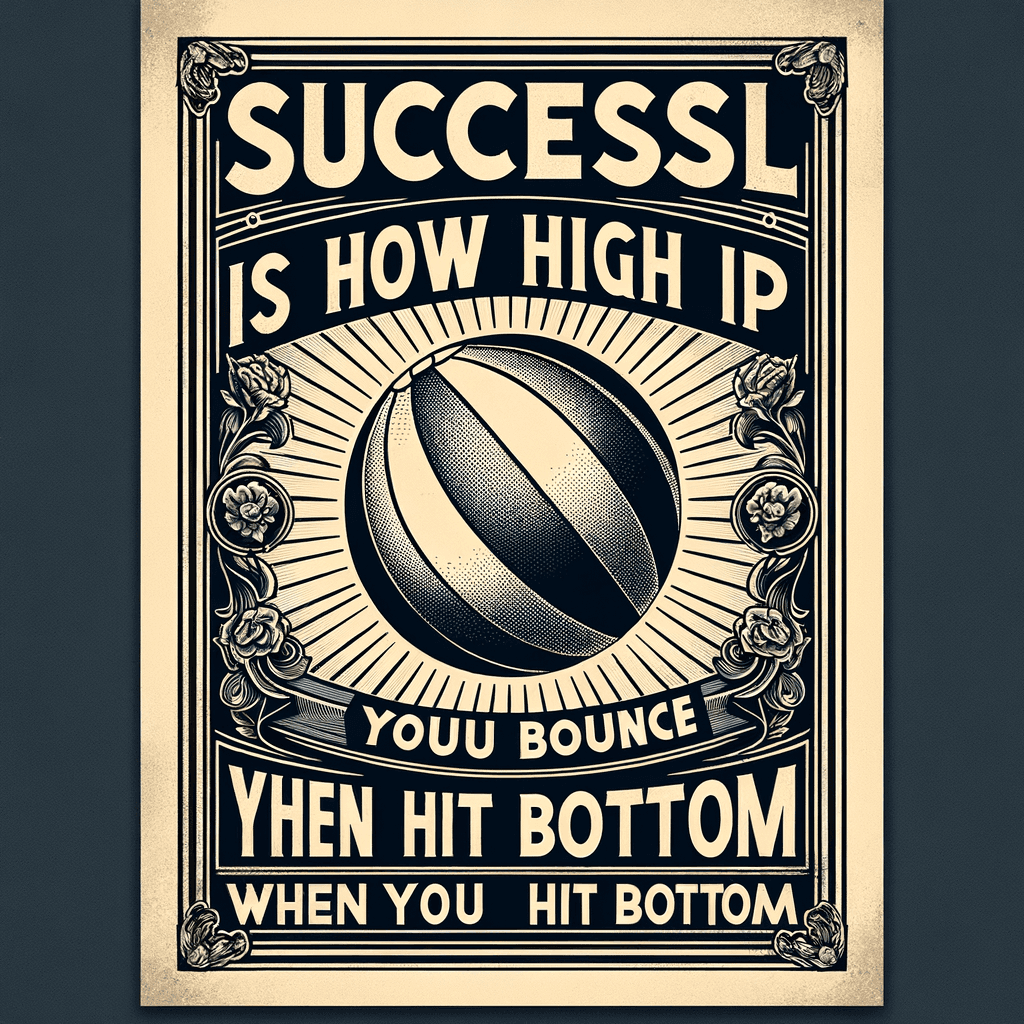
Success is how high you bounce when you hit bottom. — General George S. Patton, United States.
—What lingers after this line?
Resilience
This quote emphasizes the importance of resilience in achieving success. It suggests that success is measured by one's ability to recover from setbacks and adversity, rather than simply reaching a goal.
Perspective on Failure
Patton's words highlight a positive perspective on failure, indicating that hitting 'bottom' is not the end, but a necessary part of the journey toward success. It encourages embracing challenges as opportunities for growth.
Determination
The quote underscores the role of determination and tenacity. True success involves getting back up and trying again after facing challenges, demonstrating a commitment to one's goals.
Measurement of Success
Rather than viewing success only in terms of achievements or status, the quote suggests that the ability to rise again after experiencing failure is a profound indication of one’s success and character.
Historical Context
General George S. Patton was a prominent U.S. Army general during World War II, known for his leadership and strategic thinking. His approach to challenges also influenced his insights on success and resilience, both in military contexts and beyond.
One-minute reflection
What's one small action this suggests?
Related Quotes
6 selectedSelf-mastery rarely looks impressive. It simply holds. — James Clear
James Clear
James Clear’s observation begins by stripping self-mastery of glamour. It is not usually a heroic moment, a public triumph, or a dramatic display of willpower.
Read full interpretation →When I hear somebody sigh, 'Life is hard,' I am always tempted to ask, 'Compared to what?' — Sydney J. Harris
Sydney J. Harris
Sydney J. Harris’s remark begins with an ordinary expression of fatigue: “Life is hard.” Yet his response, “Compared to what?” quietly turns complaint into inquiry.
Read full interpretation →Don't fight the challenges. Just find a new way to stand. — Germany Kent
Germany Kent
Germany Kent’s words begin with a quiet reversal of instinct: instead of treating every challenge as an enemy to defeat, she invites us to reconsider our posture toward difficulty. The emphasis is not on surrender, but o...
Read full interpretation →Optimist: someone who figures that taking a step backward after taking a step forward is not a disaster, it's more like a cha-cha. — Robert Brault
Robert Brault
Robert Brault’s line begins with a witty redefinition: an optimist is not someone who denies backward motion, but someone who interprets it differently. Instead of treating a setback as proof of failure, the optimist see...
Read full interpretation →A mind grows by staying with difficulty long enough for the experience to change it. — Mary Catherine Bateson
Mary Catherine Bateson
Mary Catherine Bateson’s observation begins with a quiet but demanding truth: the mind does not grow merely by encountering difficulty, but by remaining with it. Challenge becomes transformative only when we resist the u...
Read full interpretation →When you are friends with your storm, you dance, instead of getting blown away. — Michael Bassey Johnson
Michael Bassey Johnson
Michael Bassey Johnson’s line begins with a striking reversal: the storm is not merely an enemy to survive, but a force one can learn to understand. In this sense, the storm may represent grief, fear, conflict, uncertain...
Read full interpretation →More From Author
More from General George S. Patton, United States. →