
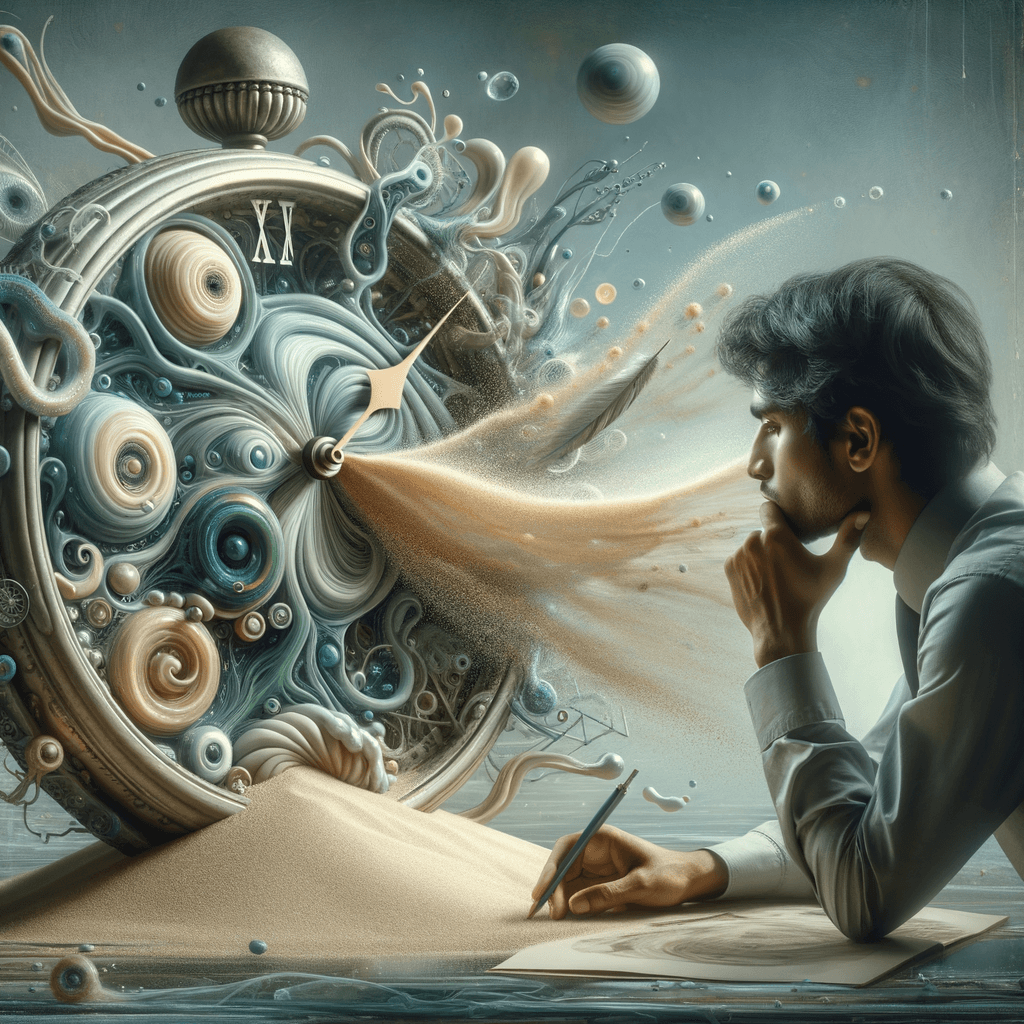
He who observes a clock, never sees the time. — Giovanni Verga
—What lingers after this line?
Irony of Over-Focusing
The quote suggests that by focusing too much on time, we lose the ability to actually experience it. Constantly worrying about time can prevent one from living in the present and appreciating moments as they happen.
Philosophy of Mindful Living
This reflects a call to mindfulness, recommending that life should not be about obsessively watching the clock (or managing time), but rather about fully engaging with what is happening around us.
Paradox of Time Perception
The quote highlights a paradox: although clocks measure time, an obsession with observing time can make us feel disconnected from it. It suggests that time flows differently when we are hyper-aware of it versus when we are simply living.
Critique of Modern Life
This idea may also criticize the way modern life constantly measures and tracks time, potentially leading to anxiety and dissatisfaction. The more we focus on adhering to rigid schedules, the less we truly experience the flow of time.
Giovanni Verga's Literary Perspective
Giovanni Verga, an Italian writer known for his realism, often explored themes of life’s struggles and the human condition. This quote aligns with his broader ideas about life’s complexities and human limitations in controlling time and fate.
One-minute reflection
What does this quote ask you to notice today?
Related Quotes
6 selectedBringing awareness to our breathing, we remind ourselves that we are here now, so we might as well be fully awake for whatever is happening. — Jon Kabat-Zinn
Zinn
Jon Kabat-Zinn’s reflection begins with something deceptively ordinary: the breath. By bringing awareness to inhaling and exhaling, we anchor ourselves in the immediate moment rather than drifting into regret about the p...
Read full interpretation →The only way to move forward is to stop pretending that the past is still happening. — Pema Chödrön
Pema Chödrön
Pema Chödrön’s line begins with a gentle but piercing insight: suffering often persists not only because something painful happened, but because part of us keeps reliving it as if it were still unfolding. In that sense,...
Read full interpretation →Whatever you do, don't let the past steal your present. — Cherríe Moraga
Cherríe Moraga
At its core, Cherríe Moraga’s line is a warning about where we place our emotional energy. The past has undeniable power: it can shape identity, inform judgment, and preserve memory.
Read full interpretation →You do not need to know precisely what is happening, or exactly where it is all going. What you need is to recognize the possibilities of the present moment. — Thomas Merton
Thomas Merton
At its heart, Thomas Merton’s line challenges the modern habit of demanding a full map before taking a single step. He suggests that wisdom does not begin with perfect prediction, but with the humility to admit that life...
Read full interpretation →From measuring my life in terms of milestones, I now try to measure it in moments—those small pockets of time that float with radiance. — Ranjani Rao
Ranjani Rao
Ranjani Rao’s reflection begins with a quiet but profound reversal: instead of judging life by major achievements, she turns toward fleeting experiences that glow from within. In doing so, she challenges the modern habit...
Read full interpretation →The present is the ever-moving shadow that divides yesterday from tomorrow. — Henry Miller
Henry Miller
Henry Miller’s image of the present as an “ever-moving shadow” turns a familiar idea into something vivid and unstable. Rather than treating the present as a solid point we can hold, he depicts it as a shifting boundary...
Read full interpretation →More From Author
More from Giovanni Verga →