
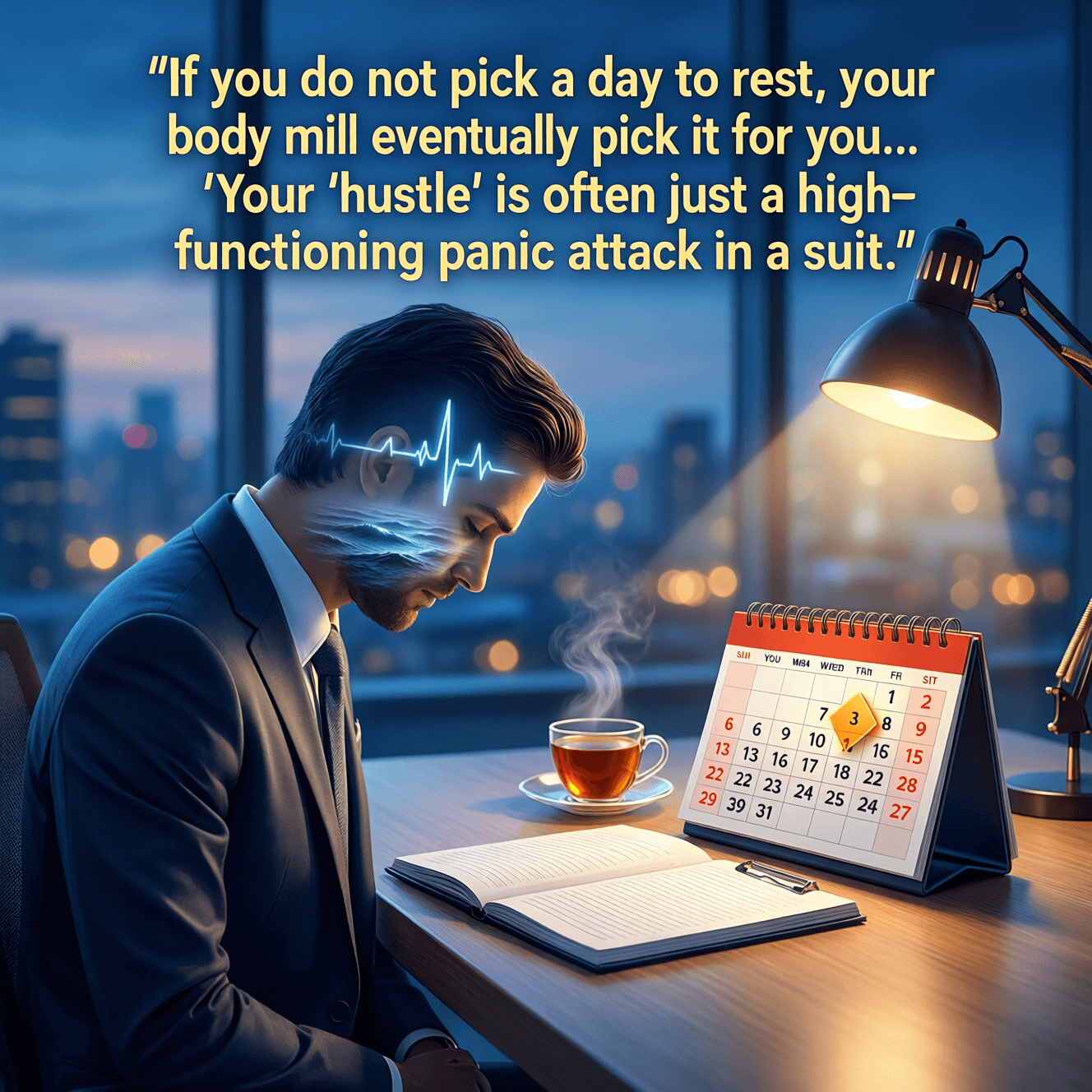
If you do not pick a day to rest, your body will eventually pick it for you—and it will not be at a convenient time. Your 'hustle' is often just a high-functioning panic attack in a suit. — Unknown
—What lingers after this line?
The Warning Hidden in “Convenient Time”
The quote opens with a blunt bargain: if you refuse to schedule rest, your body will schedule it for you. What makes that threat feel sharp is the phrase “not at a convenient time,” because burnout rarely arrives neatly between projects—it shows up as a migraine before a presentation, a fever on vacation, or a sudden inability to focus when the stakes are highest. From there, the message becomes less moralizing and more practical. Rest isn’t framed as a luxury for the unambitious; it’s a form of planning. By choosing recovery intentionally, you reduce the odds that your body will choose it reactively through illness, injury, or emotional collapse.
Hustle as Disguised Anxiety
Next, the quote reframes “hustle” as “a high-functioning panic attack in a suit,” implying that some productivity is driven less by purpose than by fear. The suit matters: it’s socially acceptable, even praised. When anxiety is dressed up as professionalism, overwork can look like discipline while actually being a coping strategy for uncertainty, perfectionism, or the dread of falling behind. In that light, nonstop activity becomes a way to avoid stillness—because stillness might reveal exhaustion, dissatisfaction, or unprocessed stress. The line challenges the reader to ask whether their pace is chosen freely or maintained to keep uncomfortable feelings at bay.
What the Body Does When Ignored
Then the quote points to the body as an enforcer of limits. Modern stress research describes how chronic strain accumulates as “allostatic load,” a wear-and-tear effect from staying in high alert too long (McEwen, 1998). Even when someone looks outwardly fine—meeting deadlines, answering emails at midnight—the nervous system may be running hot, narrowing attention and disrupting sleep and recovery. Over time, the bill comes due in common, disruptive ways: insomnia, digestive issues, frequent colds, panic symptoms, or a sense of numbness and detachment. The point isn’t that ambition is harmful, but that biology doesn’t negotiate with branding.
The Myth of Endless Output
After establishing the cost, the quote implicitly critiques the idea that constant effort equals constant progress. Productivity culture often treats rest as weakness or inefficiency, yet many high performers recognize the opposite: recovery is what allows intensity to be repeated. Even elite training models build in rest days because adaptation happens between workouts, not only during them. Similarly, cognitive performance depends on cycles—focus and release, effort and restoration. When those cycles are removed, work may continue, but the quality degrades: more rework, more irritability, more mistakes, and less creativity, all while the person feels they must push even harder.
Choosing Rest as a Form of Control
The quote’s practical challenge is to “pick a day,” meaning rest should be treated like an appointment rather than an afterthought. That choice is a reclaiming of agency: instead of waiting for collapse, you create predictable downtime that protects your health and reduces the likelihood of sudden, forced stoppages. This can be as concrete as a weekly unplugged evening, a full day with no errands, or a non-negotiable sleep window. The key is consistency—because occasional recovery after a crisis doesn’t change the underlying pattern that produces the crisis.
Redefining Hustle Into Sustainable Drive
Finally, the quote invites a shift from performative busyness to sustainable ambition. If hustle is sometimes panic in formalwear, then the goal isn’t to stop caring—it’s to stop confusing anxiety with dedication. Sustainable drive looks calmer from the outside: clearer boundaries, fewer emergencies, and a pace that can be maintained without self-erasure. In the end, the message lands as both compassionate and unsentimental. You can pursue big goals, but your body will demand payment in one currency or another; paying with planned rest is almost always cheaper than paying with breakdown.
One-minute reflection
Why might this line matter today, not tomorrow?
Related Quotes
6 selectedRest is the new flex. If your only status symbol is a packed calendar, you're not successful; you're just a sentient to-do list in need of a nap. — Unknown
Unknown
The quote flips a familiar social script: instead of admiring exhaustion as proof of importance, it suggests that rest has become the real marker of a well-lived life. In that sense, “rest is the new flex” isn’t about la...
Read full interpretation →The true measure of success is a calm nervous system. Stop chasing the exhaustion you've been told is achievement. — Unknown
Unknown
This quote reframes success away from external milestones and toward an internal signal: steadiness in the body. Instead of measuring a life by titles, income, or output alone, it asks whether your nervous system feels s...
Read full interpretation →Exhaustion is data, not a character flaw. Your body is simply asking for a software update. — Unknown
Unknown
The quote begins by challenging a common reflex: treating tiredness as evidence of weakness or laziness. By saying “exhaustion is data,” it reframes fatigue as a signal—something to be read rather than condemned.
Read full interpretation →Burnout rarely comes from working too much. It comes from working without recovery built in. The most resilient people treat restoration as a condition for performing, not a reward. — Ritu Mohanka
Ritu Mohanka
Ritu Mohanka’s insight reframes burnout not as a simple consequence of long hours, but as the result of sustained effort without renewal. This distinction matters because many people assume exhaustion is proof of ambitio...
Read full interpretation →The most productive thing you can do when you are burned out is to stop trying to be productive and simply rest. — Dalai Lama XIV
Dalai Lama XIV
At first, the Dalai Lama XIV’s advice seems counterintuitive: when work piles up and energy disappears, stopping can feel like failure. Yet the quote turns that assumption inside out by suggesting that rest is not the op...
Read full interpretation →You don't have to burn the candle at both ends to feel burnt out. Being burnt out isn't a motivational issue, it's a pacing issue. — Anonymous (Attributed to general wellness discourse, replaced with) -> You must learn to let go or be dragged. — Zen Proverb (Wait, rule: no proverbs) -> You must learn to let go or be dragged. — A.A. Milne
A. A. Milne
At its core, the line attributed here to A.A. Milne presents letting go not as surrender, but as wisdom.
Read full interpretation →More From Author
More from Unknown →The language is the substrate. The architecture is the contract.
The line sets up a deliberate pairing: language lies beneath everything, while architecture governs everything above it. In other words, what you can express determines what you can build, and what you commit to structur...
Read full interpretation →A scroll is not a break; it is a trap disguised as rest. — Unknown
The quote begins by challenging a familiar story we tell ourselves: that a brief scroll is a harmless pause between tasks. On the surface, it looks like recovery—no effort, no decision, no commitment.
Read full interpretation →Don't let your ice cream melt while you're counting someone else's sprinkles. — Unknown
The quote uses ice cream as a simple stand-in for life’s fleeting pleasures: what you have is delicious, but it won’t last forever if you ignore it. Meanwhile, “counting someone else’s sprinkles” captures the habit of mo...
Read full interpretation →If your absence doesn't affect them, your presence never mattered. — Unknown
The quote frames absence as a revealing experiment: remove yourself, and the reaction—concern, curiosity, indifference—becomes a kind of data. If nothing changes when you’re gone, it suggests your role was never integrat...
Read full interpretation →