
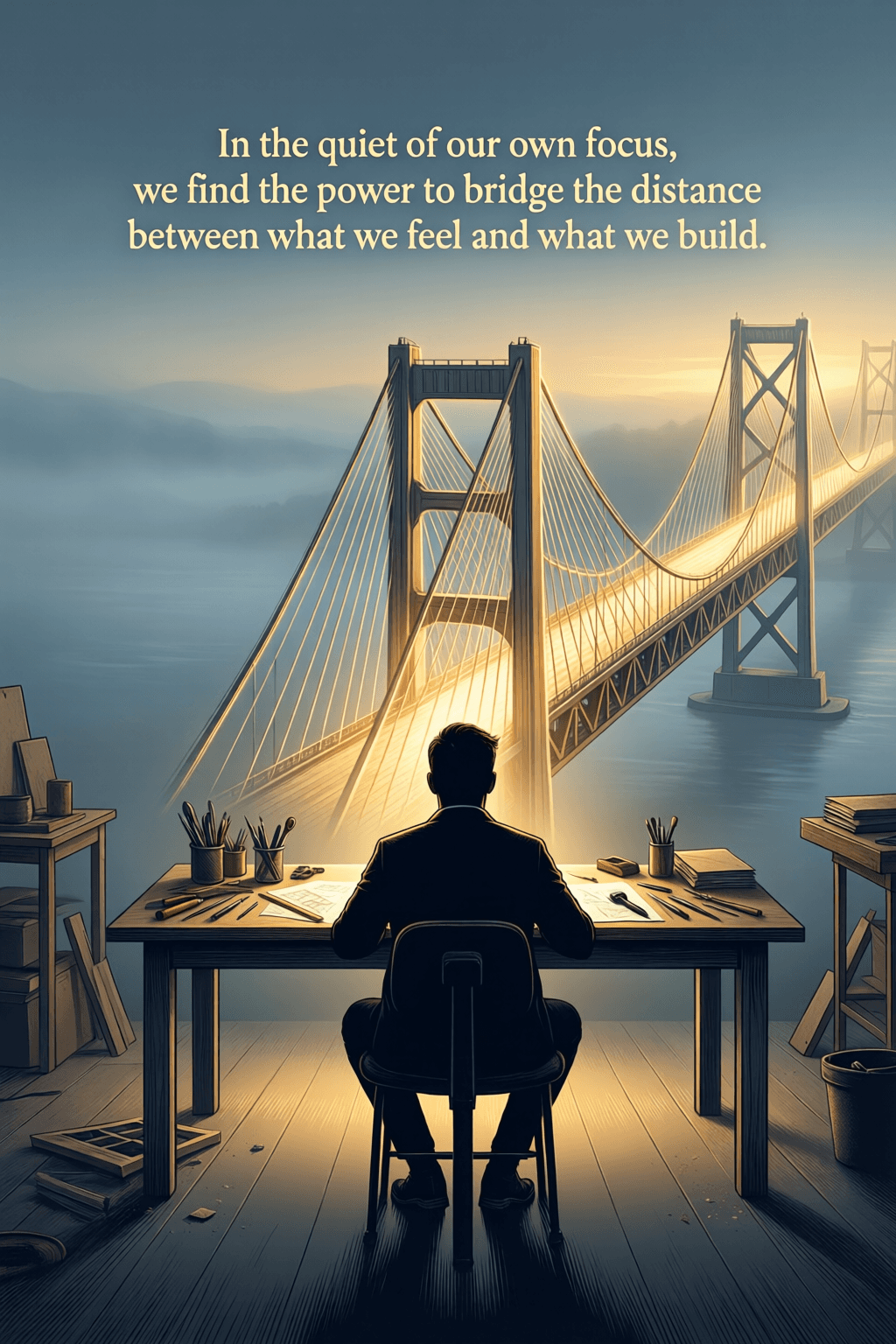
In the quiet of our own focus, we find the power to bridge the distance between what we feel and what we build. — Tove Jansson
—What lingers after this line?
The Quiet Strength of Attention
At its core, Tove Jansson’s line suggests that focus is not merely concentration but a private, sustaining force. In silence and inwardness, scattered emotion begins to take shape, allowing us to understand what matters before we try to express it. Rather than treating feeling and making as separate realms, she presents attention as the bridge between inner life and outward work. This idea feels especially Jansson-like. In works such as The Summer Book (1972), she repeatedly shows that stillness is not emptiness but a condition in which perception deepens. As a result, quiet focus becomes a form of power: it gathers vague impulses and turns them into something deliberate, whether a drawing, a sentence, or a life choice.
From Emotion to Form
Building on that, the quotation speaks to one of art’s oldest challenges: how to give form to feeling without reducing it. Emotions are fluid, often contradictory, and difficult to name; yet through focused work, they can become objects, stories, designs, or decisions that others can encounter. What we build, then, is not separate from what we feel but its translation. This movement from sensation to structure appears throughout creative history. Virginia Woolf’s A Room of One’s Own (1929), for instance, argues that interior freedom and sustained attention are necessary for artistic production. In that sense, Jansson’s thought extends beyond inspiration alone, reminding us that creation depends on the disciplined patience to let emotion ripen into form.
Why Distance Needs Bridging
Yet the quote also acknowledges a gap: there is often real distance between inner experience and outward expression. People may feel deeply but still struggle to act, speak, or make. That distance can arise from fear, distraction, or the sheer complexity of emotion itself. Jansson does not deny the divide; instead, she names focus as the means of crossing it. Consequently, the statement carries quiet encouragement. It implies that meaning is not found by eliminating emotion or by forcing productivity, but by attending closely enough that the two begin to meet. Like a craftsperson aligning two pieces of wood before joining them, we must bring care to the connection between what stirs inside us and what finally enters the world.
Creation as a Personal Discipline
From there, the quotation broadens into a philosophy of work. Focus is often romanticized as a rare burst of genius, but Jansson frames it more humbly—as something cultivated in solitude and steadiness. What we build emerges not only from talent but from returning, again and again, to the task with enough stillness to hear what our feelings are asking of us. In this way, her thought resonates with the working habits of many artists and makers. Louise Bourgeois once remarked that art was a guarantee of sanity, suggesting that disciplined creation could give shape to emotional life. Similarly, Jansson’s insight proposes that focused labor is not opposed to feeling; rather, it is the practice that allows feeling to become durable and shareable.
A Lesson Beyond Art
Finally, the quote reaches beyond painters, writers, or designers and speaks to anyone trying to live intentionally. We build not only books and images but relationships, routines, homes, and identities. In each case, the challenge remains the same: how to turn inward truth into outward reality without losing its essence. Therefore, Jansson’s words offer a gentle ethic for modern life. In a world crowded by noise and interruption, quiet focus becomes an act of fidelity to ourselves. By protecting that inward space, we gain the power to close the distance between emotion and action, and what we create—large or small—begins to carry the stamp of something genuinely felt.
One-minute reflection
Why might this line matter today, not tomorrow?
Related Quotes
6 selectedComplexity means distracted effort. Simplicity means focused effort. — Edward De Bono
Edward de Bono
At its heart, Edward de Bono’s remark draws a sharp distinction between motion and direction. Complexity, in this sense, is not merely having many parts; rather, it is effort scattered across too many priorities, decisio...
Read full interpretation →The more you can increase your focus of time and attention, the more capable you will be of managing your world. — Esther Dyson
Esther Dyson
Esther Dyson’s quote begins with a simple but powerful premise: the quality of our lives is shaped by where we place our attention. The more deliberately we focus our time and mental energy, the less we are pushed around...
Read full interpretation →Stop trying to fix your life in a world that profits from you feeling broken. True strength is reclaiming your own focus. — Jessa Crispin
Jessa Crispin
At first glance, Jessa Crispin’s quote rejects the familiar command to endlessly improve oneself. Her point is not that growth is meaningless, but that a whole industry thrives by convincing people they are perpetually f...
Read full interpretation →Being overwhelmed means that your life or work is overpowering you. Regain control by clarifying your intentions and focusing on your next step. — Daphne Michaels
Daphne Michaels
At its core, Daphne Michaels’ quote defines overwhelm as a moment when the demands of life or work seem larger than our capacity to respond. The word itself suggests not mere busyness, but a loss of proportion: tasks blu...
Read full interpretation →To do one thing well is the only way to endure a world that demands we do everything at once. — Pico Iyer
Pico Iyer
At its core, Pico Iyer’s line argues that endurance now depends less on speed than on concentration. In a culture that praises multitasking, constant updates, and endless availability, he reframes survival as an act of d...
Read full interpretation →Starve your distractions, feed your focus. — Daniel Goleman
Daniel Goleman
At its core, Daniel Goleman’s line turns focus into a matter of nourishment: whatever we repeatedly feed grows stronger, while whatever we neglect loses power. In that sense, distraction is not just an inconvenience but...
Read full interpretation →More From Author
More from Tove Jansson →