
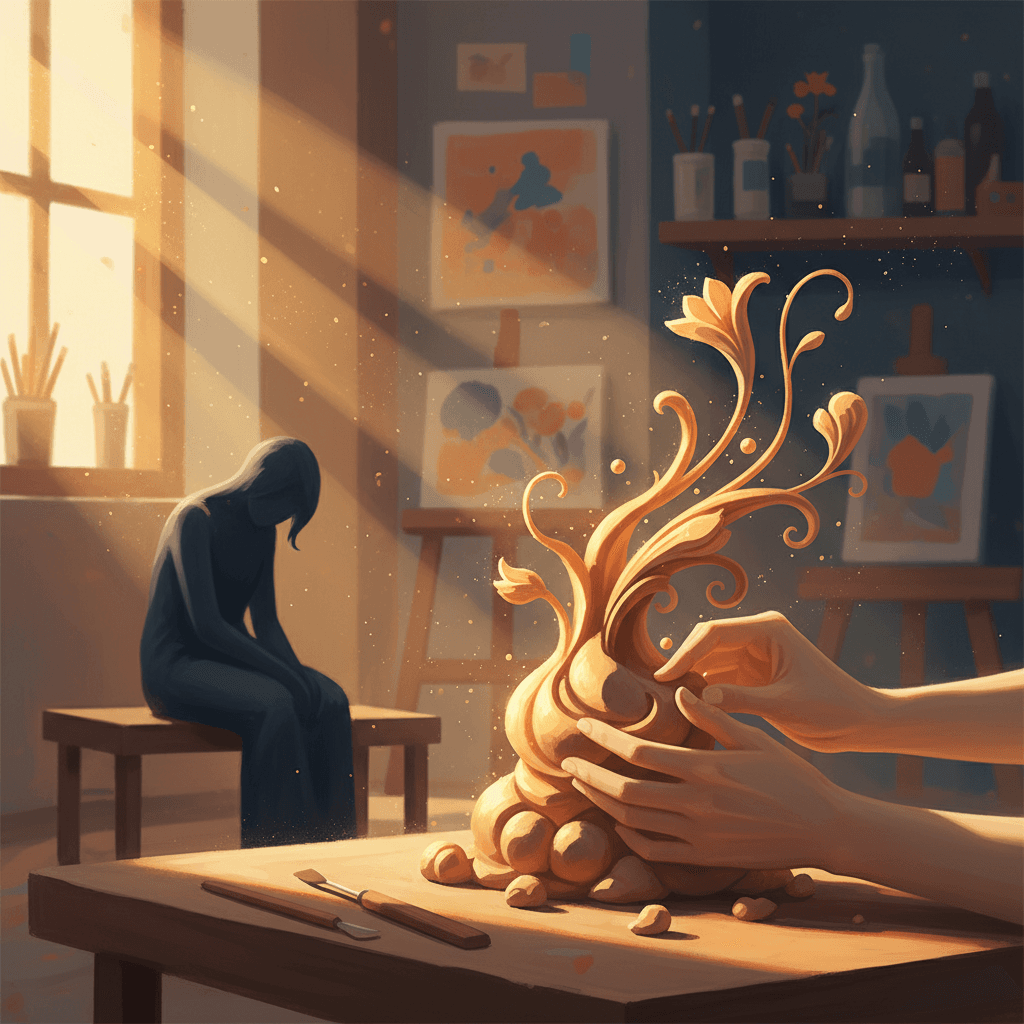
Keep your hands busy with creation, and fear will learn to sit quietly — Langston Hughes
—What lingers after this line?
Turning Hands Into Anchors of Courage
Langston Hughes suggests that what we do with our hands can transform what happens in our minds. By urging us to "keep your hands busy with creation," he reframes courage not as a feeling we must wait for, but as a practice we can enact. Rather than wrestling directly with fear, Hughes invites us to anchor ourselves in making—writing, building, cooking, sewing, drawing—so that courage arises indirectly, as a quiet companion to focused work.
Creation as a Gentle Antidote to Anxiety
Instead of demanding that fear disappear, Hughes imagines it “learning to sit quietly.” This subtle phrasing acknowledges that fear may never fully vanish; it simply loses its power to dominate. Psychologists now describe a similar dynamic in behavioral activation therapies, where meaningful action interrupts spirals of worry. When we create, our attention shifts from catastrophic possibilities to tangible problems we can actually solve—what color to choose, which word to place, how to shape the next line or stitch.
From Harlem Renaissance Struggle to Personal Agency
Hughes wrote amid the Harlem Renaissance, a period charged with both artistic brilliance and deep social fear. His own life—marked by racism, economic insecurity, and political pressure—shows how creation can be an act of defiance. Poems like “Let America Be America Again” channel collective anxieties into crafted language, transforming paralysis into protest. In this light, his advice is not simply self-help; it is a blueprint for turning private dread into public art and, ultimately, into social change.
The Discipline of Making as Everyday Resistance
Crucially, Hughes highlights busyness with "creation," not mere distraction. Scrolling endlessly or numbing out with entertainment keeps our hands occupied but rarely quiets fear; it simply postpones it. Creative work, by contrast, requires intention and discipline. Whether someone tends a garden, repairs a bicycle, or drafts a short story, each small act of making asserts, "I can shape something in this world." Over time, this steady practice becomes a kind of everyday resistance to helplessness.
Letting Fear Stay, but Not Lead
In the end, Hughes offers a compassionate stance toward fear. Rather than insisting we become fearless, he suggests we let fear take a seat in the corner while we continue to build. This mirrors modern mindfulness teachings that encourage us to notice anxiety but still act in line with our values. When our hands are engaged in creation, fear remains present but no longer commands the room; our work, not our worry, becomes the louder voice.
One-minute reflection
Where does this idea show up in your life right now?
Related Quotes
6 selectedEmotional resilience refers to your ability to roll with the punches, adapt to adversity, and bounce back after setbacks. — Bettendorf Counseling Center
Bettendorf Counseling Center
At its core, the Bettendorf Counseling Center’s definition frames emotional resilience as a flexible strength rather than a hard shell. To “roll with the punches” is not to avoid pain or pretend setbacks do not matter; i...
Read full interpretation →When you are in the middle of a creative block, remember that the work is not the point; the point is the practice of showing up. — Twyla Tharp
Twyla Tharp
Twyla Tharp’s quote shifts attention away from the finished product and toward the habit that makes creation possible in the first place. In the middle of a creative block, it is easy to believe that nothing matters unle...
Read full interpretation →It is not he who reviles or strikes you who insults you, but your opinion that these things are insulting. — Epictetus
Epictetus
Epictetus flips the usual story of offense: the injury is not located in another person’s words or blows, but in the meaning we assign to them. By separating the event from our evaluation of it, he argues that what feels...
Read full interpretation →Everything is workable. We can use the difficult situations of our lives to awaken our hearts. — Pema Chödrön
Pema Chödrön
Pema Chödrön’s line begins with a disarming premise: “Everything is workable.” Rather than denying pain or insisting that problems are secretly pleasant, she proposes a practical confidence that even messy circumstances...
Read full interpretation →If they want to be wrong about you, let them. Save your energy for the things you can actually control. — Mel Robbins
Mel Robbins, United States.
Mel Robbins’ line begins with a counterintuitive permission: if someone insists on misunderstanding you, you don’t have to chase them. The deeper point isn’t indifference or defeat; it’s recognizing that your worth is no...
Read full interpretation →Tough emotions are part of our contract with life. — Susan David
Susan David
Susan David’s line frames emotional pain not as a personal malfunction but as a built-in term of being alive. The word “contract” is especially clarifying: it implies inevitability, reciprocity, and responsibility—if you...
Read full interpretation →More From Author
More from Langston Hughes →Use your words to clear space for others to stand taller beside you. — Langston Hughes
Langston Hughes frames language as something more than self-expression: it is a tool that can rearrange a room. To “clear space” suggests removing clutter—assumptions, interruptions, ego, or the urge to dominate—so other...
Read full interpretation →Work with courage, laugh with defiance, and leave the world kinder than you found it. — Langston Hughes
Langston Hughes compresses an entire moral philosophy into three linked imperatives: work bravely, laugh defiantly, and improve the world. The structure matters, because it moves from inner posture (courage) to public st...
Read full interpretation →Write your courage into the ordinary hours; the page will remember and reward you. — Langston Hughes
Hughes frames courage not as a single grand gesture but as something we “write” into the most unremarkable parts of life—the ordinary hours that tend to blur together. In that phrasing, bravery becomes a habit of attenti...
Read full interpretation →Plant the seeds of your intentions today and tend them with steady hands — Langston Hughes
Langston Hughes frames intention not as a passing wish but as something alive—small at first, yet capable of becoming substantial. A seed holds potential, but it also requires placement in the right ground; likewise, an...
Read full interpretation →