
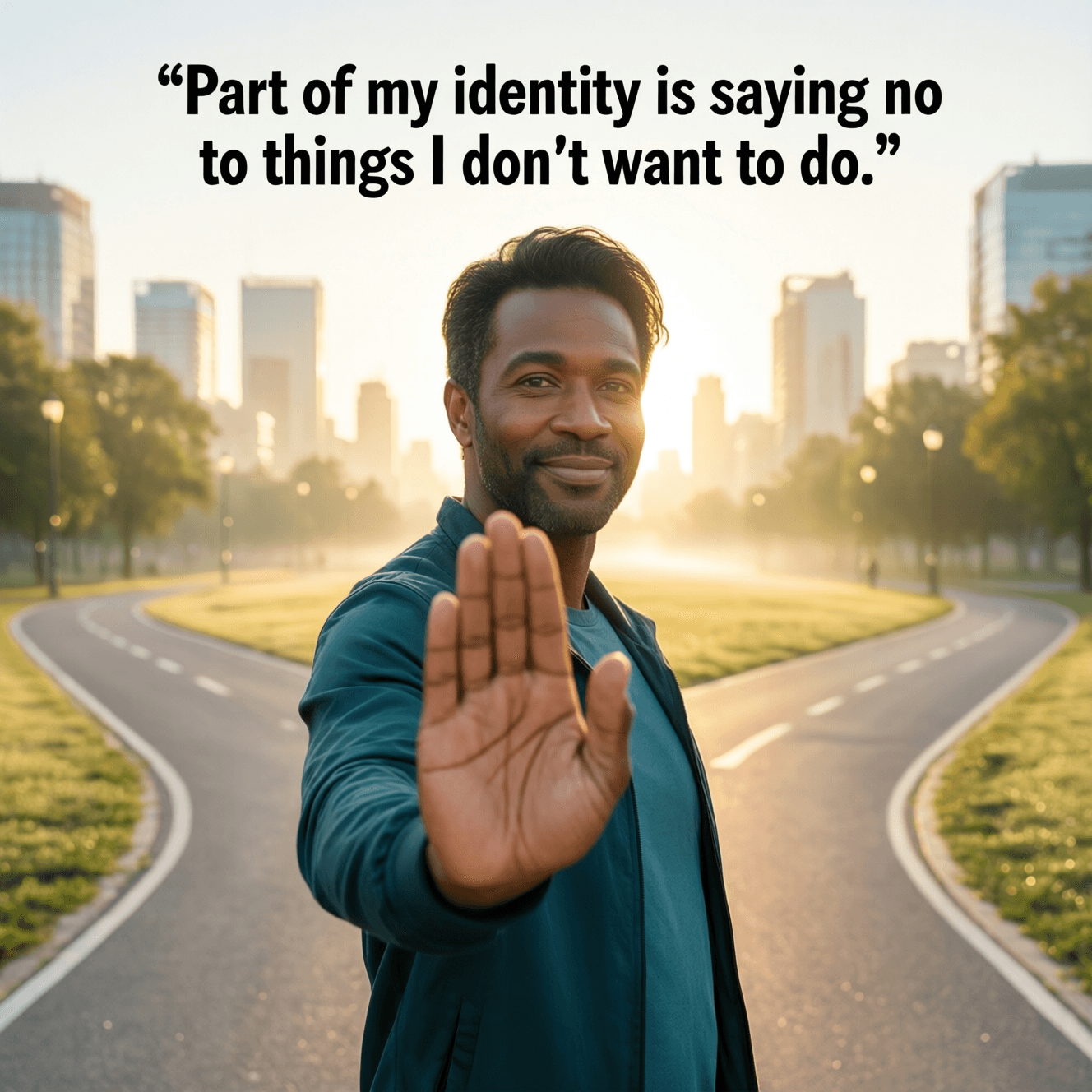
Part of my identity is saying no to things I don't want to do. — Lady Gaga
—What lingers after this line?
A Boundary Framed as Selfhood
Lady Gaga’s line doesn’t treat refusal as a minor social skill; it elevates it into something constitutive. By saying that “part of my identity” is saying no, she implies that the self isn’t only expressed through what we pursue, but also through what we decline. In that sense, choice becomes a form of authorship: the life you live is shaped as much by your exclusions as by your commitments. This framing matters because many people are trained to see “no” as rudeness or ingratitude. Gaga turns that assumption around, suggesting that the ability to refuse is not antisocial, but self-defining—a way to preserve integrity in a world full of demands.
No as Protection Against Overreach
Building on that idea, “no” functions like a psychological perimeter. Fame, work, family expectations, and digital access can all expand until they occupy every available space, and refusal is the tool that prevents that expansion from becoming entitlement. In the context of celebrity, this is especially vivid: constant invitations, obligations, and scrutiny make boundaries less a luxury than a survival strategy. Yet the principle applies beyond stardom. Whenever other people’s preferences begin to replace your own—what you do, how you spend time, what you tolerate—“no” becomes a protective mechanism that keeps your life from being managed by the loudest external voice.
Agency and the Power of Deliberate Choice
From protection, the quote naturally moves into agency. Saying no is an action, not merely the absence of agreement, and it signals that consent is active rather than assumed. This aligns with a long philosophical current that links freedom to self-governance: Isaiah Berlin’s “Two Concepts of Liberty” (1958) distinguishes between being left alone and actually directing one’s life, and refusal is one concrete way people practice that direction. When Gaga makes refusal part of identity, she is also rejecting passivity. Identity becomes less about labels assigned by others and more about decisions repeatedly made—especially under pressure.
The Hidden Cost of People-Pleasing
However, refusing can be hardest for those rewarded for compliance. People-pleasing often begins as a strategy for safety or belonging, but it can quietly erode self-trust: if you habitually override your preferences, you eventually lose confidence that your preferences matter. In everyday life this looks like agreeing to plans you dread, taking on tasks you resent, or staying silent when you disagree—small yeses that accumulate into a life that doesn’t feel self-directed. Against this backdrop, Gaga’s statement reads like a corrective. It suggests that identity requires friction—that becoming yourself involves disappointing expectations that are incompatible with your values, energy, or wellbeing.
Refusal as a Creative and Professional Filter
Next, the quote can be read as a strategy for craft. Artists and professionals are defined not only by what they produce but by what they decline to produce, endorse, or attach their name to. Steve Jobs reportedly emphasized focus as “saying no to 1,000 things” (commonly cited in coverage of Apple’s product strategy), and the underlying logic is similar: discernment creates coherence. By turning “no” into identity, Gaga hints that a recognizable voice—whether artistic, ethical, or personal—depends on selective commitment. The result is not deprivation but clarity, because every refusal preserves time and attention for what fits.
Saying No Without Becoming Closed Off
Finally, making “no” part of identity raises a question of balance. Refusal can preserve autonomy, but if it hardens into reflexive rejection, it can become isolation or defensiveness. The more sustainable reading is that “no” is in service of a deeper “yes”—yes to health, to meaningful work, to relationships that respect limits. In that way, the quote lands as an ethic of self-respect rather than stubbornness. Gaga’s identity isn’t merely resistance; it is a commitment to living deliberately, where boundaries are not walls against life but standards for how life is allowed to enter.
One-minute reflection
What does this quote ask you to notice today?
Related Quotes
6 selectedYou are in control of your life. Set new boundaries by removing all of the toxic people from your inner circle. — Jeanette Coron
Jeanette Coron
Jeanette Coron’s statement begins with a direct reminder: you are not merely reacting to life, but participating in its design. By saying you are in control, the quote shifts attention away from blame and toward agency,...
Read full interpretation →If it costs my peace, it's outside my boundary. — Adam J. Jackson
Adam J. Jackson
At its core, Adam J. Jackson’s line reframes boundaries as more than rules we impose on others; they become protections for our inner life.
Read full interpretation →Boundaries are not walls to keep others out, but gates to protect your own nervous system. — Nedra Glover Tawwab
Nedra Glover Tawwab
At first glance, boundaries are often mistaken for rejection, distance, or emotional coldness. Yet Nedra Glover Tawwab’s image of gates rather than walls shifts the entire meaning: boundaries are not built to punish othe...
Read full interpretation →It is about knowing who you are, and just doing what is comfortable for you, and not letting people pull you in a thousand different directions. — Jay-Z
Z
At its core, Jay-Z’s statement argues that self-knowledge is the foundation of a stable life. To know who you are is to possess an inner anchor that holds even when outside expectations become noisy or contradictory.
Read full interpretation →Whenever you feel compelled to put others first at the expense of yourself, you are denying your own reality. — David Stafford
David Stafford
David Stafford’s statement cuts directly to a quiet but damaging habit: treating other people’s needs as inherently more real than our own. At first, putting others first may look like generosity, maturity, or love.
Read full interpretation →You don't set boundaries to keep people out. You set them to keep yourself intact. Because peace doesn't live where you're constantly shrinking. — Intrepid Quips
Intrepid Quips
At first glance, boundaries can seem like walls meant to exclude others, yet this quote reframes them as a form of self-preservation. The point is not rejection but protection: a boundary marks the place where a person c...
Read full interpretation →More From Author
More from Lady Gaga →Even when you have doubts, take that step. Take chances. Mistakes are never just mistakes—they're lessons. — Lady Gaga
Lady Gaga’s quote begins with a striking premise: doubt does not have to disappear before action begins. In fact, she suggests that uncertainty is often the very condition under which courage becomes meaningful.
Read full interpretation →Do not allow people to dim your shine because they are blinded. Tell them to put some sunglasses on. — Lady Gaga
Lady Gaga encourages self-confidence by suggesting that one should not let others diminish their inner light or unique qualities. Instead of dimming oneself to make others comfortable, it is better to shine unapologetica...
Read full interpretation →A clear rejection is always better than a fake promise. — Lady Gaga
This quote highlights the value of being honest, even when it means delivering bad news.
Read full interpretation →