
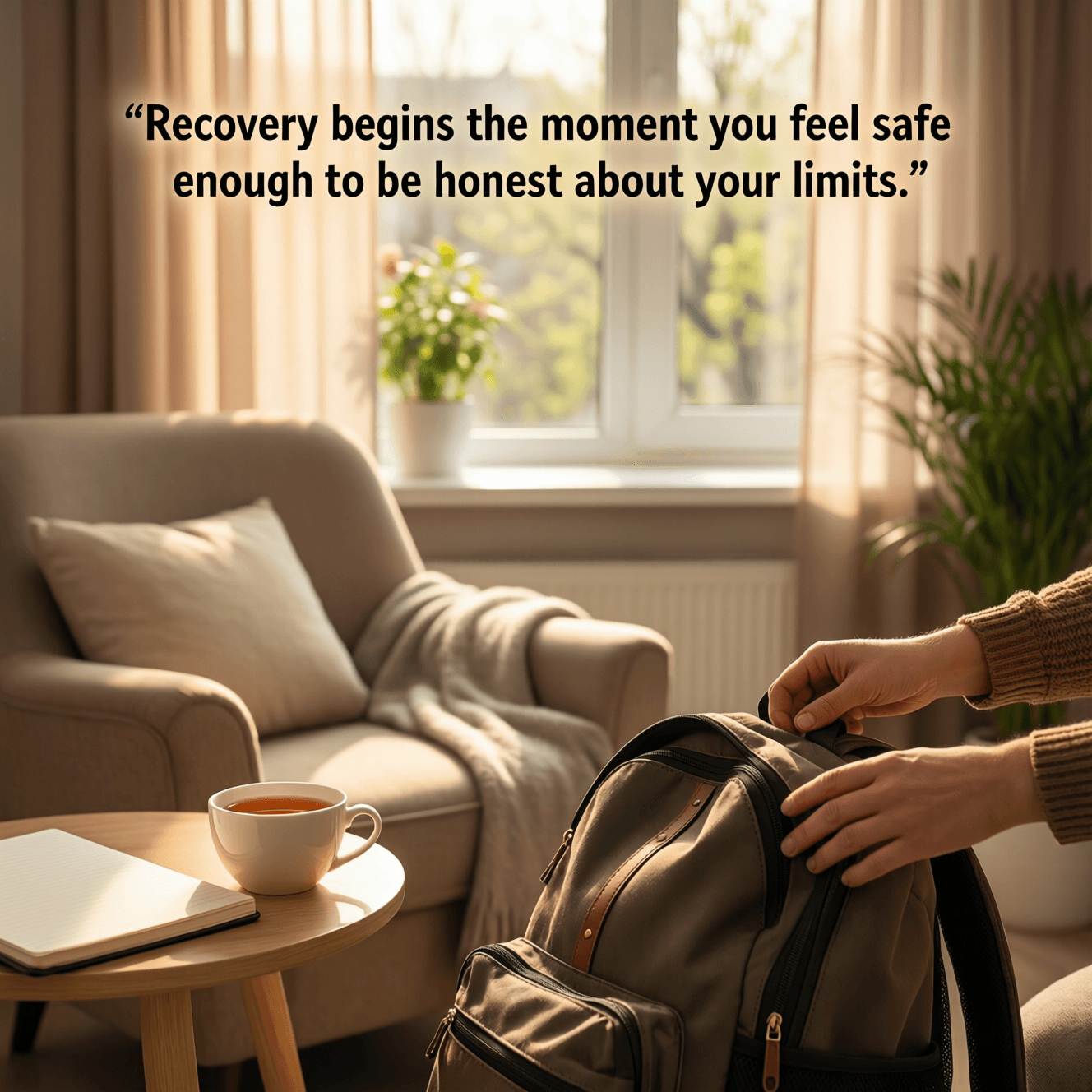
Recovery begins the moment you feel safe enough to be honest about your limits. — Jennifer Moss
—What lingers after this line?
Why Safety Comes Before Change
Jennifer Moss’s line begins with a quiet prerequisite: before anyone can rebuild, they must feel safe. Safety here isn’t mere comfort; it’s the sense that honesty won’t be punished—by a boss, a family member, a therapist, or even one’s own inner critic. In that light, “recovery” becomes less about willpower and more about creating conditions where truth can be spoken. Once safety is present, the nervous system can shift out of constant vigilance, making reflection possible. From there, what looked like resistance or laziness may reveal itself as self-protection, and the path forward becomes clearer and more compassionate.
Honesty as the Turning Point
The quote then locates the turning point in a single moment: when you can admit what is real. That honesty might sound like, “I can’t take on another project,” “I need help,” or “I’m not okay.” Importantly, Moss frames this as a beginning rather than a confession of failure, suggesting that recovery starts when denial ends. From this perspective, honesty is not simply disclosure—it is orientation. By naming what’s true, you stop negotiating with exhaustion and start working with reality, which is the first practical step toward sustainable healing.
Limits as Information, Not Weakness
Next, the focus on “limits” reframes boundaries as data about capacity. Limits can be physical (sleep, pain, illness), emotional (grief, overwhelm), or cognitive (attention, decision fatigue). Treating them as shameful often leads to overextension; treating them as information leads to wiser pacing. This echoes the spirit of burnout research that emphasizes mismatch between demands and resources as a driver of breakdown (Christina Maslach and Michael Leiter’s *The Truth About Burnout* (1997) discusses chronic workplace stressors and depletion). In that context, admitting limits is less about personal deficiency and more about restoring balance between what’s asked and what’s possible.
The Role of Trust and Environment
Because the quote ties honesty to feeling “safe enough,” it implicitly points outward: recovery is relational and environmental, not purely internal. People disclose limits when they trust they won’t be dismissed, mocked, or penalized. A manager who responds to “I’m at capacity” with problem-solving rather than judgment can become part of the recovery process. Consequently, supportive settings function like scaffolding. They allow small acts of truth-telling—declining a meeting, requesting a lighter load, asking for accommodations—to accumulate into a new normal where health is protected rather than constantly spent.
From Boundaries to Sustainable Habits
Once limits can be named safely, boundaries become actionable: renegotiating deadlines, scheduling rest, delegating, or seeking care. The initial honesty is brief, but it opens the door to routines that prevent relapse into the same patterns that required recovery in the first place. Over time, these choices create an identity shift: you become someone who listens to early warning signals rather than waiting for crisis. In that sense, Moss’s “moment” is both simple and profound—the first honest boundary is often the seed from which long-term stability grows.
A Compassionate Metric for Progress
Finally, the quote offers a gentle way to measure progress: not by constant productivity or perfect coping, but by increasing capacity for truthful self-reporting. If you can admit sooner that you’re tired, anxious, or stretched thin, you’re recovering—even if nothing else looks dramatic yet. This makes recovery feel attainable because it begins with a single, human act: saying what you can and cannot do. And as that honesty becomes safer—through supportive relationships, healthier workplaces, or kinder self-talk—the path to healing becomes not only possible, but practical.
One-minute reflection
What's one small action this suggests?
Related Quotes
6 selectedFamily is whoever feels like home to your nervous system. — Vex King
Vex King
At first glance, Vex King’s quote gently shifts the meaning of family away from bloodlines and formal roles toward felt safety. In this view, family is not only who raised you or who shares your name, but who consistentl...
Read full interpretation →If it costs my peace, it's outside my boundary. — Adam J. Jackson
Adam J. Jackson
At its core, Adam J. Jackson’s line reframes boundaries as more than rules we impose on others; they become protections for our inner life.
Read full interpretation →Boundaries are not walls to keep others out, but gates to protect your own nervous system. — Nedra Glover Tawwab
Nedra Glover Tawwab
At first glance, boundaries are often mistaken for rejection, distance, or emotional coldness. Yet Nedra Glover Tawwab’s image of gates rather than walls shifts the entire meaning: boundaries are not built to punish othe...
Read full interpretation →It is about knowing who you are, and just doing what is comfortable for you, and not letting people pull you in a thousand different directions. — Jay-Z
Z
At its core, Jay-Z’s statement argues that self-knowledge is the foundation of a stable life. To know who you are is to possess an inner anchor that holds even when outside expectations become noisy or contradictory.
Read full interpretation →The greatest gift you can give an anxious mind is a home that serves as a sanctuary, where you can be heard without being judged. — Nedra Glover Tawwab
Nedra Glover Tawwab
At its core, Nedra Glover Tawwab’s quote redefines home as more than a physical shelter. She presents it as an emotional refuge, a place where an anxious mind can finally lower its guard.
Read full interpretation →You cannot heal a body that does not feel safe. — Sanctuary Wellness
Sanctuary Wellness
At its core, the quote argues that healing is not merely a physical process but a deeply embodied one. Sanctuary Wellness suggests that before the body can repair, it must register that danger has passed.
Read full interpretation →More From Author
More from Jennifer Moss →