
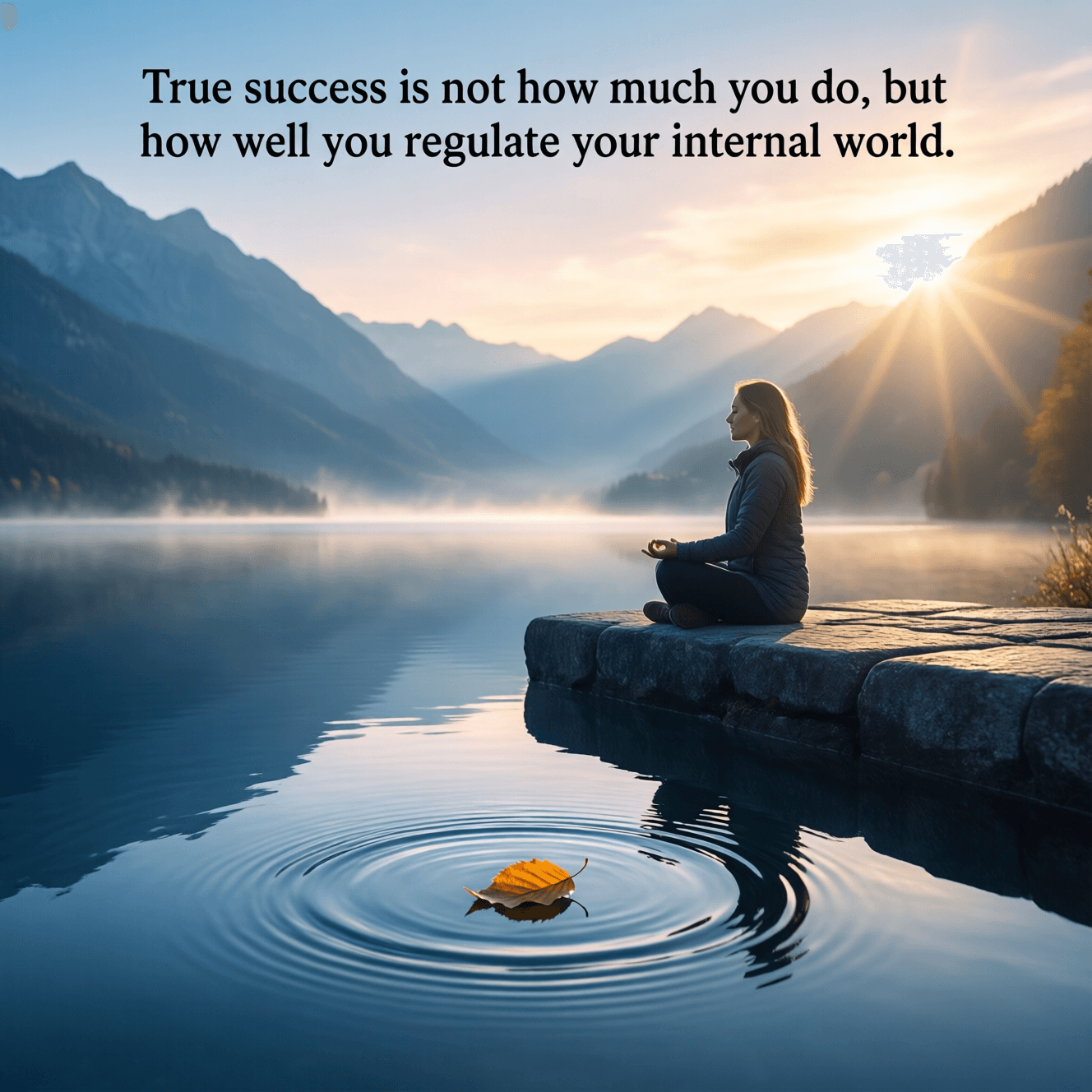
True success is not how much you do, but how well you regulate your internal world. — Unknown
—What lingers after this line?
Redefining Success Beyond Productivity
The quote challenges a common cultural reflex: counting tasks, hours, or achievements as the primary measure of success. Instead, it argues that the quality of one’s inner life—attention, emotion, and impulse—determines whether outward accomplishments are sustainable and meaningful. This reframing doesn’t dismiss hard work; it relocates its foundation. When internal conditions are chaotic, even impressive output can feel brittle, driven by anxiety or comparison. By contrast, regulated inner states can make fewer actions more effective, because they are chosen deliberately rather than reactively.
The “Internal World” as a Hidden Operating System
What we call an internal world includes mood, self-talk, bodily stress responses, and the narratives we carry about who we are. Although invisible, these factors quietly shape decisions—whether we procrastinate, lash out, overcommit, or persist through discomfort. Seen this way, inner regulation functions like an operating system: it determines how smoothly everything else runs. A person can have talent and opportunity, yet lose momentum if their inner system is constantly hijacked by rumination or fear. Conversely, a calmer, clearer inner landscape can turn ordinary effort into consistent progress.
Emotional Regulation as the Core Skill
At the center of the quote is emotional regulation—the ability to notice feelings without being ruled by them. Aristotle’s Nicomachean Ethics (c. 350 BC) frames virtue as finding the right response “at the right times, about the right things,” suggesting that excellence is less about intensity than appropriate control. In practical terms, regulated people can feel anger without becoming cruel, ambition without becoming frantic, and disappointment without collapsing. Because they recover faster and choose responses more carefully, their work and relationships tend to compound rather than fracture under pressure.
Attention, Impulse, and the Modern Mind
Moving from emotion to cognition, regulation also involves steering attention—especially in environments engineered for distraction. William James’s Principles of Psychology (1890) famously emphasizes that voluntary attention is a cornerstone of will, hinting that success often hinges on what we can repeatedly return to. Likewise, impulse control is not mere restraint; it is strategy. The capacity to pause before reacting—before sending the angry message, making the rushed purchase, or accepting another commitment—creates space for higher-quality decisions. Over time, that space becomes a competitive advantage that looks like “discipline” from the outside.
Health, Stress, and Sustainable Achievement
Internal regulation has physical consequences, too, because stress is experienced through the body. When the nervous system stays chronically activated, productivity can rise briefly and then crash into exhaustion, irritability, or illness. In contrast, a regulated system supports steadier energy, clearer thinking, and better sleep—ingredients that make achievement repeatable. This is why many high performers quietly build routines that protect the inner world first: movement, boundaries, reflection, or therapy. Although these practices may look like “less doing,” they often produce more reliable results because they reduce self-sabotage and burnout.
A Practical Measure of “How Well You Regulate”
The quote ultimately offers a different scorecard: not how busy you were, but how skillfully you navigated your own mind. Did you notice your stress early? Did you choose rest before resentment? Did you respond to setbacks with learning instead of self-contempt? From there, success becomes a kind of inner craftsmanship. As your regulation improves, your actions tend to become fewer but cleaner—more aligned, more focused, and less polluted by panic or perfectionism. The external wins that follow are then not just accomplishments, but expressions of an internally governed life.
One-minute reflection
What's one small action this suggests?
Related Quotes
6 selectedIf you are distressed by anything external, the pain is not due to the thing itself, but to your estimate of it.
Unknown
The quote shifts responsibility for distress away from the outside world and back toward the mind that interprets it. Instead of treating an event as inherently painful, it proposes that suffering arises when we label th...
Read full interpretation →Stability is the new success; true power lives in a regulated nervous system. — Unknown
Unknown
The quote reframes success away from public milestones—money, status, relentless productivity—and toward an internal condition: stability. In a culture that often rewards urgency, choosing steadiness can look unimpressiv...
Read full interpretation →If you get the inside right, the outside will fall into place. — Eckhart Tolle
Eckhart Tolle
At its heart, Eckhart Tolle’s statement suggests that external life often reflects internal condition. If the mind is conflicted, reactive, or fearful, the world can appear equally chaotic; conversely, when one cultivate...
Read full interpretation →Mental strength is the ability to regulate your thoughts, manage your emotions, and take productive action even when life is hard. — Amy Morin
Amy Morin
At its core, Amy Morin’s statement reframes mental strength as a set of skills rather than a fixed personality trait. Instead of imagining toughness as stoic invulnerability, she defines it as the ability to guide one’s...
Read full interpretation →Resilience is not the absence of stress, but the ability to regulate your internal climate while the world remains chaotic. — Seneca
Seneca
At first glance, Seneca’s insight overturns a common misconception: resilience is not a life free from pressure, disruption, or pain. Instead, it is the cultivated capacity to steady oneself internally even when external...
Read full interpretation →Your nervous system is not a machine that can be forced; it is a garden that must be tended. — Bessel van der Kolk
Bessel van der Kolk
Bessel van der Kolk’s metaphor immediately shifts the way we think about the body. Instead of imagining the nervous system as a machine to be pushed harder, repaired quickly, or disciplined into obedience, he presents it...
Read full interpretation →More From Author
More from Unknown →The language is the substrate. The architecture is the contract.
The line sets up a deliberate pairing: language lies beneath everything, while architecture governs everything above it. In other words, what you can express determines what you can build, and what you commit to structur...
Read full interpretation →A scroll is not a break; it is a trap disguised as rest. — Unknown
The quote begins by challenging a familiar story we tell ourselves: that a brief scroll is a harmless pause between tasks. On the surface, it looks like recovery—no effort, no decision, no commitment.
Read full interpretation →Don't let your ice cream melt while you're counting someone else's sprinkles. — Unknown
The quote uses ice cream as a simple stand-in for life’s fleeting pleasures: what you have is delicious, but it won’t last forever if you ignore it. Meanwhile, “counting someone else’s sprinkles” captures the habit of mo...
Read full interpretation →If your absence doesn't affect them, your presence never mattered. — Unknown
The quote frames absence as a revealing experiment: remove yourself, and the reaction—concern, curiosity, indifference—becomes a kind of data. If nothing changes when you’re gone, it suggests your role was never integrat...
Read full interpretation →