
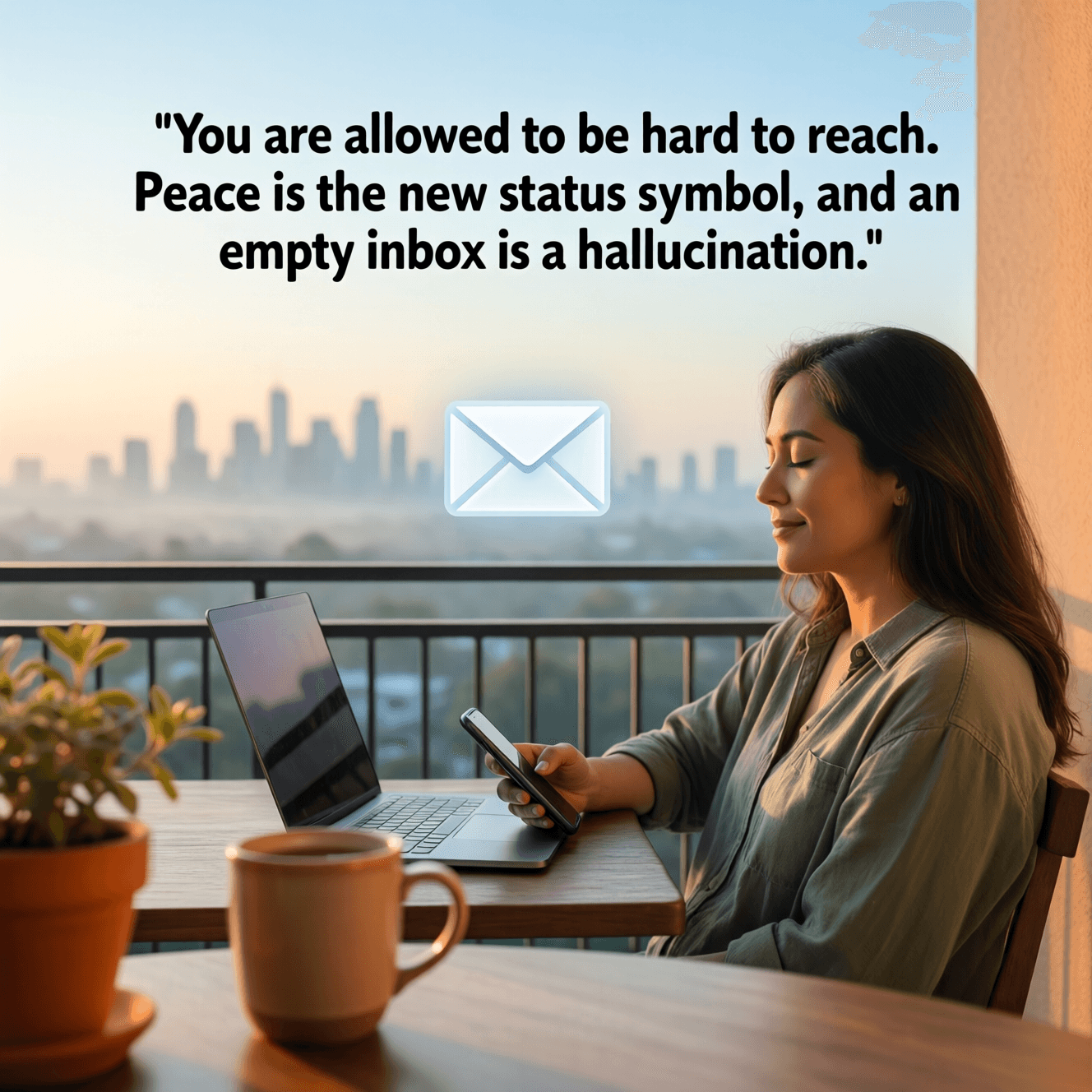
You are allowed to be hard to reach. Peace is the new status symbol, and an empty inbox is a hallucination. — Unknown
—What lingers after this line?
Reframing Availability as a Choice
The quote opens by granting permission: “You are allowed to be hard to reach.” In a culture where responsiveness is often treated as basic politeness or professional competence, choosing limited access can feel like defiance. Yet the line reframes distance not as neglect but as agency—an intentional boundary that protects attention. From there, the statement implies that constant availability has quietly become the default setting. By naming the alternative as something we’re “allowed” to do, it hints that many people already want more space but have internalized the idea that they must remain perpetually reachable to be valued.
Peace as the New Marker of Success
The quote then pivots to status: “Peace is the new status symbol.” Traditionally, status is displayed through scarcity—rare goods, exclusive access, or visible busyness. Here, however, the scarce resource is calm. Peace becomes a signal that someone has achieved control over their time, obligations, and emotional bandwidth. This shift echoes how prestige has evolved in other eras: when material security becomes more common, subtler forms of wealth stand out. In an attention economy, the ability to remain unhurried—unbothered by pings, demands, and social pressure—reads as a kind of modern affluence.
The Myth of the Empty Inbox
Next comes the blunt punchline: “an empty inbox is a hallucination.” Rather than treating inbox zero as an attainable ideal, the quote casts it as a mirage—something that appears possible from a distance but dissolves on approach. As soon as one message is answered, another arrives; the system replenishes faster than an individual can clear it. Importantly, calling it a hallucination doesn’t just describe volume—it critiques the mindset. If we believe an empty inbox is the prerequisite for peace, then peace is perpetually deferred, always one more reply away and therefore never actually reached.
Busyness, Identity, and Social Signaling
Underneath the humor sits a social truth: constant communication has become a form of signaling. Quick replies can function like proof of diligence, friendliness, or loyalty. Conversely, being “hard to reach” can be misread as arrogance or disengagement, which is why the quote feels like a small manifesto—permission to opt out of a performance. This helps explain why peace has become “status.” If everyone is expected to be busy and responsive, then the person who can safely slow down appears powerful—someone whose life isn’t governed by other people’s urgency.
Boundaries as a Practical Path to Calm
The quote ultimately suggests a strategy: peace doesn’t come from finishing communication, but from limiting it. If an empty inbox is unrealistic, then the more realistic goal is an inbox that no longer dictates mood or schedule. That might mean narrower windows for responses, fewer channels, or clearer expectations with colleagues and friends. Seen this way, being hard to reach isn’t about becoming unreachable; it’s about becoming reachable on humane terms. The “status symbol” isn’t silence for its own sake, but the ability to protect depth, rest, and focus in a world designed to keep you interruptible.
One-minute reflection
What feeling does this quote bring up for you?
Related Quotes
6 selectedIf someone throws a fit over your boundaries, it's just loud, colorful confirmation of exactly why you needed them. — Unknown
Unknown
The quote frames boundaries as a kind of relational truth serum: the moment you name a limit, you learn who benefits from you having none. Rather than treating a boundary as an act of hostility, it presents it as a pract...
Read full interpretation →Saying no is not just about time management; it is about nervous system regulation. Every 'yes' you don't mean is a betrayal your body has to carry. — Unknown
Unknown
The quote reframes “no” as something deeper than a scheduling tactic. Instead of treating boundaries as a tool for optimizing output, it positions them as a way of keeping the body within a tolerable range of stress and...
Read full interpretation →To heal, you must be willing to be the villain in the stories of people who benefited from your lack of boundaries. Stop apologizing for choosing yourself. — Unknown
Unknown
The quote begins with an unsettling truth: personal healing often changes the roles people assign us. When you start saying “no,” limiting access, or refusing unfair demands, others may interpret that shift as selfishnes...
Read full interpretation →Guard your 'no' like a holy thing. It is the only fence around your sanity in a world that profits from your exhaustion. — Unknown
Unknown
This quote treats “no” not as rudeness or refusal for its own sake, but as something almost devotional: a protective practice that deserves reverence. By calling it “a holy thing,” the line reframes boundary-setting as m...
Read full interpretation →Your attention is your life's currency. Stop donating it to platforms that profit from your distraction. Delete the noise and buy back your peace. — Unknown
Unknown
The quote opens with a sharp reframing: attention isn’t just a mental habit, it’s a form of currency. Like money, it is finite, easily misspent, and deeply tied to what your life becomes—because what you repeatedly notic...
Read full interpretation →The only people who get upset about you setting boundaries are those who benefited from you having none. — Unknown
Unknown
The saying points to a revealing pattern: when you begin to set limits, the strongest backlash often comes from people who previously enjoyed unrestricted access to your time, energy, money, attention, or emotional labor...
Read full interpretation →More From Author
More from Unknown →The language is the substrate. The architecture is the contract.
The line sets up a deliberate pairing: language lies beneath everything, while architecture governs everything above it. In other words, what you can express determines what you can build, and what you commit to structur...
Read full interpretation →A scroll is not a break; it is a trap disguised as rest. — Unknown
The quote begins by challenging a familiar story we tell ourselves: that a brief scroll is a harmless pause between tasks. On the surface, it looks like recovery—no effort, no decision, no commitment.
Read full interpretation →Don't let your ice cream melt while you're counting someone else's sprinkles. — Unknown
The quote uses ice cream as a simple stand-in for life’s fleeting pleasures: what you have is delicious, but it won’t last forever if you ignore it. Meanwhile, “counting someone else’s sprinkles” captures the habit of mo...
Read full interpretation →If your absence doesn't affect them, your presence never mattered. — Unknown
The quote frames absence as a revealing experiment: remove yourself, and the reaction—concern, curiosity, indifference—becomes a kind of data. If nothing changes when you’re gone, it suggests your role was never integrat...
Read full interpretation →