
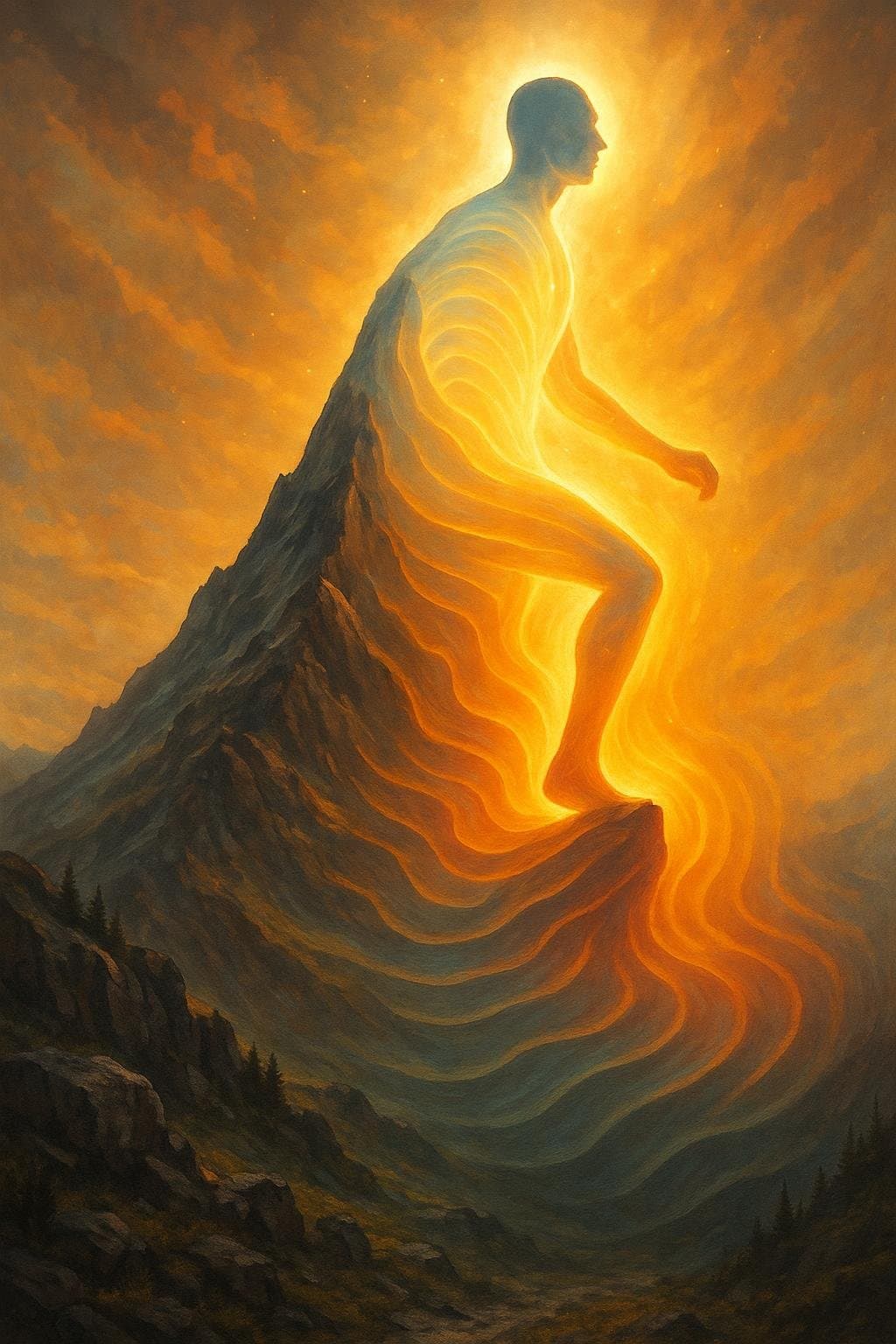
You do not really want to climb the mountain — you want to climb yourself. — Hermann Hesse
—What lingers after this line?
The Mountain as a Metaphor
At first glance, Hermann Hesse’s words appear to refer to the literal act of climbing a mountain, an external and often arduous endeavor. However, Hesse artfully deploys the mountain as a symbol for personal growth and self-overcoming. Just as a physical peak represents a challenging conquest, the true mountain lies within ourselves—the summits of our own limitations, fears, and aspirations.
Shifting the Focus Inward
This metaphorical pivot transitions the reader’s gaze from the external landscape to the rich terrain of the mind and spirit. With Hesse’s insight, the journey becomes less about the physical act and more about understanding and surpassing one’s internal barriers. In his novel *Siddhartha* (1922), Hesse similarly guides characters through outer journeys that mirror inner transformations, reinforcing the theme of self-discovery.
Historical and Philosophical Parallels
Throughout history, thinkers have echoed Hesse’s theme. Plato’s allegory of the cave (*Republic*, c. 375 BC) suggests enlightenment is not found outside but through recognizing the shadows within. Likewise, Eastern philosophies like Zen Buddhism teach that the obstacles we perceive in the world often reflect struggles within ourselves, emphasizing self-mastery as the ultimate aim.
Personal Growth Through Challenge
Building upon these traditions, the notion of ‘climbing oneself’ speaks to the transformative power of adversity. Each obstacle encountered on a mountain—be it fatigue or fear—mirrors the inner challenges faced when striving for self-betterment. Modern psychology corroborates this, positing that self-actualization emerges through overcoming internal conflicts rather than external conquests.
The Continuing Journey of Self
Ultimately, Hesse’s observation invites us to reconsider our motivations. The mountain before us is ever-changing, but the journey within is continuous and profound. As climbers of our own potential, we realize that reaching the summit is less important than the growth we undergo along the way, making every ascent a step toward deeper self-understanding.
Recommended Reading
As an Amazon Associate, we earn from qualifying purchases.
One-minute reflection
What's one small action this suggests?
Related Quotes
6 selectedThe only journey is the one within. — Rainer Maria Rilke
Rainer Maria Rilke
This quote underscores the importance of introspection and self-discovery. It suggests that the most significant journey a person can undertake is the exploration of their own thoughts, feelings, and essence.
Read full interpretation →The only revolution that is possible is the one within. — Jiddu Krishnamurti
Jiddu Krishnamurti
Krishnamurti’s line turns the usual meaning of “revolution” on its head. Instead of crowds, slogans, or new governments, he points to a quieter upheaval: a deep shift in the way a person perceives, thinks, and acts.
Read full interpretation →The way is not in the sky. The way is in the heart. — Buddha
Buddha
Buddha’s line redirects spiritual seeking away from distant, external places—“the sky”—and toward the intimate terrain of lived experience. Instead of imagining truth as something hidden in the heavens or guarded by spec...
Read full interpretation →Travel inward with courage and return with new maps for living. — Paulo Coelho
Paulo Coelho
Coelho’s line reframes travel as an inward expedition rather than a change of scenery. To “travel inward” is to observe your fears, desires, habits, and hidden assumptions with the same attentiveness you’d bring to a for...
Read full interpretation →Train your shadow as faithfully as your light; both must serve your journey. — Carl Jung
Carl Jung
At first glance, the line urges discipline where we least expect it: not only polish what is admirable, but also educate what is disowned. In Jungian terms, this is the work of engaging the shadow—the traits, impulses, a...
Read full interpretation →Some scenery can only be appreciated by oneself, and some paths must be walked alone.
Unknown
This quote emphasizes the importance of personal reflection. There are certain experiences and moments that are best understood and appreciated in solitude.
Read full interpretation →More From Author
More from Hermann Hesse →Within you, there is a stillness and a sanctuary to which you can retreat at any time. — Hermann Hesse
Hermann Hesse’s line begins with a quiet assurance: the sanctuary you seek is not something you must build, earn, or discover in distant places—it is already “within you.” By framing stillness as an inner location, he sh...
Read full interpretation →Within you, there is a stillness and a sanctuary to which you can retreat at any time. — Hermann Hesse
Hermann Hesse suggests that peace is not primarily something to be found by rearranging external circumstances, but something already present—an interior “sanctuary” that can be entered at will. The phrase implies both i...
Read full interpretation →Everything that slows us down and forces patience is a help. — Hermann Hesse
Hermann Hesse’s line flips a common assumption: that anything slowing us down is an obstacle. Instead, he suggests that friction in life—waiting, repetition, interruptions—can serve as an ally because it compels a differ...
Read full interpretation →Within you, there is a stillness and a sanctuary to which you can retreat at any time. — Hermann Hesse
Hermann Hesse’s line begins with a simple but radical claim: safety is not only something we seek in places or people, but something we can access within ourselves. By framing stillness as a “sanctuary,” he suggests an i...
Read full interpretation →