
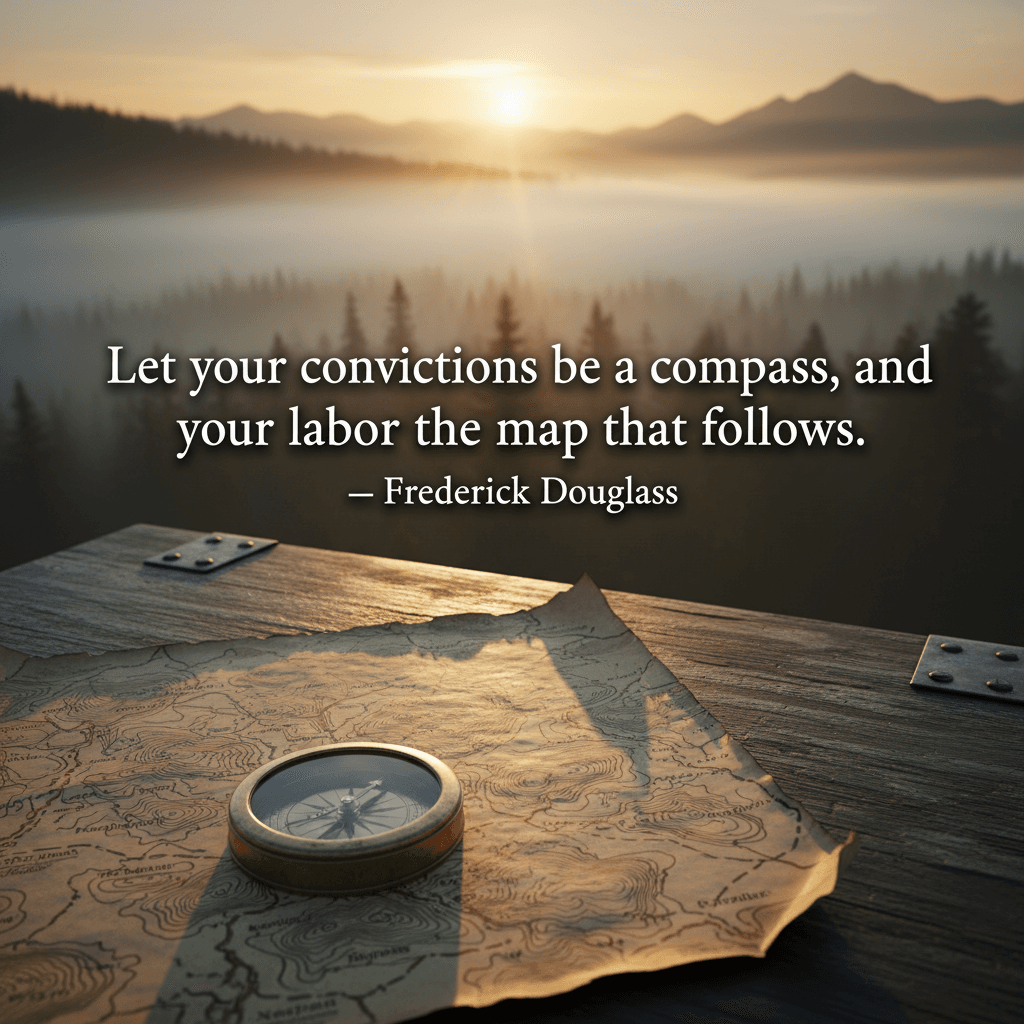
Let your convictions be a compass, and your labor the map that follows. — Frederick Douglass
—What lingers after this line?
Moral North: The Compass of Conviction
At the outset, the metaphor of convictions as a compass captures an orienting force that precedes movement. For Frederick Douglass, moral clarity was not abstraction but direction—the fixed north of human dignity and freedom. His life, from bondage in Maryland to statesman and orator, reflects a steady bearing shaped by the belief that slavery violated both natural law and the American promise. That conviction did not merely comfort him; it aligned his choices, relationships, and risks. Yet, as a compass cannot walk the traveler to safety, convictions alone demand a second element: the practical routes we must chart to make them real.
From Principle to Practice: Drawing the Map
From there, Douglass’s labor emerges as the map that follows conviction. He transformed principles into pathways—founding The North Star (1847), delivering thousands of lectures, and organizing across states. His famous reminder, “If there is no struggle there is no progress” (1857), insists that maps are drawn by effort under resistance, not by wishful lines. Each article, petition, and speech became a road toward emancipation and citizenship. Thus the metaphor deepens: conviction indicates true north, while persistent, skillful work surveys the terrain, registers obstacles, and plots detours when injustice blocks the way.
Historical Bearings: Douglass’s Cartography of Freedom
Historically, Douglass’s writings function like field notes of a moral cartographer. Narrative of the Life of Frederick Douglass (1845) records how literacy opened a pathway from slavery to freedom, turning inner resolve into practical strategy. Later, “What to the Slave Is the Fourth of July?” (1852) reoriented national celebration by exposing its moral dissonance, redrawing the public’s sense of where the nation stood. Each text revises the map’s legend—clarifying symbols of hypocrisy and landmarks of hope—while anchoring the compass to universal rights. In this way, arguments and anecdotes became coordinates for collective navigation.
Collective Navigation: Communities as Co-Cartographers
Consequently, the journey never remained solitary. Abolitionists, Black communities, and women’s rights advocates served as co-cartographers, testing routes and sharing waypoints. Douglass’s alliances—with figures like William Lloyd Garrison early on, and his advocacy at Seneca Falls (1848)—illustrate how pooled experience refines the map. A newspaper’s readership, a lecture hall’s debates, and an underground network’s courage created feedback loops that validated direction and adjusted course. Shared conviction supplied the compass bearing; shared labor traced reliable roads. Thus movements advanced not by a single heroic stride, but by many feet on the same trail.
Workmanship of Freedom: Skill, Discipline, Craft
Moreover, Douglass framed labor as craft rather than mere exertion. He had been a shipyard caulker; he became a virtuoso of rhetoric and argument. In Self-Made Men (1859; revised later), he praised disciplined skill, not as self-congratulation, but as a practice that dignifies the worker and fortifies the cause. Learning to read and to speak publicly—hard-won competencies—converted abstract ideals into persuasive force. In his telling, dignity arrives when effort is shaped by method: evidence marshaled, audiences understood, and words honed. Craft makes the map legible to others, inviting them to travel with you.
Present Routes: Applying the Metaphor Today
Extending this logic, today’s struggles also require a compass-and-map approach. If your conviction is climate stewardship, the compass is ethical responsibility; the map is policy literacy, coalition-building, and measurable emissions cuts. In corporate life, a commitment to fairness sets direction, while transparent pay audits and promotion criteria trace the path. In civic life, voting rights as a value must be paired with canvassing, court challenges, and turnout logistics. Across domains, Douglass’s lesson holds: moral clarity decides where to go; organized labor—of hands, minds, and institutions—determines how to arrive.
Resilience in Unknown Terrain: Adapting Without Drift
Finally, real journeys cross uncharted ground, demanding adjustment without losing north. After the Civil War, Douglass recalibrated strategies through Reconstruction, federal service, and diplomacy, including his role as U.S. Minister to Haiti (1889). In “The Lessons of the Hour” (1894), he confronted new forms of racial terror, showing that maps must be revised as landscapes shift. Yet his compass did not waver: equal citizenship, education, and lawful protection remained the bearing. The enduring message is clear—let conviction fix direction, let labor redraw the route, and let resilience keep both aligned when the world changes.
One-minute reflection
What does this quote ask you to notice today?
Related Quotes
6 selectedSet your hands to work that honors tomorrow and your feet will find steady ground. — John Steinbeck
John Steinbeck
Steinbeck’s line ties dignity to direction: “hands” symbolize daily effort, but the effort must “honor tomorrow,” meaning it should be guided by a longer horizon than immediate comfort. Rather than romanticizing busyness...
Read full interpretation →Claim the small truths you live by; they become the maps for others. — Chimamanda Ngozi Adichie
Chimamanda Ngozi Adichie
Adichie’s line begins with an intimate proposition: the “small truths” you live by—quiet convictions, daily choices, personal boundaries—are not minor at all. They are the substance of character, formed in the unglamorou...
Read full interpretation →Labor with intention so tomorrow answers with abundance. — Rabindranath Tagore
Rabindranath Tagore
Tagore’s line frames tomorrow not as a random gift, but as something that “answers” the way an echo answers a voice. In other words, the quality of the future is shaped by the clarity and sincerity of today’s labor.
Read full interpretation →Carry your values like a map when the road grows confusing — Kahlil Gibran
Kahlil Gibran
Kahlil Gibran’s image turns values into something practical: not abstract ideals, but a map you can actually travel with. When life feels straightforward, almost any direction seems workable; it’s when the “road grows co...
Read full interpretation →Let compassion be the engine that drives your decisions. — Fyodor Dostoevsky
Fyodor Dostoevsky
Dostoevsky’s call to let compassion be the engine of our decisions suggests more than occasional kindness; it proposes compassion as the primary driving force behind how we act. Just as an engine powers a vehicle, he imp...
Read full interpretation →Set your course by the stars, not by the lights of every passing ship. — Omar N. Bradley
Omar N. Bradley
Bradley’s counsel offers a navigational ethic: anchor decisions to enduring principles—“stars”—rather than the seductive glow of momentary approval, the “lights of every passing ship.” In practice, this means privileging...
Read full interpretation →More From Author
More from Frederick Douglass →The soul that is within me no man can degrade. — Frederick Douglass
Frederick Douglass’s line insists that there is a core of personhood that cannot be seized, even when everything else is threatened. He points to an inward refuge—“the soul that is within me”—where identity and worth rem...
Read full interpretation →Use the weight of every no as a lever to reach toward a new yes. — Frederick Douglass
Frederick Douglass frames rejection not as a dead end but as potential energy. A “no” carries weight—social pressure, disappointment, fatigue—and he suggests that this heaviness can be redirected rather than merely endur...
Read full interpretation →Rise each time with gratitude for the lesson and hunger for the next step. — Frederick Douglass
Douglass frames “rise each time” as an intentional stance rather than a lucky outcome. In his view, setbacks are inevitable, but our posture afterward is not: we can either remain where the blow landed or stand again wit...
Read full interpretation →Refuse to be a spectator of your life; be its craftsman. — Frederick Douglass
Frederick Douglass’s line draws a sharp boundary between merely witnessing our days and actively shaping them. To be a “spectator” is to let circumstances, other people, or fear decide the direction of our time; to be a...
Read full interpretation →