
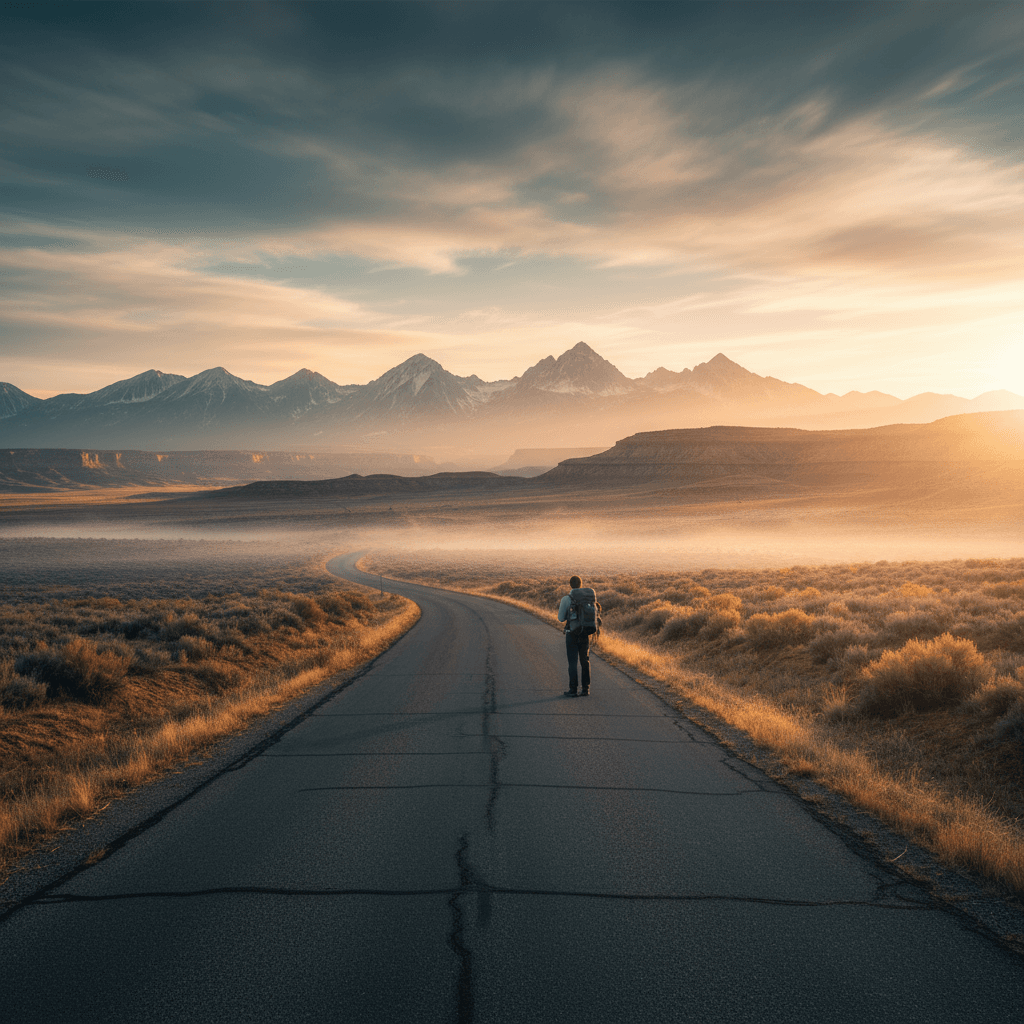
Live, travel, adventure, bless, and don't be sorry. — Jack Kerouac
—What lingers after this line?
A Manifesto in Five Verbs
Kerouac compresses an ethic into a pulse: live, travel, adventure, bless, and do not be sorry. The cadence is imperative yet generous, urging motion, risk, reverence, and a refusal to apologize for genuine feeling. More than a slogan, it proposes a portable compass for a restless century. From this charge, the road becomes a laboratory where vitality is tested in real time.
Roads as Freedom, Not Escape
In On the Road (1957), movement is not flight but inquiry. Sal Paradise and Dean Moriarty treat highways like jazz charts, improvising their way toward experience rather than conclusions. Travel here is a practice of attentiveness: hitchhiking to hear another voice, lingering in a diner to catch the hum of America. Thus adventure becomes the curriculum of aliveness, not a detour from responsibility. And yet motion without meaning risks becoming blur; this is where blessing enters.
The Sacred Gesture of Bless
Bless reframes wandering as stewardship. Kerouac’s Catholic roots and Zen-curious turn in The Dharma Bums (1958) converge on a simple posture: meet the world with gratitude. Japhy Ryder, modeled on Gary Snyder, embodies a way of walking that bows to mountains and people alike, making attention a form of prayer. In this light, blessing means giving more than you take and naming goodness where you find it. With reverence established, the clause do not be sorry gains moral clarity.
The Courage to Be Unapologetic
Do not be sorry is not license to wound; it is a stand against reflexive self-shrinking. In a 1950s culture of conformity, the Beats defended unembarrassed intensity, a stance echoed in Ginsberg’s Howl (1956). Kerouac invites unapologetic joy, honest desire, and clear refusals, while still keeping room for real contrition when harm occurs. In other words, stop apologizing for being fully alive; keep apologizing when you fail to be fully humane. Even so, the costs of this experiment must be faced.
Costs, Shadows, and Responsibility
Kerouac’s later years, marked by alcoholism and remorse, reveal the shadow side of restless living; companions often absorbed the fallout (see Ann Charters, Kerouac: A Biography, 1973). The lesson is not to retract the verbs, but to balance them: pair adventure with care, blessing with boundaries. Radical candor needs radical compassion or it curdles into self-absorption. A mature reading of the quote keeps its fire while building a hearth around it.
Modern Echoes: Nomads and Micro-Adventures
Today the spirit surfaces in digital nomads, gap-year wanderers, and micro-adventures close to home (cf. Alastair Humphreys, Microadventures, 2014). Slow travel, community homestays, and Leave No Trace ethics convert movement into mutual benefit. Platforms like Couchsurfing (founded 2004) thrive when blessing replaces mere consumption, turning trips into exchanges of story and care. In this way, the verbs become practices that localize wonder and distribute its gifts.
Choosing Aliveness Every Day
Kerouac’s list scales down to daily acts: take the long walk, speak the truth kindly, send a note of thanks, try the unfamiliar spice, tip well, and decline the needless apology that shrinks your spirit. When you do err, apologize fully and repair. Thus the sequence holds: live with presence, travel in mind and body, adventure beyond habit, bless what you touch, and do not be sorry for the light you bring.
One-minute reflection
Why might this line matter today, not tomorrow?
Related Quotes
6 selectedEmbrace the uncertainty, for it is the canvas upon which your greatest adventures will be painted. – Unknown
Unknown
This quote encourages us to accept and embrace the unknown. It suggests that uncertainty is not something to fear, but rather an essential part of life's journey.
Read full interpretation →Do not stop thinking of life as an adventure. You have no security unless you can live bravely, excitingly, imaginatively; unless you can choose a challenge instead of competence. — Eleanor Roosevelt
Eleanor Roosevelt
This quote encourages viewing life as an exciting journey filled with new experiences and challenges. It suggests that an adventurous approach to life makes it fulfilling and dynamic.
Read full interpretation →Awaken your spirit to adventure; hold nothing back, and live life fully. — T.A. Barron, USA.
T.A. Barron, USA.
This quote encourages individuals to embrace adventure and new experiences. It suggests that one should be open to exploring the unknown and stepping out of their comfort zone.
Read full interpretation →I don't know where I'm going from here, but I promise it won't be boring. — David Bowie
David Bowie
David Bowie’s line begins with a disarming admission: he doesn’t know what comes next. Yet instead of treating uncertainty as a weakness, he turns it into a stage—an open space where possibility can thrive.
Read full interpretation →The mountains are calling and I must go. - John Muir
John Muir
This quote personifies mountains as having a voice that calls out to the individual, suggesting a magnetic or spiritual pull that nature exerts on those who appreciate it.
Read full interpretation →Not all those who wander are lost. - J.R.R. Tolkien
J.R.R. Tolkien
This quote suggests that wandering, or exploring, is a valuable process that doesn't imply aimlessness. It highlights the idea that exploration can lead to self-discovery and personal growth.
Read full interpretation →More From Author
More from Jack Kerouac →