
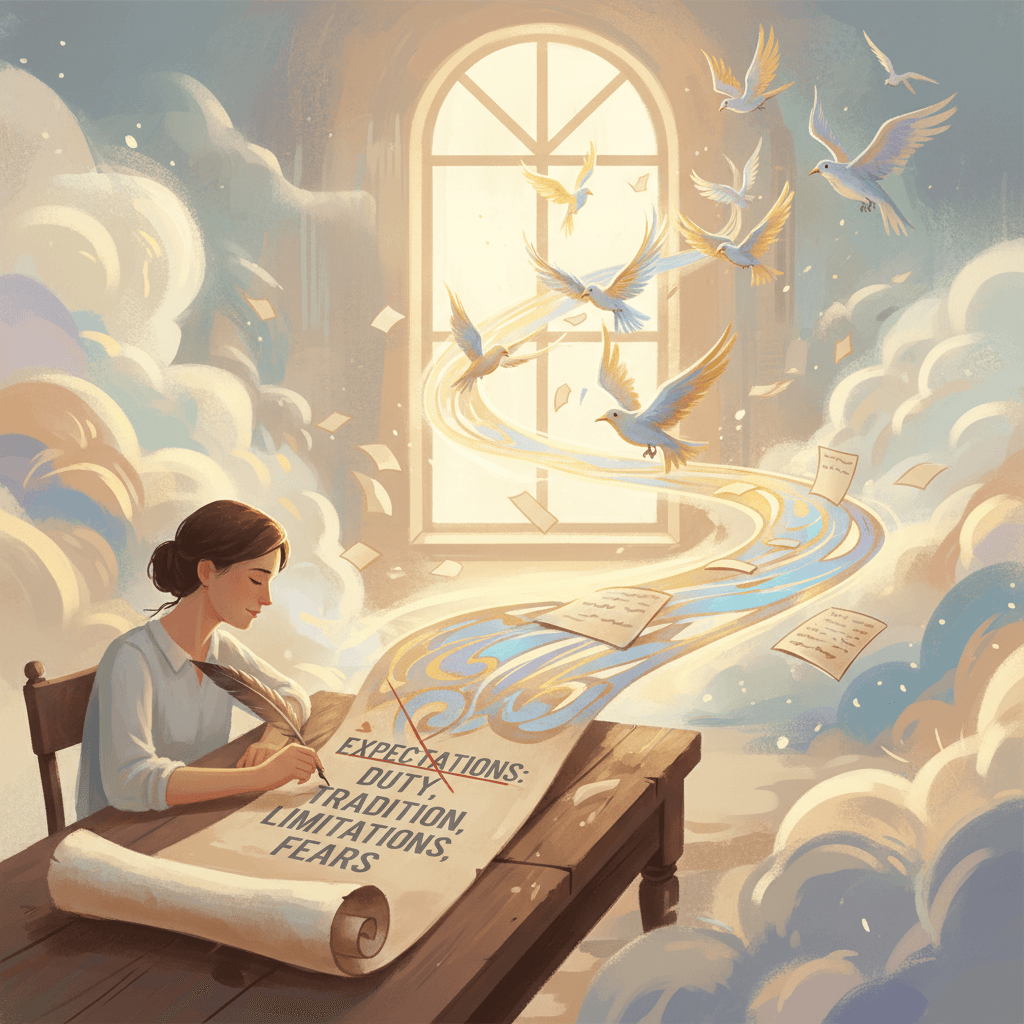
Rewrite what others expect of you; the new draft can free an entire life — Simone de Beauvoir
—What lingers after this line?
The Call to Rewrite the Script
Simone de Beauvoir’s line—“Rewrite what others expect of you; the new draft can free an entire life”—invites us to treat our existence like a text we are allowed to edit. Rather than accepting inherited roles as final, she suggests we pick up the pen and question every assumption about who we should be. This shift from passive acceptance to active authorship is the first movement from constraint toward freedom, framing life as an ongoing work in progress rather than a finished script handed down by others.
Existential Freedom and Social Roles
This idea grows directly from Beauvoir’s existentialism, developed alongside Jean-Paul Sartre in mid‑20th‑century Paris. In *The Ethics of Ambiguity* (1947), she argues we are “condemned to be free”: even when we obey, we are choosing to obey. Yet, social roles—worker, spouse, child, citizen—often disguise themselves as destiny. By recognizing them as contingent constructions rather than absolute truths, we begin loosening their hold, preparing the ground for a new “draft” of our lives.
Gendered Expectations as Chains
Nowhere is this clearer than in gender. In *The Second Sex* (1949), Beauvoir famously writes, “One is not born, but rather becomes, a woman,” highlighting how society scripts femininity as passivity and sacrifice. Similarly, masculinity is often drafted as stoicism and dominance. When she urges us to rewrite expectations, she is challenging these gendered scripts in particular. Questioning why a daughter “must” care for everyone or why a son “must not” cry becomes a concrete act of liberation.
The Craft of Redrafting Your Life
Translating this philosophy into practice involves deliberate, sometimes uncomfortable revision. First, we have to identify which expectations govern our choices: whose approval we chase, which careers feel ‘acceptable,’ what kind of love seems ‘respectable.’ Then we start editing—perhaps by declining a family tradition that erases our identity, or by choosing a vocation that values meaning over prestige. Each small revision to the expected storyline strengthens our ability to author a life aligned with our values rather than others’ demands.
From Individual Edits to Collective Freedom
Finally, Beauvoir’s insight extends beyond personal fulfillment to social transformation. When individuals rewrite expectations, they also weaken the old scripts for everyone else. Feminist movements, civil rights struggles, and queer activism all illustrate this: each person who refused a prescribed role made new possibilities legible to others. Thus, the “new draft” of one life can ripple outward, altering what seems imaginable for an entire community, and demonstrating how personal courage in rewriting expectations can help free many lives, not just one.
One-minute reflection
Why might this line matter today, not tomorrow?
Related Quotes
6 selectedIn action, we find our freedom. — Simone de Beauvoir
Simone de Beauvoir
Simone de Beauvoir’s statement that freedom is found in action harks back to existentialist philosophy, which emphasizes human agency and personal responsibility. Rather than viewing freedom as a static condition, existe...
Read full interpretation →Step out of the history that is holding you back. Step into the new story you are willing to create. — Oprah Winfrey
Oprah Winfrey
This quote encourages individuals to take control of their lives and not be defined or limited by their past experiences. It emphasizes the power of self-determination and the ability to create a new future.
Read full interpretation →Though no one can go back and make a brand new start, anyone can start from now and make a brand new ending. — Carl Bard
Carl Bard
This quote emphasizes that we cannot change the past. Whatever has happened is beyond our control and cannot be undone.
Read full interpretation →Turn the page and write the next chapter of your life boldly. — Chimamanda Ngozi Adichie
Chimamanda Ngozi Adichie
This quote encourages individuals to move forward in life with confidence and courage. It suggests that people should not dwell on the past but rather focus on creating a new, exciting future.
Read full interpretation →The only way to deal with an unfree world is to become so absolutely free that your very existence is an act of rebellion. — Albert Camus
Albert Camus
Camus refers to societies or environments where personal freedoms are restricted by authority, oppression, or social norms.
Read full interpretation →The rhythm of life is in the courage to change the tune. — Chimamanda Ngozi Adichie
Chimamanda Ngozi Adichie
The quote highlights the importance of having the courage to make changes in life, suggesting that real vitality comes from adaptability.
Read full interpretation →More From Author
More from Simone de Beauvoir →I am too intelligent, too demanding, and too resourceful for anyone to be able to take charge of me entirely. — Simone de Beauvoir
Simone de Beauvoir’s line reads first as a firm personal boundary: she refuses the premise that another person could—or should—“take charge” of her entirely. The triad “too intelligent, too demanding, and too resourceful...
Read full interpretation →Hold fast to what you can change and gently release what you cannot. — Simone de Beauvoir
Simone de Beauvoir’s line works like a practical compass: first, grasp firmly the parts of life that respond to effort; then, loosen your grip on what will not yield. The pairing matters because willpower alone can becom...
Read full interpretation →One can never consent to creep when one feels an impulse to soar. — Simone de Beauvoir
Simone de Beauvoir’s line begins with a quiet rebellion: once you feel the tug of possibility, “consenting to creep” becomes intolerable. The word consent matters, because it frames smallness as a choice we are pressured...
Read full interpretation →Turn hesitation into rehearsal, and action will follow. — Simone de Beauvoir
Simone de Beauvoir’s line reframes hesitation not as failure, but as raw material. Instead of treating uncertainty like a wall, she implies it can be treated like a doorway—an early stage of becoming capable.
Read full interpretation →