
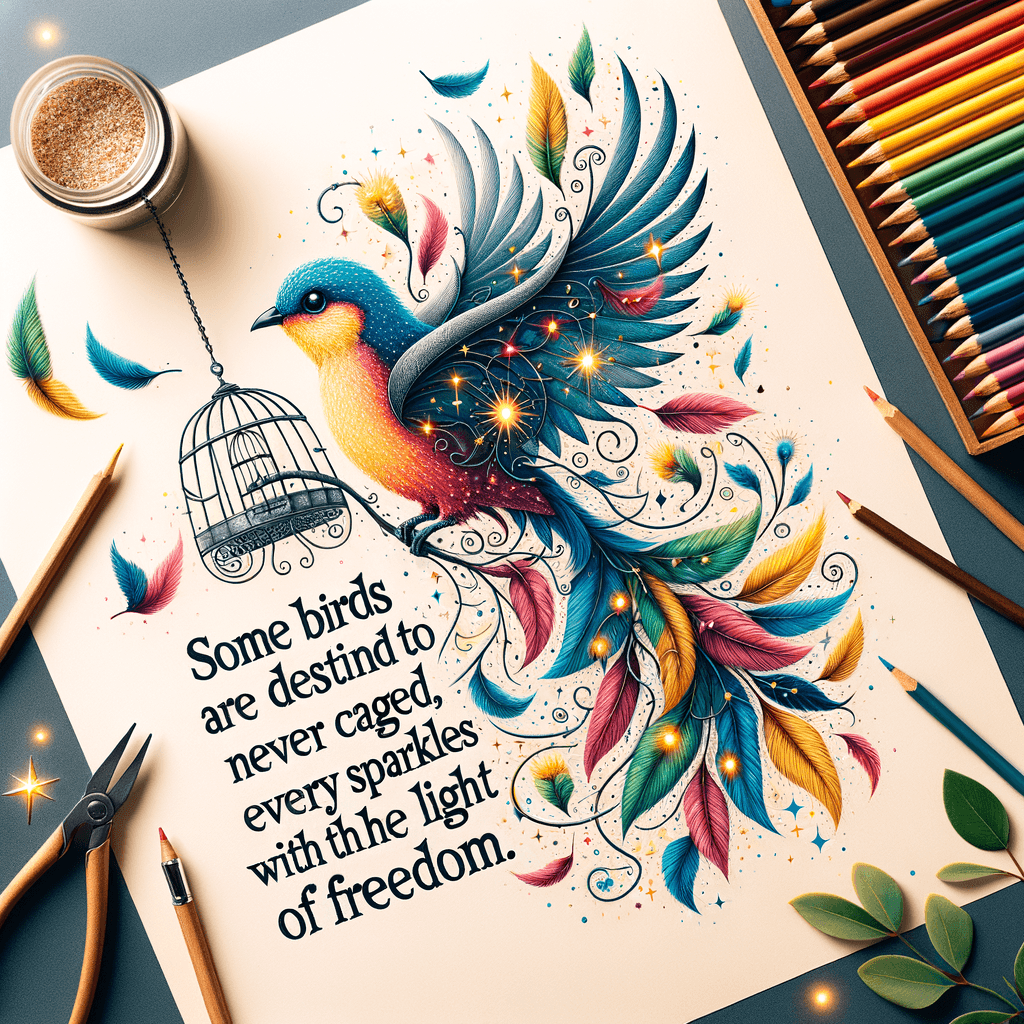
Some birds are not meant to be caged; their feathers shine with the light of freedom.
—What lingers after this line?
Individual Freedom
This quote suggests that certain individuals or entities naturally embody the spirit of freedom and independence. Trying to confine them is futile as their true essence thrives in liberation.
Innate Nature
It refers to the idea that some beings are inherently unable to be restrained or tamed. Their true beauty and potential are realized only when they are free.
Visual Symbolism
The imagery of feathers shining with the light of freedom symbolizes the radiant and undeniable presence of innate liberty, suggesting that it is evident and cannot be hidden.
Resistance to Confinement
This quote emphasizes the resistance against any form of captivity or restriction, portraying freedom as a natural state that cannot be easily suppressed.
Human Spirit
Though the quote uses birds as a metaphor, it can be extended to human contexts, implying that some people's spirits are too dynamic and vibrant to be contained. They must live freely to maintain their true essence.
One-minute reflection
Where does this idea show up in your life right now?
Related Quotes
6 selectedSome birds are destined not to be caged; every one of their feathers shines with the light of freedom.
Unknown
This quote implies that certain beings, by their very nature, are meant to live freely. The essence of their existence is intertwined with freedom, and attempting to confine them goes against their very spirit.
Read full interpretation →The wind of freedom blows.
Unknown
The wind in this quote symbolizes freedom and its natural, uncontainable nature. Just as the wind travels freely across land and sea, so too does the spirit of freedom move without restraint.
Read full interpretation →Your home should lower your shoulders the moment you walk in. — Unknown (attributed to design philosophy/experts, but skipping as per rules: switching to:) The boundary to what we can accept is the boundary to our freedom. — Tara Brach
Tara Brach
At first glance, Tara Brach’s statement sounds simple, yet it points to a profound inner mechanism: the limits of our freedom are often set not only by external conditions, but by what we refuse to face within ourselves....
Read full interpretation →The boundary to what we can accept is the boundary to our freedom. — Tara Brach
Tara Brach
At first glance, Tara Brach’s statement suggests that freedom is not only shaped by external circumstances but also by our inner willingness to face reality. What we cannot accept—whether grief, uncertainty, fear, or imp...
Read full interpretation →True freedom is found in the discipline to choose what you want most over what you want in this fleeting moment. — Arden Mahlberg
Arden Mahlberg
At first glance, freedom is often imagined as the ability to do whatever one wants at any given moment. Arden Mahlberg’s statement gently overturns that assumption by suggesting that real freedom is not impulsive indulge...
Read full interpretation →Freedom is knowing what is yours to influence. — Zeno of Citium
Zeno of Citium
At its heart, Zeno’s statement defines freedom not as unlimited power, but as clear discernment. The founder of Stoicism, writing in the early 3rd century BC, argued that human beings suffer when they confuse what belong...
Read full interpretation →More From Author
More from Unknown →The language is the substrate. The architecture is the contract.
The line sets up a deliberate pairing: language lies beneath everything, while architecture governs everything above it. In other words, what you can express determines what you can build, and what you commit to structur...
Read full interpretation →A scroll is not a break; it is a trap disguised as rest. — Unknown
The quote begins by challenging a familiar story we tell ourselves: that a brief scroll is a harmless pause between tasks. On the surface, it looks like recovery—no effort, no decision, no commitment.
Read full interpretation →Don't let your ice cream melt while you're counting someone else's sprinkles. — Unknown
The quote uses ice cream as a simple stand-in for life’s fleeting pleasures: what you have is delicious, but it won’t last forever if you ignore it. Meanwhile, “counting someone else’s sprinkles” captures the habit of mo...
Read full interpretation →If your absence doesn't affect them, your presence never mattered. — Unknown
The quote frames absence as a revealing experiment: remove yourself, and the reaction—concern, curiosity, indifference—becomes a kind of data. If nothing changes when you’re gone, it suggests your role was never integrat...
Read full interpretation →