
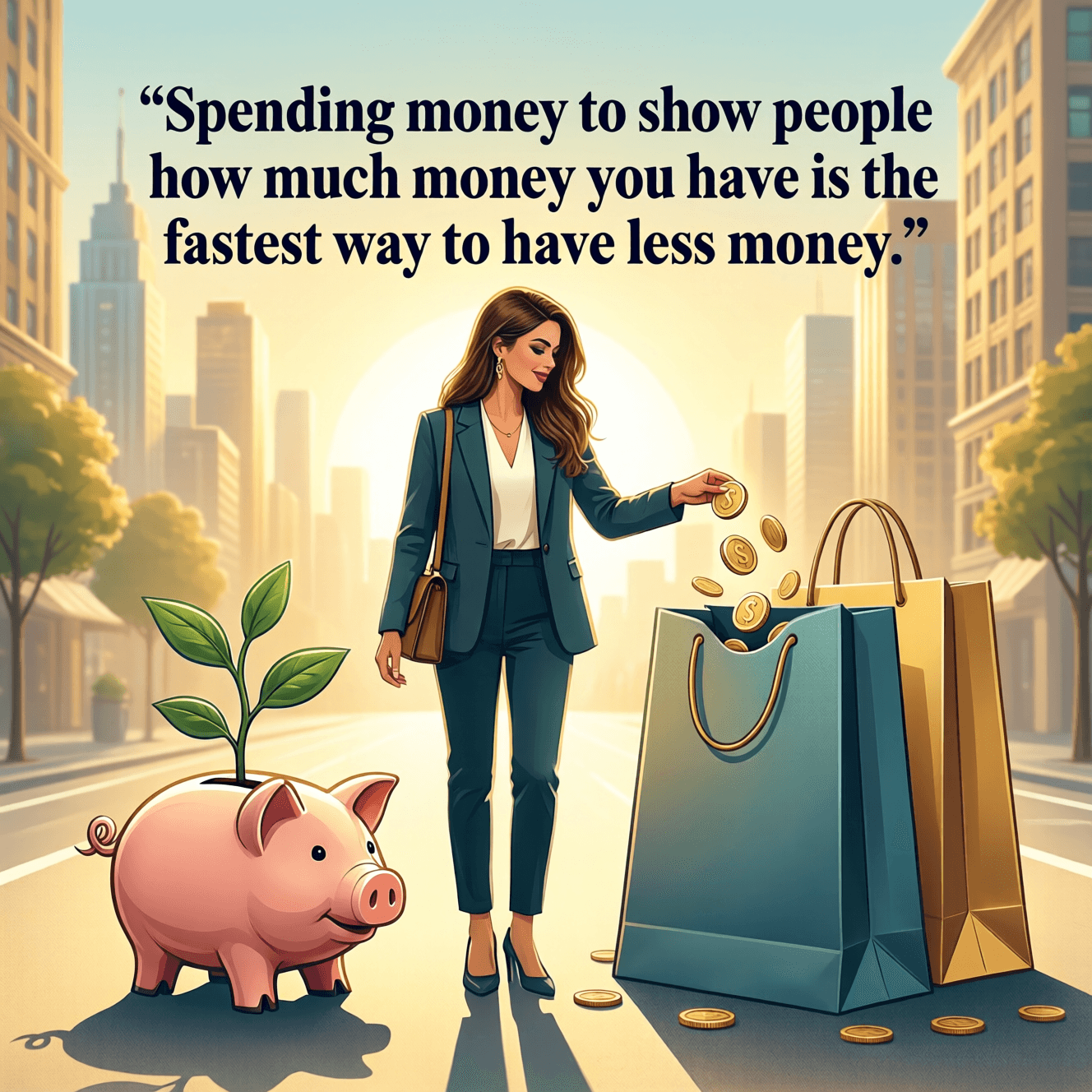
Spending money to show people how much money you have is the fastest way to have less money. — Morgan Housel
—What lingers after this line?
The Core Paradox of Display
Morgan Housel’s line hinges on a simple contradiction: the more you spend trying to look wealthy, the less wealth you keep. Status purchases feel like proof of success, but they often function as withdrawals from the very asset base that could create lasting security. In that sense, looking rich can be a short-term performance that undermines long-term reality. From there, the quote pushes us to distinguish between wealth and income. Income is what arrives each month; wealth is what remains after expenses and compounds over time. When the goal shifts from building what remains to signaling what arrives, the math tilts quickly against you.
Status Is a Costly Subscription
Once status enters the picture, spending tends to become recurring rather than occasional—designer wardrobes must be refreshed, luxury cars get upgraded, and the “right” neighborhoods demand higher ongoing costs. That’s why the problem isn’t only the first purchase but the lifestyle commitments that follow it. The desire to keep up appearances can quietly convert a high income into a fragile balance sheet. Moreover, visible consumption invites comparison. Each public signal sets a new baseline for what others expect from you, and that expectation can pressure you into maintaining a level of spending that no longer feels optional. The result resembles a subscription to social approval, billed monthly.
The Opportunity Cost You Don’t See
Even when flashy spending doesn’t create debt, it carries an invisible price: the future value of what that money could have become. A luxury purchase may be enjoyable, but if it’s primarily meant to persuade others, it competes directly with investing, skill-building, or building a cash cushion—choices that can produce resilience and freedom. This is where compounding becomes the silent contrast. Money kept and invested can grow on its own, while money spent for display ends the story at the checkout counter. Over years, that difference can separate people who feel wealthy from people who are wealthy.
The Social Signaling Trap
Housel’s point also highlights how status games are hard to win because the “audience” keeps changing. There will always be someone with a newer car, a bigger house, or a more extravagant vacation, so spending to impress becomes an arms race with no finish line. In practice, the reward is temporary while the cost is permanent. Thorstein Veblen’s idea of conspicuous consumption in *The Theory of the Leisure Class* (1899) describes this pattern as spending designed to display social rank. Linking that to Housel’s warning, signaling can become a financial strategy that produces the opposite of its intended message: less capacity, fewer options, and tighter constraints.
Debt and Fragility as Hidden Outcomes
As the signaling trap intensifies, many people bridge the gap between desired image and available cash with debt. That’s the fastest route from “looking successful” to living with elevated stress, reduced flexibility, and vulnerability to layoffs or emergencies. Even without debt, high fixed costs can make a person one downturn away from hard choices. Seen this way, the quote isn’t moralizing about enjoyment; it’s describing fragility. When spending is optimized for appearance, it often increases commitments while decreasing slack. Financial slack—money and time you control—is what turns setbacks into inconveniences rather than crises.
Redefining Rich: Quiet Wealth and Freedom
The quote ultimately invites a different definition of richness: not what others see, but what you can choose. Quiet wealth looks like low obligations, robust savings, and the ability to say no—to jobs, to social pressure, to purchases that don’t align with your goals. Because it isn’t performed, it doesn’t require constant reinforcement. In that closing light, the fastest way to have more money is often to stop trying to prove you have it. When spending serves your values rather than your reputation, money shifts from being a costume to being a tool—one that buys stability, autonomy, and time.
One-minute reflection
What feeling does this quote bring up for you?
Related Quotes
6 selectedThe things you own end up owning you. It is only after you lose everything that you're free to do anything. — Chuck Palahniuk
Chuck Palahniuk
At first glance, Palahniuk’s line appears to criticize materialism, yet it goes further by describing a reversal of power. We believe we possess objects, but gradually those objects begin to dictate our time, anxiety, an...
Read full interpretation →Money looks better in the bank than on your feet. — Sophia Amoruso
Sophia Amoruso
Sophia Amoruso’s line distills a familiar tension: the urge to look successful versus the need to become secure. By comparing money “in the bank” to money “on your feet,” she’s not condemning style so much as questioning...
Read full interpretation →You are not your job, you're not how much money you have in the bank. — Chuck Palahniuk
Chuck Palahniuk
Chuck Palahniuk’s line works like a quick jolt: it challenges the habit of answering “Who are you?” with a title, salary, or résumé. By insisting you are not your job or your bank balance, he separates a human life from...
Read full interpretation →When I was young I thought that money was the most important thing in life; now that I am old I know that it is. — Oscar Wilde
Oscar Wilde
Oscar Wilde’s line begins like a tidy moral fable: youth mistakenly worships money, while age brings wiser priorities. Yet the sentence swivels on its final clause—“now that I am old I know that it is”—turning expected g...
Read full interpretation →It is not the man who has too little, but the man who craves more, that is poor. — Seneca
Seneca
Seneca overturns the usual definition of poverty by shifting it from external possessions to internal appetite. In his view, the person with modest means can be rich if their desires are proportioned to what they have, w...
Read full interpretation →Too many people spend money they haven't earned, to buy things they don't want, to impress people they don't like. — Will Rogers
Will Rogers
Will Rogers compresses an entire social pathology into one sentence: people often let image outrun reality. By stacking “haven’t earned,” “don’t want,” and “don’t like,” he sketches a chain reaction where financial decis...
Read full interpretation →More From Author
More from Morgan Housel →The most important investment you can make is in your own education. — Morgan Housel
Morgan Housel’s statement reframes investment away from stocks, property, or savings accounts and toward something far more durable: personal knowledge. At first glance, education may seem less tangible than financial as...
Read full interpretation →Money's greatest intrinsic value is its ability to give you control over your time. — Morgan Housel
Morgan Housel’s line shifts the conversation away from money as a scoreboard and toward money as an instrument. Instead of asking how much wealth proves success, it asks what wealth lets you do with your days.
Read full interpretation →Doing well with money has a little to do with how smart you are and a lot to do with how you behave. — Morgan Housel
Morgan Housel’s line reframes “being good with money” away from spreadsheets and toward psychology. The point isn’t that knowledge is useless, but that intelligence alone rarely determines outcomes when money is involved...
Read full interpretation →Having no FOMO might be the most important investing skill. — Morgan Housel
Morgan Housel’s line points to a deceptively simple truth: the market punishes urgency more often than it rewards it. FOMO—fear of missing out—turns investing from a plan into a reflex, where decisions are driven by what...
Read full interpretation →