
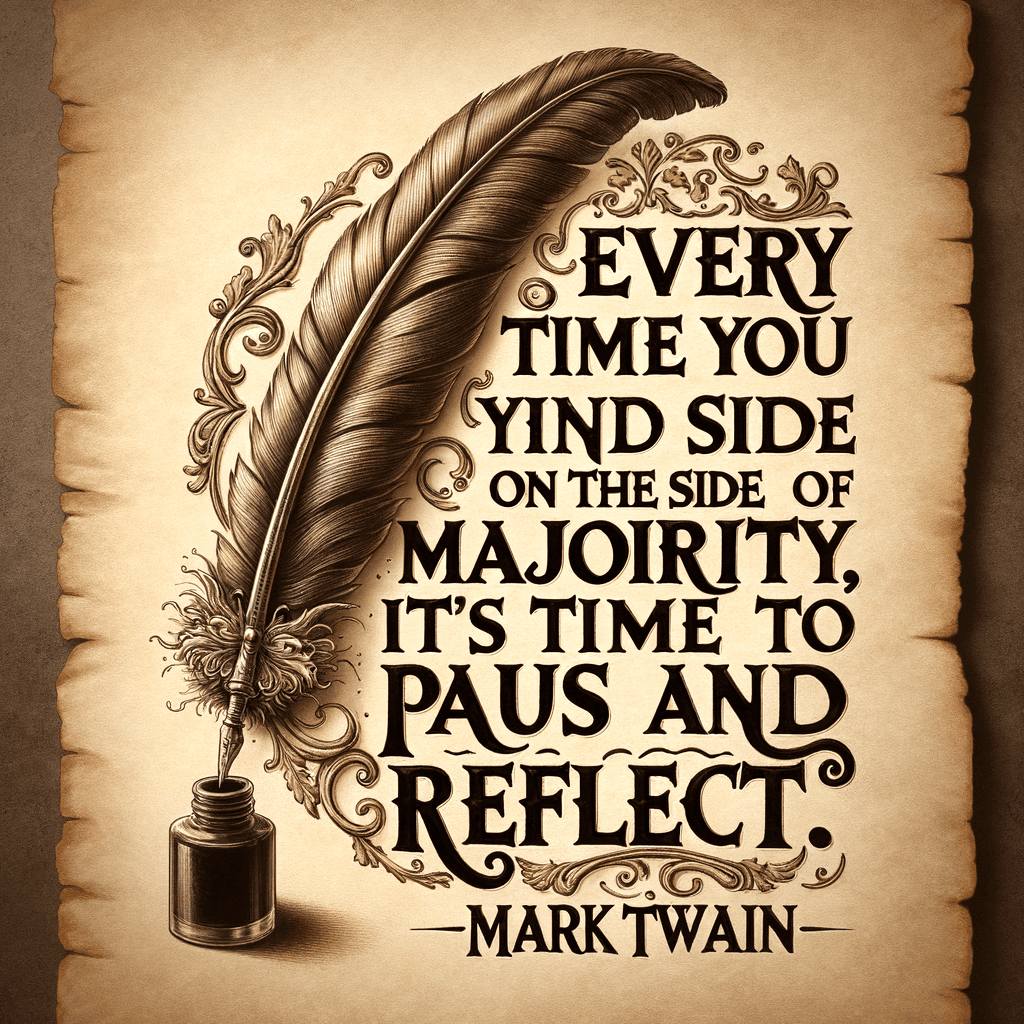
Whenever you find yourself on the side of the majority, it is time to pause and reflect. - Mark Twain
—What lingers after this line?
Critical Thinking
This quote encourages individuals to engage in critical thinking. Whenever you find yourself agreeing with the majority, it is a cue to step back and examine your beliefs and decisions to ensure they are well-founded and not influenced by groupthink.
Individuality and Independence
Twain emphasizes the importance of individuality and independent thought. Following the crowd can lead to conformist behavior, so it's crucial to pause and consider if your actions and beliefs are truly your own.
Avoiding Complacency
The quote is a reminder to avoid complacency. It suggests that being in the majority can sometimes feel comfortable and reassuring, but it is important to challenge the status quo and strive for personal growth and understanding.
Questioning Social Norms
Twain's words encourage questioning societal norms and majority opinions. Just because a belief or practice is widely accepted does not mean it is correct or just, and individuals should reflect on the deeper implications and reasons behind prevailing views.
Historical Context
Mark Twain was an American writer and humorist in the 19th century known for his keen observations on society and human nature. His works often explored the tensions between societal expectations and personal freedoms.
One-minute reflection
Where does this idea show up in your life right now?
Related Quotes
6 selectedWhenever you find yourself on the side of the majority, it is time to pause and reflect. - Mark Twain
Mark Twain
This quote encourages critical thinking and self-reflection. It prompts individuals to question whether they genuinely believe in the popular viewpoint or if they are simply conforming to societal opinions.
Read full interpretation →To be part of society is to lose a part of yourself; do what you would do if you were the only person on Earth. — Derek Sivers
Derek Sivers
Derek Sivers’ line begins with a sober observation: joining society often means trimming away parts of the self to fit shared expectations. Manners, careers, tastes, and even ambitions can become performances shaped by a...
Read full interpretation →Where all think alike there is little danger of innovation. — Edward Abbey
Edward Abbey
Edward Abbey’s line turns a common assumption on its head. At first glance, a group that thinks alike may seem stable, efficient, and harmonious.
Read full interpretation →It is not enough to have a good mind; the main thing is to use it well. — René Descartes
René Descartes
Descartes draws an immediate distinction between possessing intelligence and exercising it properly. In other words, raw mental ability is only a starting point; what truly matters is judgment, discipline, and the abilit...
Read full interpretation →The chief enemy of creativity is good sense. — Pablo Picasso
Pablo Picasso
At first glance, Picasso’s claim sounds like a provocation against reason itself. Yet his point is subtler: ‘good sense’ often means the habits, rules, and social expectations that keep people from taking imaginative ris...
Read full interpretation →Think before you speak. Read before you think. — Fran Lebowitz
Fran Lebowitz
Fran Lebowitz delivers her point through a neat inversion: the familiar advice “think before you speak” is immediately complicated by “read before you think.” That reversal jolts us into noticing something we often ignor...
Read full interpretation →More From Author
More from Mark Twain →We can secure other people's approval if we do right and try hard; but our own is worth a hundred of it. — Mark Twain
At its heart, Mark Twain argues that external approval is attainable through good conduct and honest effort, yet it remains secondary to a deeper judgment: our own. Praise from others can reassure us, but it is often cha...
Read full interpretation →Grief can take care of itself, but to get the full value of a joy you must have somebody to divide it with. — Mark Twain
Mark Twain’s remark begins with a striking contrast: grief, he says, can sustain its own weight, while joy needs companionship to reach its fullest meaning. In other words, sorrow often folds inward, making us solitary,...
Read full interpretation →Work consists of whatever a body is obliged to do, and that Play consists of whatever a body is not obliged to do. — Mark Twain
At first glance, Mark Twain’s line seems almost playful in its simplicity, yet it cuts directly to the heart of human motivation. Work, in his framing, is not defined by effort alone but by obligation: it is what a perso...
Read full interpretation →Eat a live frog first thing in the morning and nothing worse will happen to you the rest of the day. — Mark Twain
Mark Twain’s line is meant to jolt: the grotesque image of eating a live frog isn’t culinary advice but a metaphor for confronting the most unpleasant task first. By exaggerating the discomfort, Twain makes the underlyin...
Read full interpretation →