
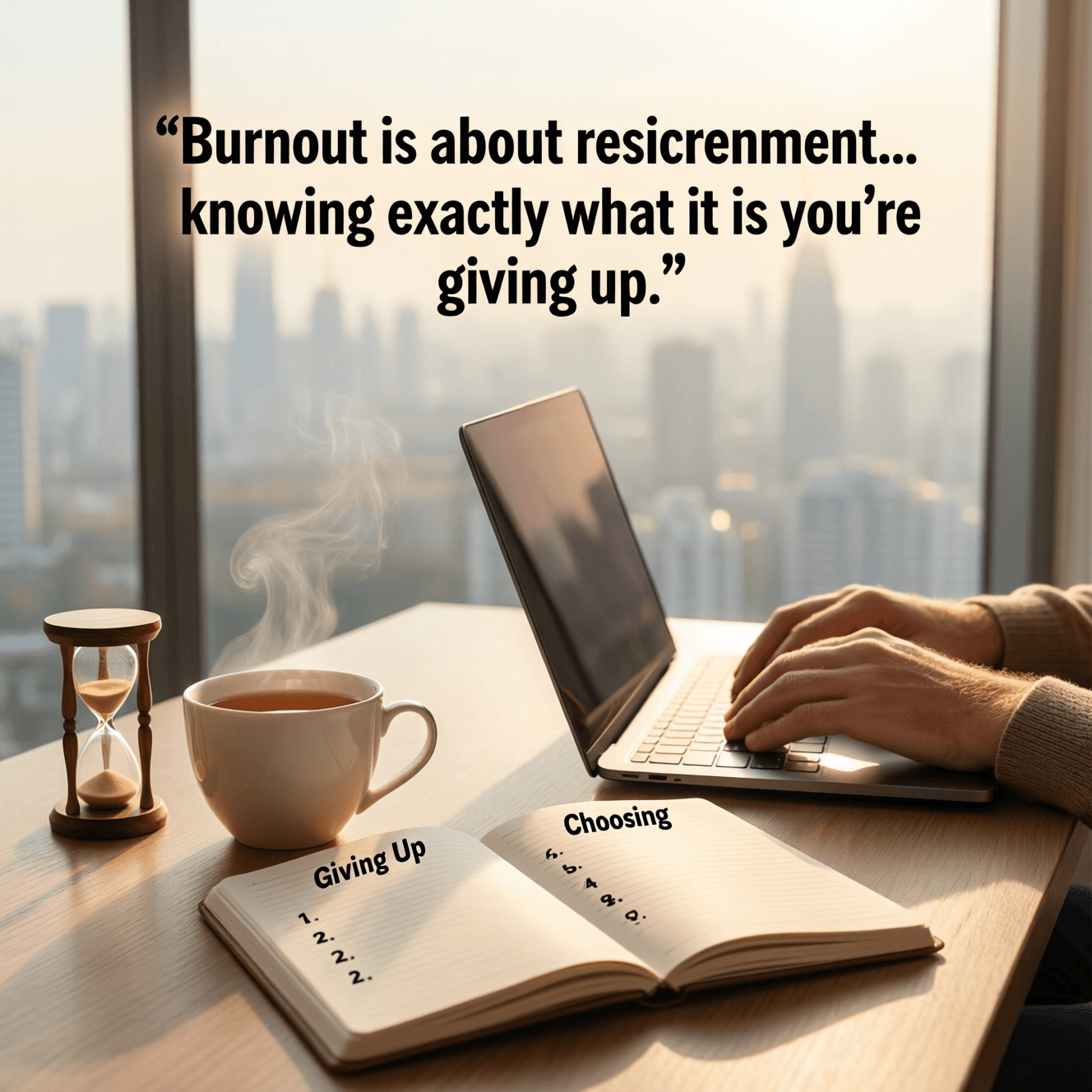
Burnout is about resentment. You beat it by knowing exactly what it is you're giving up that makes you resentful. — Marissa Mayer
—What lingers after this line?
Reframing Burnout as an Emotional Signal
Marissa Mayer’s claim pivots burnout away from pure exhaustion and toward a more specific emotional marker: resentment. In this framing, fatigue is often the surface symptom, while resentment is the deeper alarm that something feels unfair, unchosen, or chronically one-sided. Rather than asking only, “Why am I so tired?”, Mayer nudges us to ask, “What am I angry about having to carry?” That shift matters because resentment is information. It points to misaligned expectations, unclear boundaries, or a persistent gap between what you value and what your days require. Once burnout is understood as a message—not just a malfunction—you can respond with clarity instead of self-blame.
The Invisible Trade: What You’re Actually Giving Up
From there, Mayer’s emphasis on “knowing exactly what it is you’re giving up” highlights how resentment often grows in the vague space of untracked sacrifices. People commonly say, “Work is taking over my life,” but the resentment becomes actionable only when translated into specifics: missed dinners, abandoned hobbies, neglected health, or the constant anxiety of being reachable. In practice, burnout can intensify when the sacrifice is unnamed because the mind treats it as endless and uncontrollable. By identifying the precise cost—time with a child, sleep, creative energy, friendships—you turn a foggy grievance into a concrete ledger, which is the first step toward renegotiation.
Choice, Agency, and the Birth of Resentment
Once the trade is visible, the next question is whether it feels chosen. Resentment tends to flare when someone believes they have no agency: “I have to do this,” “No one else will,” or “If I say no, everything falls apart.” Even when the situation truly is constrained, the internal story of powerlessness adds emotional weight to every demand. That’s why Mayer’s approach implies a subtle but important pivot: if you can name what you’re giving up, you can also decide whether that exchange is still worth it. Sometimes the answer is yes—temporarily and consciously. But when the sacrifice is involuntary, indefinite, or unreciprocated, resentment becomes the predictable outcome.
How Resentment Accumulates in Everyday Work
Resentment often doesn’t arrive with a single catastrophic workload; it compounds through small, repeated boundary breaches. The meeting that creeps into lunch, the late-night “quick question,” the weekend inbox check that becomes expected—each instance is a tiny surrender of rest, autonomy, or personal identity. Over time, the person may still perform well, yet feel increasingly hostile toward the role, the team, or even the people they care about. This is also why high performers can burn out faster: they are frequently rewarded with more responsibility, not more protection. If extra effort buys only higher expectations, the hidden bargain becomes: “I give more, and I lose more,” which is fertile ground for resentment.
Beating Burnout by Renegotiating the Sacrifice
Mayer’s proposed antidote follows logically: once you know the specific thing you’re giving up, you can stop paying that price automatically. The solution isn’t merely “rest more,” but “change the terms.” That may mean setting a clear cutoff time, delegating a task that drains you, declining low-impact meetings, or explicitly trading one obligation for another rather than adding endlessly. Just as importantly, some sacrifices can be made less resentful by making them explicit and time-bound: “For six weeks I’m choosing to work late for this launch, and then I’m taking Friday afternoons back.” The resentment often softens when the sacrifice is both acknowledged and finite.
A Practical Self-Audit to Restore Alignment
To apply the quote, it helps to run a simple audit: identify the moments you feel disproportionate irritation, then ask what value is being violated—sleep, respect, family time, creativity, physical health, or fairness. The goal is precision: not “I’m overwhelmed,” but “I resent that I can’t eat dinner without checking messages,” or “I resent that my work is never ‘done’ because the criteria keep shifting.” With that clarity, you can choose a targeted response: redefine “done,” establish response windows, request clearer priorities, or adjust commitments to match what you can sustainably give. In this way, Mayer’s point becomes a roadmap: resentment reveals the exact sacrifice that needs to be named, limited, or consciously chosen again.
One-minute reflection
What's one small action this suggests?
Related Quotes
6 selectedThe cost of your new life is your old one. — Brianna Wiest
Brianna Wiest
Brianna Wiest’s line frames transformation as a direct trade: to step into a “new life,” you must pay with the familiar structures of the “old one.” Rather than promising effortless reinvention, the quote insists that me...
Read full interpretation →Resentment is like drinking poison and waiting for the other person to die. — Carrie Fisher
Carrie Fisher
Carrie Fisher’s line lands because it flips our usual assumption about blame and punishment. Resentment feels like a weapon aimed outward—proof that someone hurt us and should pay—but the metaphor exposes a cruel physics...
Read full interpretation →Seek the narrow path that leads to meaning rather than the wide road that promises ease. — Kahlil Gibran
Kahlil Gibran
Gibran frames life as a landscape with diverging routes: one broad and welcoming, the other narrow and demanding. The wide road “promises ease,” offering quick comfort, social approval, or convenient habits that reduce f...
Read full interpretation →Give me liberty, or give me death! — Patrick Henry
Patrick Henry
This famous declaration by Patrick Henry serves as a powerful call to action for the pursuit of freedom. It emphasizes the importance of liberty as a fundamental right worth fighting for.
Read full interpretation →To make a great champion, you must be willing to pay a greater price. — Bud Wilkinson
Bud Wilkinson
This quote highlights that achieving greatness in any field requires a strong commitment and a readiness to give more than what is typically expected.
Read full interpretation →To reach a great height, a prince must go to extreme lengths. — Antoine de Saint-Exupéry
Exupéry
This quote emphasizes the importance of determination and relentless effort to achieve greatness. 'A prince' can be seen as a metaphor for anyone aspiring to reach influential or elevated positions.
Read full interpretation →More From Author
More from Marissa Mayer →