
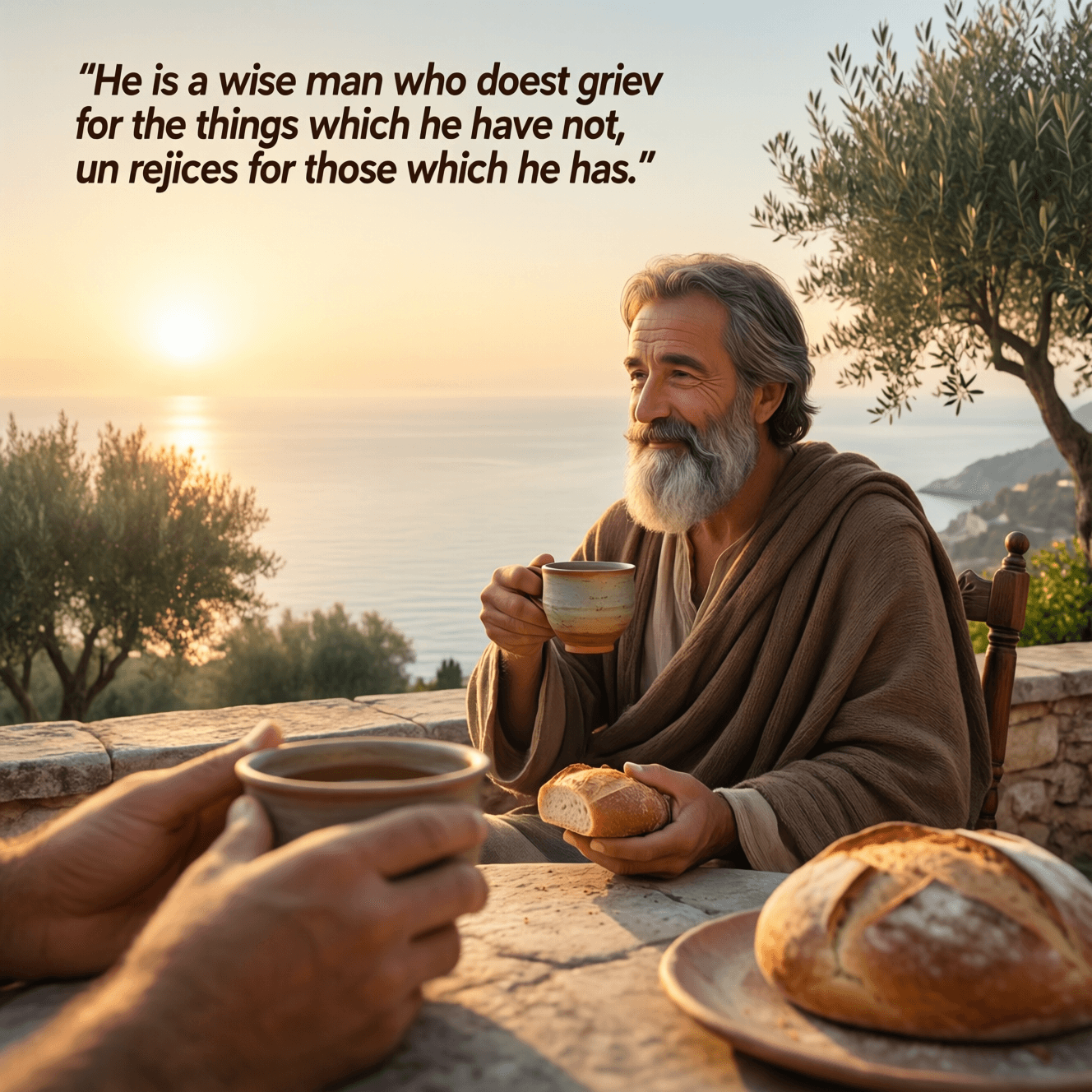
He is a wise man who does not grieve for the things which he has not, but rejoices for those which he has. — Epictetus
—What lingers after this line?
Epictetus on the Direction of Attention
Epictetus frames wisdom as a choice about where the mind habitually rests. Instead of measuring life by absences—status, possessions, opportunities not obtained—the wise person turns attention toward what is already present and workable. This is not a call to ignorance or complacency, but a deliberate refusal to let “not having” dictate one’s emotional weather. From that starting point, the quote quietly shifts the definition of wealth: it becomes less about accumulation and more about perception. When gratitude governs attention, contentment becomes accessible in ordinary circumstances rather than postponed until some future acquisition.
Stoic Control: What Is and Isn’t Ours
This emphasis on rejoicing in what one has aligns with Stoicism’s central distinction between what depends on us and what does not. In the Enchiridion (c. 125 AD), Epictetus teaches that our judgments, desires, and aversions are within our control, while many external outcomes are not. Grief over what we lack often hides an implicit demand that the world should have arranged itself differently. Consequently, gratitude becomes a practical exercise in focusing on what can be meaningfully engaged: one’s character, choices, and present responsibilities. The wise person doesn’t deny disappointment; rather, he refuses to surrender his inner steadiness to circumstances he cannot command.
Grief as a Habit of Comparison
Grieving “for the things which he has not” frequently arises from comparison—imagining alternate lives, rival successes, or idealized versions of the self. The mind rehearses a counterfactual story: if only this had happened, then I would be whole. Yet that story tends to expand endlessly, because each new gain reveals another lack. By contrast, rejoicing in what one has interrupts this treadmill. It replaces comparative accounting with a more grounded inventory: relationships that endure, skills earned, health preserved, or even small daily comforts. In this way, Epictetus suggests that wisdom is less an abstract theory and more an ongoing discipline against the seductions of “if only.”
Rejoicing Without Becoming Passive
A common misreading is that gratitude means abandoning ambition. Epictetus is not urging people to stop improving their lives; he is urging them to stop tying peace to outcomes. One can pursue advancement while remaining emotionally free from the belief that lacking it makes life unlivable. This is where Stoic joy differs from mere consolation. Rejoicing in what one has provides a stable platform for action: you strive from sufficiency, not from desperation. When gains come, they are welcomed; when they do not, your dignity remains intact because it was never outsourced to the result.
A Practical Example of Stoic Gratitude
Consider someone passed over for a promotion. The untrained response is to ruminate on what is missing—recognition, income, status—until resentment hardens into identity. Epictetus would ask what remains: competence, the ability to learn, supportive colleagues, the chance to refine one’s work, and the freedom to seek other paths. From there, rejoicing is not forced positivity; it is accurate seeing. The person can still feel disappointment, yet choose not to treat it as a verdict on life. That choice preserves energy for constructive steps—asking for feedback, building skills, or changing roles—rather than spending it on grief that yields nothing.
The Deeper Aim: Inner Freedom
Ultimately, the quote is a blueprint for inner freedom. When you train yourself to rejoice in what you have, you reduce the power of fortune to govern your mood. That is why Epictetus links this attitude with wisdom: it signals maturity in how one relates to desire and loss. As the perspective settles in, gratitude becomes less a momentary feeling and more a stable posture toward life. The wise person can acknowledge what is missing without being ruled by it, and that steadiness—quiet, durable, and self-directed—is the kind of riches Stoicism prizes most.
One-minute reflection
Why might this line matter today, not tomorrow?
Related Quotes
6 selectedIt is in no man's power to have whatever he wants, but he has it in his power not to wish for what he hasn't got, and cheerfully make the most of the things that do come his way. — Epictetus
Epictetus
Epictetus begins with a sober truth: no one can command reality to supply every desire. Fortune, health, status, and even the actions of other people remain only partly within our reach.
Read full interpretation →Gratitude turns what we have into enough.
Unknown
This quote highlights the transformative power of gratitude. Recognizing and appreciating what we have can shift our perspective from scarcity to abundance.
Read full interpretation →Wealth consists not in having great possessions, but in having few wants. — Epictetus
Epictetus
Epictetus reframes the concept of wealth from accumulation to contentment. Rather than measuring riches by outward abundance, he suggests true wealth lies in one's ability to limit desires.
Read full interpretation →Wealth consists not in having great possessions, but in having few wants. — Epictetus
Epictetus
Epictetus, a prominent Stoic philosopher, reframes the idea of wealth from material accumulation to internal contentment. In his *Discourses* (c.
Read full interpretation →Learn to be thankful for what you already have, while you pursue all that you want. — Jim Rohn
Jim Rohn
Jim Rohn’s advice begins with a delicate balance: appreciation for the present should not cancel ambition for the future. Instead, gratitude and aspiration can move together, like two steps in the same journey.
Read full interpretation →You are not Atlas carrying the world on your shoulder. It is good to remember that the planet is carrying you. — Vandana Shiva
Vandana Shiva
Vandana Shiva’s words begin by overturning a familiar heroic image: the individual as Atlas, straining beneath the weight of the world. Instead, she gently corrects that illusion, reminding us that we are not supporting...
Read full interpretation →More From Author
More from Epictetus →A ship should not ride on a single anchor, nor life on a single hope. — Epictetus
At first glance, Epictetus turns a practical image into a moral lesson: a ship secured by only one anchor is vulnerable to shifting winds, rough tides, and hidden strain. In the same way, a life fastened to a single hope...
Read full interpretation →Never call yourself a philosopher; show it. — Epictetus
Epictetus compresses an entire ethical program into a sharp command: do not claim the title, demonstrate the life. In other words, wisdom is not a badge one pins on oneself but a pattern others can recognize in conduct.
Read full interpretation →The economy can take your money. A crisis can take your opportunities. But fear can take your judgment—and that is the loss most people never recover from. — Epictetus
At first glance, this saying draws a sharp line between what happens to us and what happens within us. Money can vanish in a recession, and opportunities can disappear when markets collapse, yet Epictetus argues that the...
Read full interpretation →The greatest victory is the battle fought against your own desire to quit when things get quiet. — Epictetus
At first glance, this saying shifts the meaning of victory away from public triumph and toward an inward contest. The hardest battle, it suggests, is not fought in dramatic moments but in silence—when excitement fades, r...
Read full interpretation →