
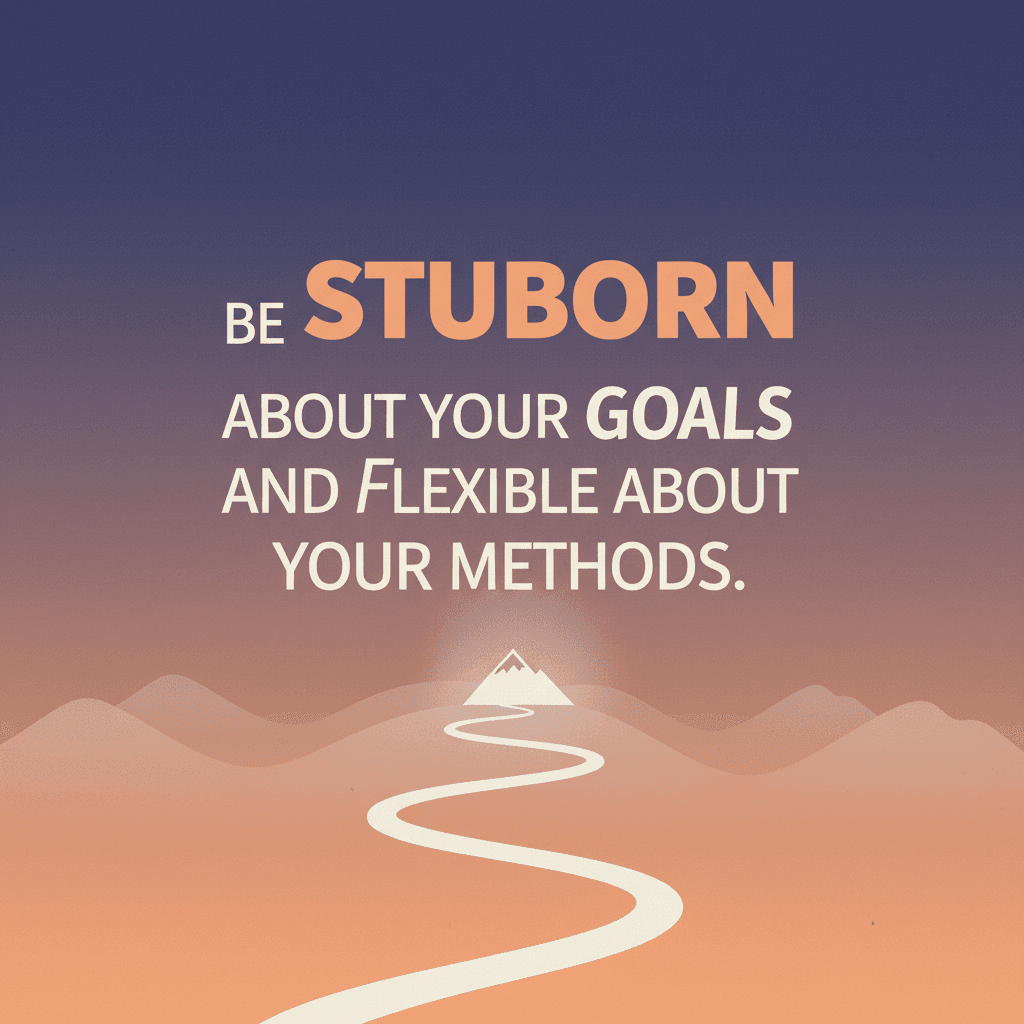
Be stubborn about your goals and flexible about your methods. — H. Jackson Brown Jr.
—What lingers after this line?
The Productive Tension at the Heart
H. Jackson Brown Jr. pairs two forces that seem to conflict but in practice enable progress: unwavering commitment to outcomes and supple experimentation in approach. Treat the goal as a North Star that does not move; treat the method as sails you constantly trim. This framing separates identity from tactics, so setbacks become data rather than verdicts on who you are. Thus, persistence fuels direction while flexibility supplies motion.
Echoes from Strategy and History
This balance has deep roots. Dwight D. Eisenhower remarked that plans are worthless, but planning is everything (1957), underscoring that preparation matters more than any single script. Likewise, Sun Tzu likened tactics to water shaping itself to terrain (The Art of War, c. 5th century BC). The goal—win the campaign—remains fixed; the method—maneuver—adapts to ground and weather. These historical voices foreshadow Brown’s counsel: clarity about ends empowers agility about means.
A Scientific Mindset for Everyday Goals
Extending this lineage, the scientific method treats methods as hypotheses to be stress‑tested. Karl Popper’s The Logic of Scientific Discovery (1959) reframed progress as bold conjectures followed by honest refutation. In entrepreneurship, Eric Ries’s The Lean Startup (2011) operationalized this with the build‑measure‑learn loop: hold the outcome steady, but iterate the path using evidence. Thus, you preserve stubbornness where it belongs—in defining success—while being flexible in the experiments that get you there.
Tools That Anchor Ends and Free Means
From theory to practice, certain tools institutionalize Brown’s principle. OKRs, pioneered by Andy Grove at Intel and popularized by John Doerr (Measure What Matters, 2018), bind ambitious Objectives to flexible, testable Key Results. Meanwhile, Colonel John Boyd’s OODA loop (1970s) trains rapid adaptation: observe, orient, decide, act—then repeat. Used together, OKRs harden goals while OODA accelerates method updates, creating a system that is both resolute and responsive.
Case Studies of Flexible Execution
To see the stakes, consider Apollo 13 (1970). NASA’s unyielding goal—bring the crew home—never changed, yet engineers improvised a carbon‑dioxide scrubber from mismatched filters and duct tape. Similarly, Taiichi Ohno’s Toyota Production System (1978) institutionalized kaizen: a relentless aim for quality paired with fluid process tweaks on the line. In both stories, clarity of purpose turned constraints into creativity. Fixing the destination unlocked ingenuity in the route.
Psychological Skills Behind Adaptability
To sustain such agility, cultivate mindsets that welcome feedback. Carol Dweck’s research on growth mindset (2006) shows that viewing ability as improvable promotes persistence through setbacks. Implementation intentions—if‑then plans studied by Peter Gollwitzer (1999)—pre‑decide adaptive moves under pressure. Gabriele Oettingen’s WOOP method (2014) pairs desire with reality checks, sharpening both resolve and flexibility. Altogether, these practices protect stubborn goals while keeping methods fluid.
Guardrails Against Drift and Rigidity
Yet flexibility needs guardrails. Goodhart’s Law (1975) warns that when a measure becomes a target, it can corrupt the goal; thus review metrics to ensure they still reflect outcomes. Borrow a lean habit: hold regular pivot‑or‑persevere reviews (Ries, 2011) with predefined success thresholds and kill criteria. If evidence shows learning without progress, pivot methods; if evidence shows noise, extend the run; if evidence shows decay, stop. The goal remains non‑negotiable; the tactic earns its keep.
Daily Routines That Operationalize the Quote
Finally, embed Brown’s philosophy in simple rhythms. Define one clear outcome per cycle and draft a small portfolio of methods: default plan, low‑cost variant, and radical experiment. Run a premortem to surface likely failures (Gary Klein, 2007), then schedule weekly OODA‑style reviews to update methods, not the objective. Close each cycle with a brief after‑action: keep, tweak, or retire each method. Over time, the habit of adaptive means turns long‑term goals into inevitabilities.
One-minute reflection
What's one small action this suggests?
Related Quotes
6 selectedPersevering is not running in a straight line, but adapting to each curve in the road.
Unknown
This quote implies that perseverance is not about maintaining a constant, unchanging course of action. Instead, it involves flexibility and the ability to adjust to challenges and obstacles that arise.
Read full interpretation →To ignite your life you must focus on one thing long enough for it to catch fire. — Gary Keller
Gary Keller
Gary Keller’s quote begins with a simple but demanding idea: transformation rarely comes from scattered effort. To “ignite your life” is to create momentum, meaning, and visible progress, yet that spark needs sustained a...
Read full interpretation →Emotional resilience refers to your ability to roll with the punches, adapt to adversity, and bounce back after setbacks. — Bettendorf Counseling Center
Bettendorf Counseling Center
At its core, the Bettendorf Counseling Center’s definition frames emotional resilience as a flexible strength rather than a hard shell. To “roll with the punches” is not to avoid pain or pretend setbacks do not matter; i...
Read full interpretation →The artist is not a solid, static being. The artist is fluid, like water, moving with the tides and changing form. — James McCrae
James McCrae
James McCrae’s image of the artist as fluid immediately challenges the common idea that creative people possess a single, fixed essence. Instead, he suggests that artistry is a process of becoming, not a stable condition...
Read full interpretation →We will either find a way, or make one. — Hannibal Barca
Hannibal Barca
At its core, Hannibal Barca’s line is a declaration that obstacles do not end the story; they merely change the method. Rather than waiting for ideal conditions, he frames action itself as the answer: if a route exists,...
Read full interpretation →The mind adapts and converts to its own purposes the obstacle to our acting. — Marcus Aurelius
Marcus Aurelius
At its heart, Marcus Aurelius’s line expresses a central Stoic conviction: external events do not fully determine our lives; rather, our judgments about them shape what they become. In his Meditations (c.
Read full interpretation →More From Author
More from H. Jackson Brown Jr. →Talent without discipline is like an octopus on roller skates. There's plenty of movement, but you never know if it's going to be forward, backward, or sideways. — H. Jackson Brown, Jr.
H. Jackson Brown, Jr.
Read full interpretation →Don't wish it were easier; wish you were better. — H. Jackson Brown Jr.
H. Jackson Brown Jr.’s line shifts attention away from external hardship toward internal growth.
Read full interpretation →The best preparation for tomorrow is doing your best today. — H. Jackson Brown Jr.
This quote emphasizes the importance of concentrating on your current actions. By giving your best effort today, you are effectively preparing yourself for future challenges and opportunities.
Read full interpretation →Do not wait to be inspired. Begin, and inspiration will find you. — H. Jackson Brown Jr.
This quote encourages taking a proactive approach to tasks and projects. Instead of waiting for inspiration to strike, start working, and the act of doing will eventually ignite creativity.
Read full interpretation →