
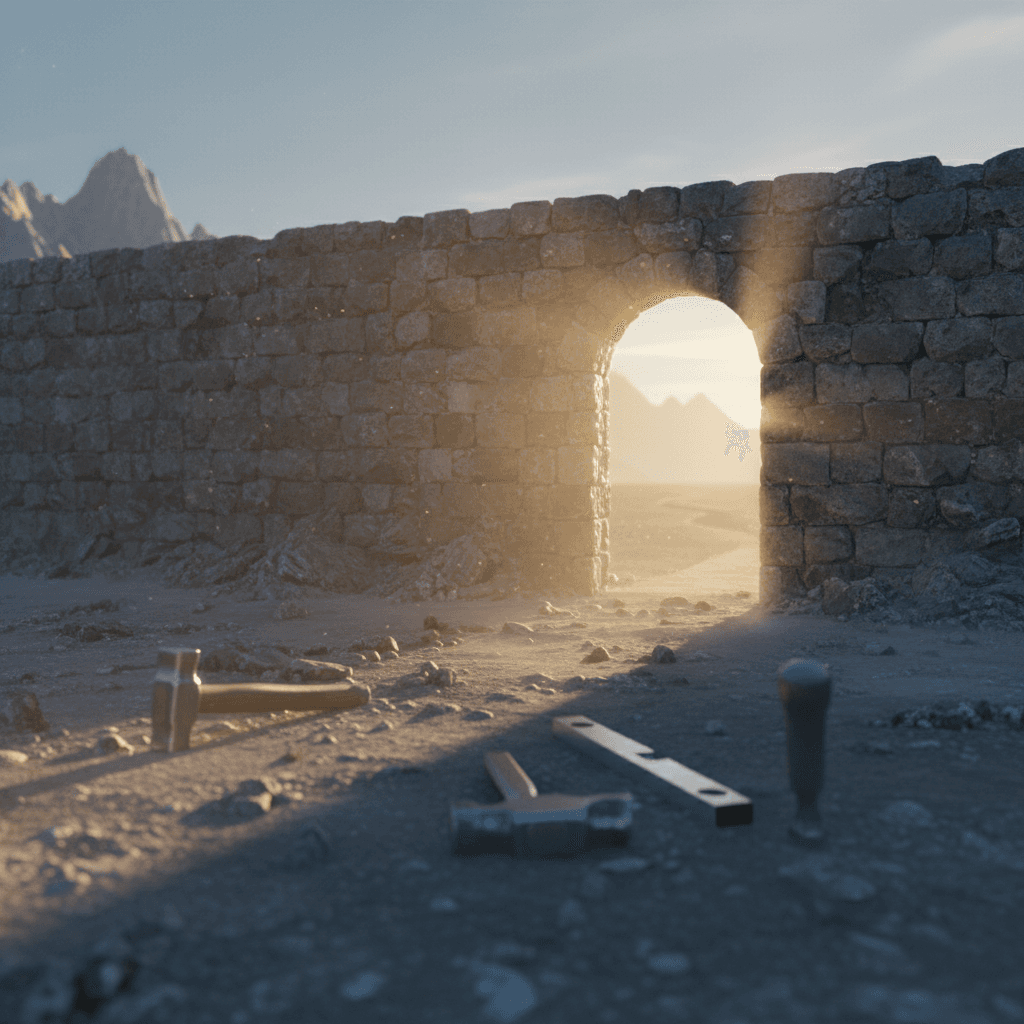
Convert doubt into tools and build a doorway where there was none. — José Martí
—What lingers after this line?
Martí’s Call: Doubt as Raw Material
José Martí’s aphorism urges us to treat doubt not as a verdict but as a resource. An exiled Cuban essayist and organizer (1853–1895), he framed uncertainty as the energy of construction rather than the pretext for retreat. In "Nuestra América" (1891), Martí presses for knowledge crafted to local realities, while his line "trenches of ideas are worth more than trenches of stone" (Patria, 1892) reframes defense as creation. By recasting doubt as building material, the metaphor of the doorway becomes precise: it is a deliberate passage cut into what once appeared a solid wall. The question, then, is methodological—how do we fashion hinges and handles from our misgivings? To answer, we turn from metaphor to practice.
From Question to Instrument: The Scientific Habit
Across science and design, skepticism becomes apparatus. Karl Popper’s falsification principle—advance by testing what might be wrong—turns doubts into experiments (The Logic of Scientific Discovery, 1934/1959). Florence Nightingale’s polar area diagram (1858) converted uncertainty about soldier mortality into visual evidence that compelled sanitary reform, proving that orderly tools can carve public doorways. Design thinking follows a similar arc: prototype to learn, not to confirm. As Tim Brown explains, low-fidelity models expose unknowns early and cheaply (Harvard Business Review, 2008). In this way, the question morphs into a measuring stick, and the hunch into a test rig. Having framed the philosophy, we can now assemble a day-to-day toolkit for constructing passages through uncertainty.
A Practical Kit for Everyday Builders
Start by reframing: translate worries into "How might we…" prompts that invite many solutions. Next, log your core assumptions and give each a test card—hypothesis, method, metric—borrowing from lean startup practice (Eric Ries, The Lean Startup, 2011). These simple artifacts transform vague doubt into scheduled learning. Add structure: checklists catch predictable failure modes in complex work (Atul Gawande, The Checklist Manifesto, 2009). Capture insights in a connected note system—Luhmann’s slip-box, or Zettelkasten, turned scattered ideas into a prolific engine (see Sönke Ahrens, 2017). Even playful methods help: "rubber duck" explanations surface gaps by forcing clarity. With tools in hand, we are better equipped to build doorways under the tightest constraints.
Doorways Under Constraint: Frugal Innovation
When resources are scarce, ingenuity retools doubt into access. M-Pesa in Kenya (launched 2007) turned SIM cards into bank branches, addressing skepticism about traditional infrastructure and opening a financial doorway for millions (Jack & Suri, Science, 2011). Likewise, the e-NABLE community uses open-source designs and 3D printing to deliver low-cost prosthetics, converting cost barriers into collaborative blueprints (c. 2013–present). This ethos echoes "jugaad"—resourceful improvisation that embraces constraints as design briefs (Radjou, Prabhu, Ahuja, Jugaad Innovation, 2012). The pattern is consistent: doubt about feasibility becomes a prompt to simplify, repurpose, and share. From here, it is a short step to social architecture—building doorways not only for products but for people.
Social Doorways: Education and Liberation
Martí linked emancipation to learning, arguing that self-made knowledge equips communities to pass through their own thresholds ("Nuestra América," 1891). In similar spirit, the Freedom Schools of Mississippi (1964) transformed civic doubt into collective literacy, creating entry points into public life through study and dialogue (SNCC archives). Paulo Freire’s "Pedagogy of the Oppressed" (1970) codified this move: problem-posing education recasts skepticism as inquiry shared between teacher and student. In each case, curriculum becomes carpentry—lessons are hinges, discussion the handle. Yet door-building also demands inner craftsmanship, which returns us to the psychology of doubt.
Transforming Anxiety: Curiosity, Mindset, and Action
Internally, doubt can be redirected by cognitive reappraisal: What else could this feeling mean, and what evidence would change my mind? Cognitive therapy formalized such moves (Aaron T. Beck, 1979). Carol Dweck’s work on growth mindset (2006) adds that abilities increase with deliberate practice, reframing "I can’t" as "I can’t yet." Even stress can be harnessed when viewed as fuel rather than harm (Alia Crum et al., 2013). To operationalize, use implementation intentions: "If X uncertainty appears, then I run Y test" (Peter Gollwitzer, 1999). In doing so, emotion cues execution. With the mind aligned to act, we still need a way to choose where to cut the doorway and how to mount the hinge.
Choosing the Wall and the Hinge
Good builders plan. A pre-mortem imagines the project failed and asks why, surfacing weak studs before cutting (Gary Klein, Harvard Business Review, 2007). The OODA loop—observe, orient, decide, act—keeps learning tight and adaptive (John Boyd, 1970s). Meanwhile, optionality spreads risk: small bets and reversible moves keep the doorway from becoming a trap (Nassim Nicholas Taleb, Antifragile, 2012). Thus, we convert doubt into instruments, rituals, and choices that shape passage where none existed. Returning to Martí, the wall is not denied; it is studied, scored, and opened. The tool is the answer to the question, and the doorway is its proof.
One-minute reflection
What does this quote ask you to notice today?
Related Quotes
6 selectedTurn obstacles into tools; build with what stands in your way. — Viktor Frankl
Viktor Frankl
Viktor Frankl framed resistance itself as material for meaning. In Man’s Search for Meaning (1946), he recounts how, amid deprivation, he redirected suffering into purpose by serving fellow prisoners and envisioning futu...
Read full interpretation →The measure of who we are is what we do with what we have. — Vince Lombardi
Vince Lombardi
Vince Lombardi’s line shifts identity away from self-description and toward observable choice. Instead of asking who we are in theory—our intentions, labels, or ambitions—he points to what we actually do when faced with...
Read full interpretation →If the wind will not serve, take to the oars. — Publilius Syrus
Publilius Syrus
Publilius Syrus condenses a whole philosophy of agency into a sailor’s image: when the wind fails, you do not drift and complain—you row. The point is not that circumstances never matter, but that waiting for ideal condi...
Read full interpretation →Either I will find a way or I will make one. — Hannibal
Hannibal
Hannibal’s line is built on a stark refusal to accept paralysis: if a path already exists, he will locate it; if it doesn’t, he will construct it. The phrasing places responsibility squarely on the self, turning obstacle...
Read full interpretation →Turn scarcity into a classroom; scarcity teaches creative abundance. — Paulo Coelho
Paulo Coelho
Coelho reframes scarcity from a sentence into a syllabus: when resources tighten, life becomes a classroom that forces attention, prioritization, and ingenuity. Instead of seeing lack as only deprivation, he suggests we...
Read full interpretation →Create doors where others see only walls — Simone de Beauvoir
Simone de Beauvoir
Simone de Beauvoir’s line compresses a life strategy into a single image: when the world presents a wall—social limits, fear, convention—you can still build a door. The point is not denial of obstacles but a refusal to t...
Read full interpretation →More From Author
More from José Martí →Forward is a verb; it asks for hands and will — José Martí
When José Martí writes that “Forward is a verb,” he transforms what we usually treat as a mere direction into a call to act. Instead of thinking of “forward” as a passive movement that somehow happens to us, Martí insist...
Read full interpretation →Wake each morning with purpose; small intentions can set continents in motion. — José Martí
José Martí’s line invites us to reconsider the moment most people treat casually: waking up. Rather than seeing morning as a blur of alarms and obligations, he frames it as a decisive threshold.
Read full interpretation →Cultivation of the mind is as necessary as food to the body. — José Martí
José Martí, the Cuban poet, journalist, and independence leader (1853–1895), framed learning not as a luxury but as sustenance. When he declares that cultivating the mind is as necessary as food, he casts knowledge as th...
Read full interpretation →Conquer yourself and the world lies at your feet. — José Martí
José Martí (1853–1895), the Cuban poet and independence leader, binds political liberation to inner discipline when he writes, “Conquer yourself and the world lies at your feet.” The line reads less like a boast than a b...
Read full interpretation →