
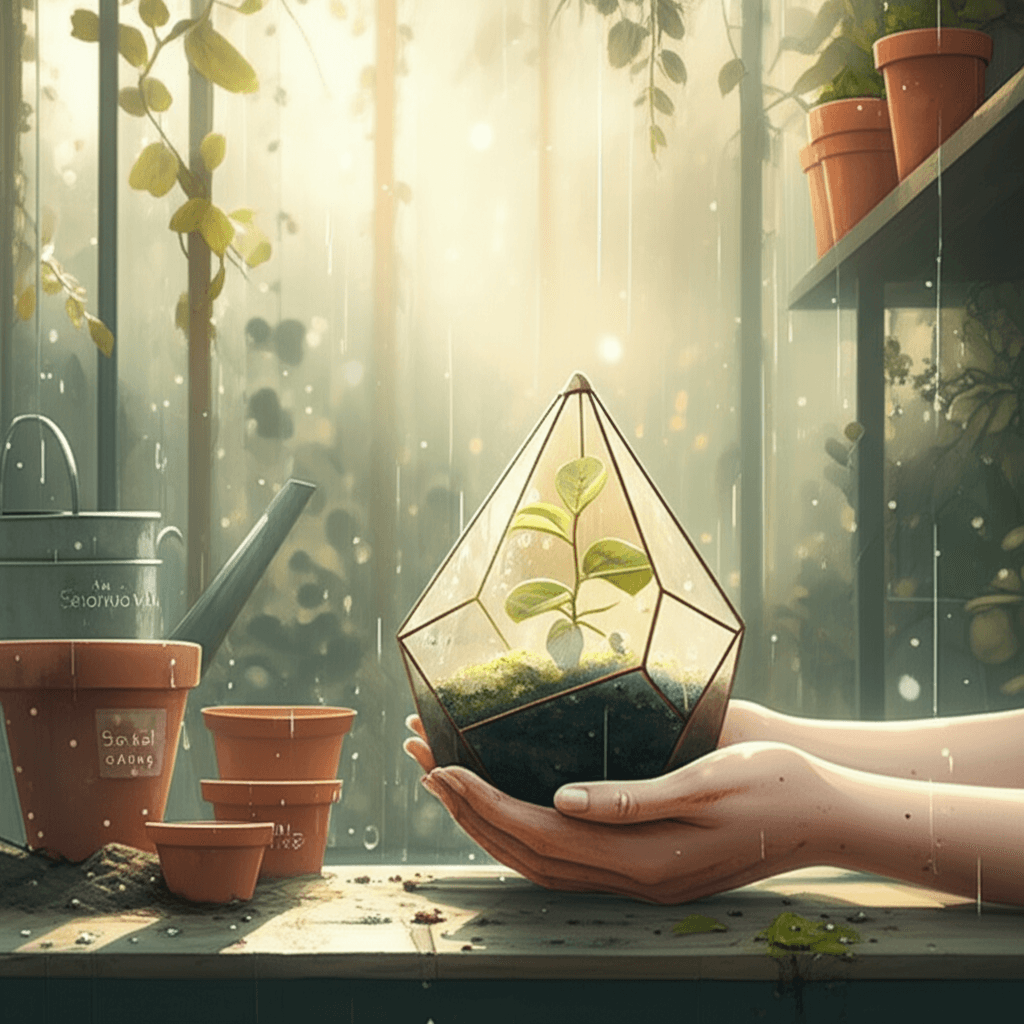
Create space for your own growth with the same care you give others. — Sappho
—What lingers after this line?
Reclaiming Self-Nurture as Ethical Balance
Though the wording feels modern, the spirit of this counsel harmonizes with Sappho’s fragments, where the self is not a selfish domain but a living instrument of song. The line asks us to allocate the same attentive generosity we extend outward to the inward terrain that enables it. In other words, care is a circuit: if one link is neglected, the whole system falters. Sappho’s Fragment 16 (“some say cavalry…”) reframes value around what one loves, implying that honoring our own vital needs is an ethical orientation, not indulgence. Beginning here, we learn that making room for our growth is not retreat but responsibility.
Sappho’s Lyric I as Sanctuary
From this opening, Sappho’s first-person voice shows how interiority becomes a shared space. In Fragment 31 (“he seems to me equal to gods”), she maps breath, pulse, and trembling—physiology as poetry—inviting readers into a sanctuary of felt experience. By dignifying her inner weather, she legitimizes personal space as worthy of attention. That intimacy does not isolate; rather, it creates a chorus: one confident “I” teaches others permission to be fully present. Thus the lyric room Sappho builds is not a locked chamber but a threshold where self-knowledge matures into empathy.
From Philautia to Modern Care Ethics
Carrying this insight forward, Aristotle’s Nicomachean Ethics IX suggests a virtuous form of self-love (philautia) in which the good person loves the noblest part of themselves, thereby benefiting the community. Millennia later, Carol Gilligan’s In a Different Voice (1982) and Joan Tronto’s Caring Democracy (2013) argue that care is relational infrastructure, sustained by practitioners who are themselves sustained. The throughline is clear: tending the self is not a rival to altruism but its prerequisite. When self-care is principled—ordered toward flourishing rather than escape—it strengthens the very networks of care we hope to uphold.
Boundaries as Fertile Borders
Consequently, we can imagine boundaries not as walls but as hedgerows: living borders that shelter songbirds, enrich soil, and define where cultivation can thrive. Audre Lorde’s A Burst of Light (1988) insists, “Caring for myself is not self-indulgence, it is self-preservation,” especially for those whose labor is perennially extracted. Healthy limits preserve the conditions under which generosity remains freely given. In this sense, saying no becomes a way of saying yes to depth, continuity, and the promise that your garden will bear fruit in its season.
Practices that Carve Out Room
In practical terms, create recurring rituals that protect your inner acreage. Block white space on the calendar as inviolable; begin mornings with a three-minute check-in naming body, mood, and intention; end days by noting a seed you planted in yourself. Creative micro-practices—ten lines in a notebook, a brief walk without a phone, one song played or sung—convert abstract self-care into muscle memory. As Marcus Aurelius writes in Meditations 4.3, the quietest retreat is within one’s own soul; returning there regularly strengthens a refuge you can carry anywhere.
Reciprocity: Your Growth Nourishes Others
Importantly, such rituals are not selfish detours but maintenance for compassion’s engine. Research on burnout by Christina Maslach and Michael Leiter (The Truth About Burnout, 1997) shows that chronic overload erodes efficacy and empathy alike. Conversely, when people experience recovery and meaning, they report greater “compassion satisfaction” (Charles Figley, 1995). By feeding your roots, you protect your canopy: the shade you offer remains cool, and the fruit you share stays sweet. Thus, your self-investment returns as steadier presence for those you serve.
Seasons of Care and the Long View
Finally, growth is seasonal, not linear. The Demeter–Persephone myth reminds us that dormancy is part of fertility; fields must lie fallow to renew. Sappho’s so-called Tithonus fragment (P. Köln 21351) meditates on aging and change, yet still affirms the love of what is beautiful—a gentle permission to adapt our pace as time turns. When you grant yourself cyclical rest, you align with a deeper rhythm: after wintering comes tender green. In honoring that cadence, you become both caretaker and cared-for, a garden and its devoted gardener.
Recommended Reading
As an Amazon Associate, we earn from qualifying purchases.
One-minute reflection
What's one small action this suggests?
Related Quotes
6 selectedYour personal space is a foundation for self-care. — Minaa B.
Minaa B.
Minaa B.’s statement begins with a simple but powerful premise: personal space is not a luxury, but a base layer of health. In this sense, self-care becomes more than candles, routines, or occasional rest; it starts with...
Read full interpretation →It is not enough to have great qualities; we should also have the management of them. — La Rochefoucauld
La Rochefoucauld
La Rochefoucauld’s remark begins with a subtle but important distinction: possessing admirable qualities is not the same as using them well. Intelligence, courage, generosity, and charm may seem inherently valuable, yet...
Read full interpretation →Don't be afraid to start over. This time you're not starting from scratch, you're starting from experience. — Germany Kent
Germany Kent
At its core, Germany Kent’s quote transforms the idea of starting over from a failure into a form of progress. The phrase rejects the fear that often accompanies fresh starts, reminding us that a restart is never truly e...
Read full interpretation →Self-compassion is a skill that can be practiced and learned over time. — Dr. Angela Derrick
Dr. Angela Derrick
At its core, Dr. Angela Derrick’s statement reframes self-compassion as something practical rather than mysterious.
Read full interpretation →If you want to be happy, if you want to be successful, if you want to be great, we have to develop the capability, we have to develop the day-to-day habits that allow this to ensue. — Epictetus
Epictetus
At its core, this saying presents happiness, success, and greatness not as accidents of fate but as capacities that must be cultivated. By repeating the phrase “we have to develop,” the thought shifts attention away from...
Read full interpretation →The only way to find out if you are capable of more is to stop making excuses for why you have settled for less. — David Goggins
David Goggins
David Goggins’s quote begins as a direct confrontation with comfort. Rather than asking whether people possess hidden potential, it argues that the answer remains unknowable until they stop defending their current level...
Read full interpretation →More From Author
More from Sappho →Sow a single clear word and let it bloom into a chorus. — Sappho
Sappho’s line begins by shrinking expression down to its smallest unit: a single clear word. The emphasis on clarity suggests intention rather than verbosity, as if meaning can be planted only when it is cleanly chosen.
Read full interpretation →Let desire fuel your craft but let kindness steady the heart. — Sappho
Sappho’s line sets up a deliberate pairing: desire as the engine of making, and kindness as the stabilizer of being. Desire pushes the artist toward intensity—toward risk, experimentation, and the hunger to shape experie...
Read full interpretation →Let your voice fracture the silence; even a small sound reshapes the air. — Sappho
Sappho’s line begins by treating silence not as emptiness, but as a kind of held breath—an atmosphere with shape and tension. When she urges, “Let your voice fracture the silence,” she implies that quiet has weight, and...
Read full interpretation →Sing with the courage of a throat that will not be silenced by storms. — Sappho
Sappho’s line frames singing as more than art—it is a refusal to be erased. The “throat” is deliberately physical, reminding us that courage is not an abstract virtue but something practiced in a body that can tremble, t...
Read full interpretation →