
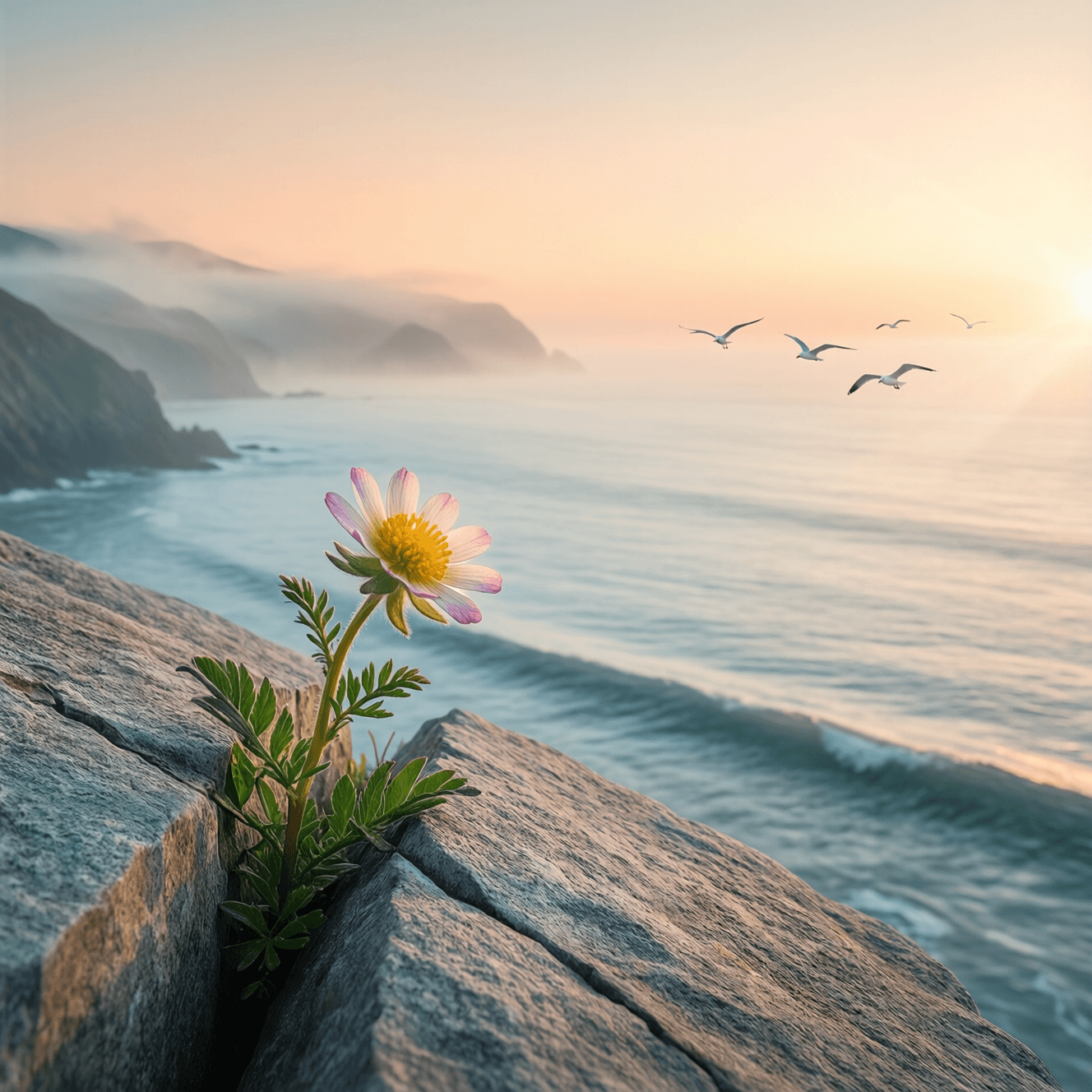
Don't we bloom for ourselves? — Ocean Vuong
—What lingers after this line?
A Question That Turns Inward
Ocean Vuong’s line arrives as a question rather than a declaration, which makes it feel intimate and unsettled at once. By asking “Don’t we bloom for ourselves?”, he nudges the reader to examine an assumption many people carry: that our growth is meant to be witnessed, approved, or rewarded by someone else. From there, the image of blooming becomes less about performance and more about an interior event—something that happens because living things are compelled to become more fully themselves. The question doesn’t deny that others may benefit from our flourishing; it simply re-centers the origin of that flourishing in the self.
Blooming Beyond the Gaze of Others
Once the question is posed, it naturally challenges the pressure to be legible and pleasing. A flower is often valued for how it looks to an observer, yet Vuong’s phrasing suggests a different biology of meaning: the bloom is first for the plant, not the passerby. In human terms, this reframes ambition, healing, and artistry as acts that do not require permission. Even when a life is lived under scrutiny—family expectations, social media metrics, institutional judgment—the line implies a quiet right to develop offstage, to become without constantly explaining who that becoming is for.
Self-Development as Survival, Not Luxury
Following that shift away from external validation, the question begins to sound like a survival ethic. Blooming can be read as a necessary unfolding: learning to name your needs, finding language for your pain, building a life that fits. This is especially resonant in Vuong’s broader literary terrain, where tenderness and harm often coexist and selfhood is hard-won. Consider a simple anecdote: someone who returns to school at night after a draining job may never receive applause, yet the act still enlarges their inner world. In that sense, blooming is not a decorative achievement—it is a way of staying alive with dignity.
The Tension Between Self and Sacrifice
Even so, the question doesn’t erase the fact that people routinely bloom for others: children, partners, communities, ancestors. Precisely because of that reality, Vuong’s “Don’t we” functions like a gentle corrective, a reminder to check whether devotion has become self-erasure. This tension is old and recognizable. Many moral traditions praise sacrifice, yet modern psychology’s language of boundaries insists that care without selfhood becomes resentment or collapse. The line sits between these poles, suggesting that the healthiest giving may come after we have granted ourselves the basic right to grow.
Art as a Private Flowering
From here, the metaphor readily expands into creativity. A poem, a painting, or a song can be offered to the world, but it often begins as a private necessity—an attempt to render experience bearable. Vuong’s own work exemplifies this: lyric beauty carries grief, memory, and identity as if the poem is both witness and shelter. In that light, blooming for oneself does not mean isolating from the world; it means the work originates from an inner demand rather than market applause. Paradoxically, what is made for the self can become what most deeply nourishes others, precisely because it is honest.
A Quiet Defiance and a Gentle Permission
Finally, the question reads as permission—softly phrased, but firm in implication. To bloom for yourself is to reject the idea that your life is mainly an ornament for others’ comfort, desire, or narrative. It is also to insist that becoming is not selfish by default; it can be a form of integrity. The line leaves room for complexity: we bloom in private and in public, in solitude and in relationship. Yet by ending on “ourselves,” Vuong gives the last word to inner life, as if to say that even amid obligation and love, the self is not an afterthought—it is the soil.
One-minute reflection
Where does this idea show up in your life right now?
Related Quotes
6 selectedLearning to love yourself is like learning to walk – essential, life-changing, and the only way to stand tall. — Vironika Tugaleva
Vironika Tugaleva
Vironika Tugaleva’s comparison begins with a simple but powerful truth: self-love is not a luxury, but a basic human necessity. Just as walking allows a child to move through the world with growing independence, learning...
Read full interpretation →The most gifted members of the human species are at their creative best when they cannot have their way, and must compensate for what they miss by realizing and cultivating their capacities. — Bryant H. McGill
Bryant H. McGill
Bryant H. McGill’s observation begins with a striking reversal: gifted people may not reach their highest potential when everything comes easily, but when something blocks their path.
Read full interpretation →A mind grows by staying with difficulty long enough for the experience to change it. — Mary Catherine Bateson
Mary Catherine Bateson
Mary Catherine Bateson’s observation begins with a quiet but demanding truth: the mind does not grow merely by encountering difficulty, but by remaining with it. Challenge becomes transformative only when we resist the u...
Read full interpretation →Consistency is a superpower. — Ryan Holiday
Ryan Holiday
Ryan Holiday’s line begins with a deceptively simple idea: greatness is rarely built through dramatic gestures. More often, it emerges from repeated actions that seem ordinary in isolation but become extraordinary over t...
Read full interpretation →Confidence is silent. Insecurities are loud. — Unknown (Wait—skip/replace with: True nobility is being superior to your former self. — Ernest Hemingway)
Ernest Hemingway
At its core, Hemingway’s line redefines nobility as an inward achievement rather than a social rank. Instead of measuring worth by wealth, pedigree, or dominance over others, it points to a quieter standard: becoming bet...
Read full interpretation →You are under no obligation to be consistent with the person you were yesterday. — James McCrae
James McCrae
At its core, James McCrae’s line challenges the quiet pressure to remain legible to others. Many people feel bound to opinions, habits, or identities simply because they once claimed them, as though consistency were a mo...
Read full interpretation →More From Author
More from Ocean Vuong →The most beautiful part of your body is where it's headed. & remember, the mind, too, is a destination. — Ocean Vuong
Ocean Vuong shifts beauty away from a fixed appraisal of the body and toward the body in transit—“where it’s headed.” Instead of treating attractiveness as a snapshot, the line suggests that beauty unfolds through intent...
Read full interpretation →It is a rare and ethical thing to be a person who is willing to be changed. — Ocean Vuong
Ocean Vuong frames openness to transformation as both uncommon and ethically charged, suggesting that character is not merely what we defend but what we are willing to revise. In this view, the “rare” person is not the o...
Read full interpretation →Underneath the grid is a field—it was always there—where to be lost is never to be wrong, but simply more. — Ocean Vuong
Vuong opens with a quiet contrast: a “grid” suggests order, measurement, and right angles—an imposed way of seeing life as legible and correct. Underneath it, however, is a “field,” something organic and unruled, where g...
Read full interpretation →