
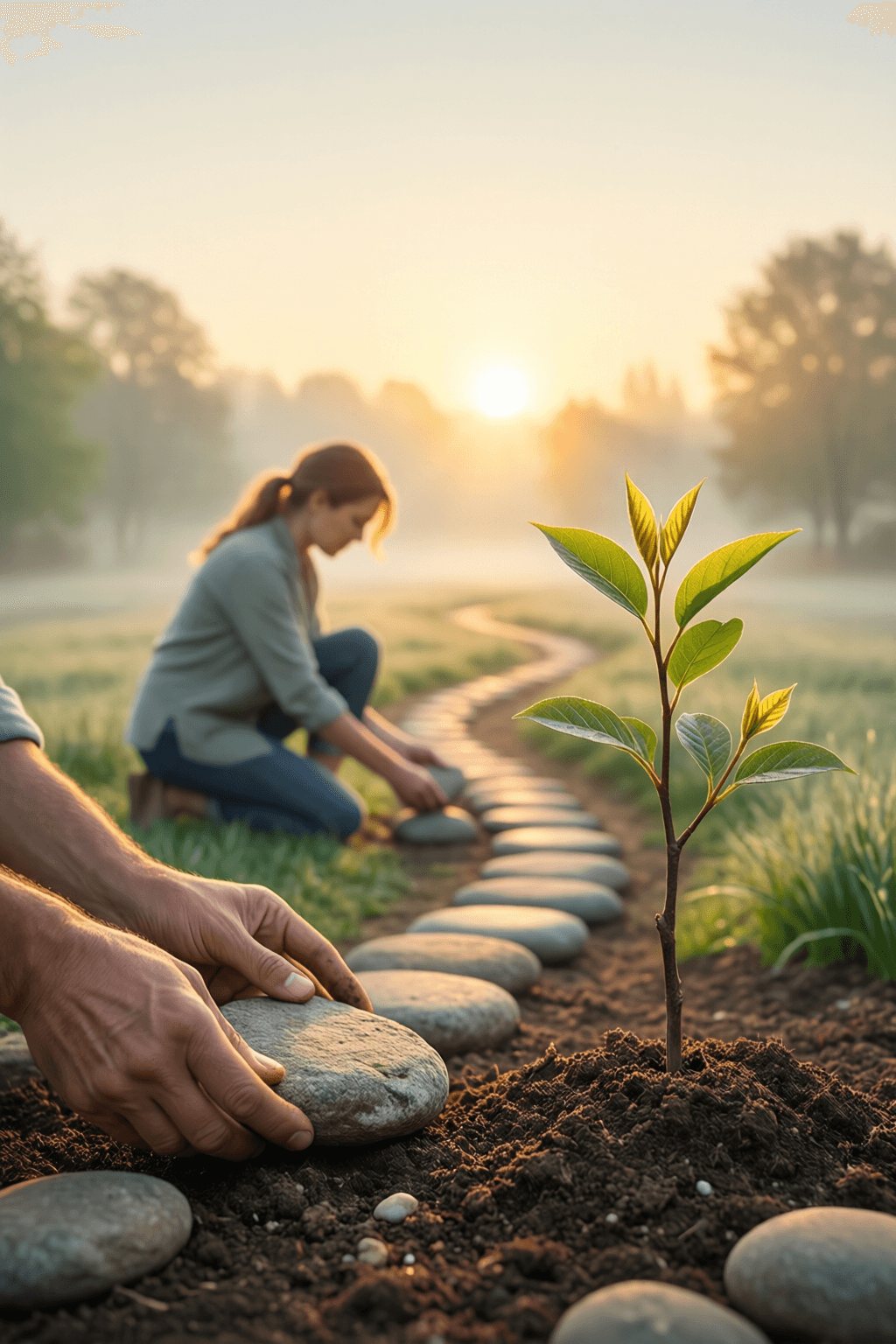
Growth often looks like slowing down, reassessing, and rebuilding with intention. — Erin Gregory
—What lingers after this line?
Redefining What Progress Looks Like
At first glance, growth is often imagined as constant acceleration—more output, faster decisions, visible momentum. Erin Gregory’s quote gently overturns that assumption by suggesting that real development may appear quieter: a pause, a careful review, a deliberate restart. In this sense, slowing down is not the opposite of progress but one of its most mature forms. Rather than glorifying motion for its own sake, the idea invites us to distinguish activity from advancement. Much as a gardener prunes healthy branches to strengthen future bloom, intentional restraint can create the conditions for deeper, more sustainable change. What looks like delay from the outside may, in fact, be preparation.
The Wisdom of Reassessment
From that starting point, reassessing becomes the hinge of meaningful growth. To reassess is to step back from habit and ask whether current efforts still align with one’s values, goals, or changing reality. This reflective turn echoes Socrates’ enduring claim in Plato’s Apology (c. 399 BC) that “the unexamined life is not worth living,” linking self-scrutiny with a fuller form of living. In practical life, reassessment often arrives after burnout, disappointment, or success that feels strangely empty. At such moments, the pause is not weakness but clarity in formation. By questioning old assumptions, a person makes room for more honest choices and more resilient direction.
Rebuilding With Intention
Once reflection has done its work, rebuilding becomes more than repair; it becomes design. Gregory’s emphasis on intention suggests that growth is not simply recovering what was lost, but reconstructing life, work, or identity around clearer principles. In this way, rebuilding resembles architecture: a stronger structure depends not only on effort, but on a better blueprint. History offers a vivid parallel in the postwar reconstruction of cities like Warsaw after World War II. The rebuilding was not merely about replacing ruins; it was about deciding what should endure and what should be newly imagined. Likewise, personal growth asks us to choose deliberately what habits, relationships, and ambitions deserve a place in the next version of ourselves.
Slowness as a Form of Strength
Consequently, the quote challenges a culture that often equates speed with worth. Modern productivity ideals can make patience feel like failure, yet many disciplines teach the opposite. In Zen practice, for example, careful repetition and attentive stillness are treated as pathways to mastery, not detours from it. The same principle holds in emotional and professional life. A musician slowing a difficult passage, an athlete returning to fundamentals, or a leader rethinking strategy after rapid expansion all demonstrate the same truth: disciplined slowness can prevent costly collapse. What appears modest in the moment often produces the most durable transformation.
The Emotional Courage of Starting Again
Still, slowing down and rebuilding are rarely comfortable. They require admitting that an earlier approach no longer works, and that recognition can bruise pride. For that reason, Gregory’s insight also speaks to courage: the willingness to release momentum in order to recover meaning. Samuel Beckett’s oft-quoted line from Worstward Ho (1983), “Try again. Fail again. Fail better,” captures this same brave humility. Starting again is not evidence that growth has been interrupted; rather, it may be the clearest sign that growth is real. When people rebuild intentionally, they refuse to be governed by inertia. Instead, they choose renewal over appearance and substance over speed.
A More Sustainable Vision of Becoming
Ultimately, the quote offers a gentler and more sustainable definition of becoming. Growth need not always be dramatic, public, or linear. Sometimes it is a season of quiet correction—a slowing of pace, a revision of priorities, a patient reconstruction of what matters most. Seen this way, progress is less like a straight climb and more like a living cycle of expansion, reflection, and renewal. Gregory’s words therefore reassure anyone in a period of pause: if that pause is honest and intentional, it may not be a setback at all. It may be growth taking on its strongest form.
Recommended Reading
As an Amazon Associate, we earn from qualifying purchases.
One-minute reflection
Where does this idea show up in your life right now?
Related Quotes
6 selectedThe most important, difficult, and rewarding thing to work on is yourself. — Sven Schnieders
Sven Schnieders
At its heart, Sven Schnieders’ statement argues that self-development is the most valuable project a person can undertake. Unlike external goals—career success, status, or possessions—the work done on one’s character, ha...
Read full interpretation →Consistency is the sum that equals what we become. — Henri Matisse
Henri Matisse
At its core, Matisse’s remark suggests that identity is not formed in a single dramatic moment but accumulated through repeated actions. What we do regularly—how we think, practice, respond, and persist—gradually adds up...
Read full interpretation →If you get the inside right, the outside will fall into place. — Eckhart Tolle
Eckhart Tolle
At its heart, Eckhart Tolle’s statement suggests that external life often reflects internal condition. If the mind is conflicted, reactive, or fearful, the world can appear equally chaotic; conversely, when one cultivate...
Read full interpretation →What progress have I made? I have begun to be a friend to myself. — Seneca
Seneca
At first glance, Seneca’s line shifts the idea of progress away from status, wealth, or public praise and toward an inner achievement. To say, “I have begun to be a friend to myself,” suggests that real development start...
Read full interpretation →Quietly, I am becoming the woman I was always meant to be. — Mitsuye Yamada
Mitsuye Yamada
Mitsuye Yamada’s line begins not with spectacle, but with stillness. The word “quietly” suggests that the deepest changes in a life often happen away from applause, in private acts of courage, reflection, and endurance.
Read full interpretation →Learning is not a sprint toward an end goal; it is a life-long rhythm of shedding what no longer serves you to make room for what does. — Pema Chödrön
Pema Chödrön
At first glance, Pema Chödrön’s reflection challenges one of the most common assumptions about education: that learning is a race with a clear endpoint. Degrees, promotions, and certifications often tempt us to think of...
Read full interpretation →More From Author
More from Erin Gregory →