
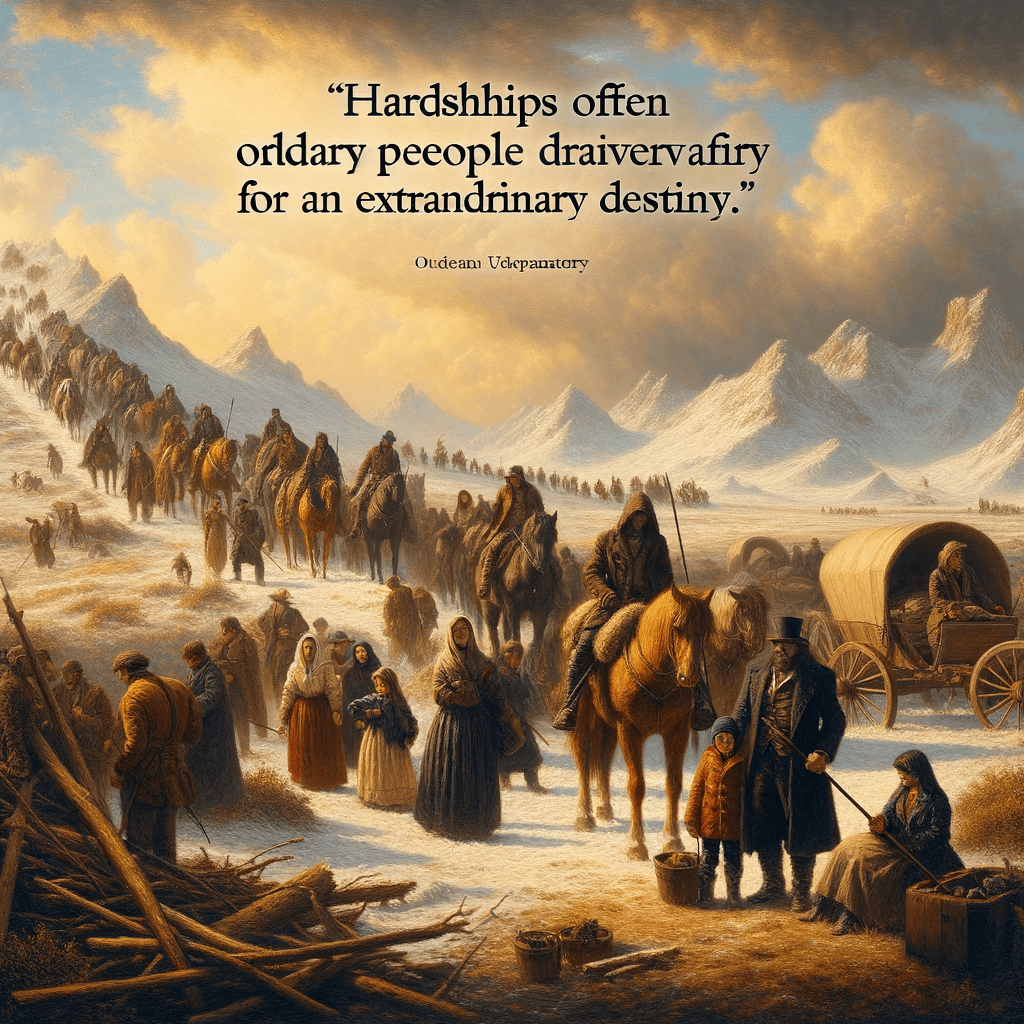
Hardships often prepare ordinary people for an extraordinary destiny. — C.S. Lewis
—What lingers after this line?
Resilience Through Challenges
This quote underscores the idea that facing difficulties helps build resilience. Hardships act as a crucible, forging stronger, more capable individuals.
Growth and Transformation
It emphasizes personal growth and transformation through adversity. Difficult experiences can serve as pivotal moments that propel people toward significant achievements.
Potential for Greatness
C.S. Lewis implies that everyone has the potential to achieve greatness. Ordinary individuals can reach extraordinary destinies by overcoming life's challenges.
Preparation for Future Success
The quote suggests that hardships are not just obstacles but also opportunities for learning and development. They prepare people for future success and remarkable accomplishments.
Philosophical Perspective
Lewis’s viewpoint aligns with a broader philosophical perspective that life’s difficulties are valuable experiences. These experiences shape character and destiny, often in unimaginable ways.
One-minute reflection
What feeling does this quote bring up for you?
Related Quotes
6 selectedWe don't develop courage by being happy in our relationships every day. We develop it by surviving difficult times and challenging adversity. — Epicurus
Epicurus
At first glance, Epicurus seems to challenge the common belief that healthy relationships are defined by uninterrupted happiness. Instead, he points to a deeper truth: courage is not formed in comfort, but in the moments...
Read full interpretation →If you have passed through life without an opponent, no one can ever know what you are capable of, not even you. — Seneca
Seneca
At its core, Seneca’s remark argues that ability remains largely invisible until it meets resistance. A life without opponents may feel peaceful, yet it offers few occasions to prove courage, discipline, or endurance.
Read full interpretation →It is your reaction to adversity, not adversity itself that determines how your life's story will develop. — Dieter F. Uchtdorf
Dieter F. Uchtdorf
At its heart, Dieter F. Uchtdorf’s statement shifts attention away from hardship itself and toward human agency.
Read full interpretation →When you are hit with life-disrupting events, you either cope or you crumble; you become better or bitter; you emerge stronger or weaker. — Denis Waitley
Denis Waitley
Denis Waitley frames disruption not merely as misfortune, but as a decisive turning point. When life is shaken by loss, failure, illness, or betrayal, ordinary habits no longer suffice, and character is tested in motion.
Read full interpretation →We are tied together in the single garment of destiny, caught in an inescapable network of mutuality. — Martin Luther King Jr.
Martin Luther King Jr.
Martin Luther King Jr.’s image of a “single garment of destiny” begins with a simple but powerful claim: no life stands alone. By choosing the language of clothing and weaving, he suggests that human beings are stitched...
Read full interpretation →Into each life some rain must fall. — Henry Wadsworth Longfellow
Henry Wadsworth Longfellow
Longfellow’s line, “Into each life some rain must fall,” turns hardship into a simple law of nature: difficulties arrive not because we have failed, but because we are human. By choosing rain—a common, recurring event—he...
Read full interpretation →More From Author
More from C.S. Lewis →Aim at heaven and you will get earth thrown in. Aim at earth and you get neither. — C. S. Lewis
C. S.
Read full interpretation →Love is not affectionate feeling, but a steady wish for the loved one's ultimate good as far as it can be obtained. — C.S. Lewis
At first glance, C.S. Lewis challenges one of the most common assumptions about love: that it is mainly a warm feeling.
Read full interpretation →Even in literature and art, no man who bothers about originality will ever be original: whereas if you simply try to tell the truth, you will, nine times out of ten, become original without ever having noticed it. — C.S. Lewis
At first glance, C.S. Lewis presents a paradox: the harder an artist chases originality, the less likely it is to appear.
Read full interpretation →To love at all is to be vulnerable. Love anything and your heart will be wrung and possibly broken. If you want to make sure of keeping it intact, you must give it to no one. — C.S. Lewis
C.S. Lewis begins with a stark truth: to love anything at all is to accept vulnerability.
Read full interpretation →